
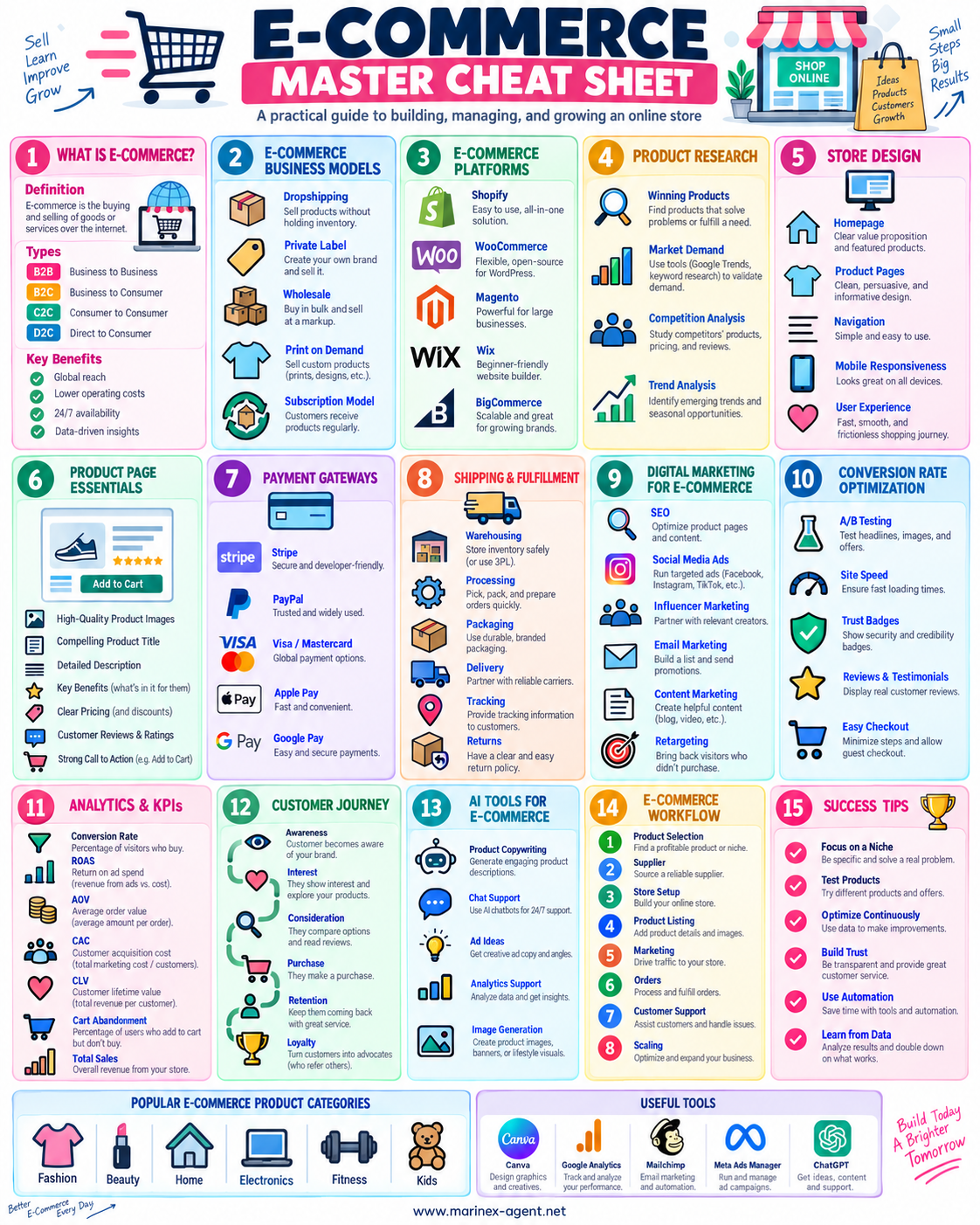
E-Commerce Master Guide: 15 Essential Areas
1. What Is E-Commerce?
REF NO: GRN-002
E-commerce is the buying and selling of goods or services over the internet. It allows businesses and customers to complete transactions without visiting a physical store.
The main types include B2B, B2C, C2C, and D2C. Each model serves a different type of customer and business relationship.
Key advantages include global reach, lower operating costs, 24/7 availability, and access to valuable customer data.
2. E-Commerce Business Models
There are several common e-commerce models.
Dropshipping allows sellers to offer products without holding inventory. Private Label lets a business sell products under its own brand. Wholesale focuses on bulk purchasing and resale.
Other models include Print on Demand and Subscription Business, where customers receive products or services regularly.
The best model depends on capital, experience, product type, and target market.
3. E-Commerce Platforms
An e-commerce platform is the technical foundation of an online store.
Popular options include Shopify, WooCommerce, Magento, Wix, and BigCommerce.
Shopify is easy to use, WooCommerce is flexible for WordPress, Magento is powerful for larger businesses, while Wix and BigCommerce offer different levels of simplicity and scalability.
The right platform should match your budget, technical skills, product range, and growth plans.
4. Product Research
Good product selection is one of the most important parts of e-commerce.
A successful product should solve a problem, satisfy a need, or attract strong customer interest.
Research should include market demand, competition, pricing, trends, and customer reviews.
Tools such as Google Trends, keyword research, marketplaces, and competitor analysis can help identify promising products.
5. Store Design
A good online store should be clear, professional, and easy to navigate.
Important elements include a strong homepage, clear product pages, simple navigation, mobile responsiveness, and good user experience.
Customers should be able to find products quickly and understand what the store offers.
A clean design also helps build trust and improves conversion rates.
6. Product Page Essentials
A strong product page should give customers all the information they need to make a purchase decision.
Important elements include:
- high-quality product images;
- clear product title;
- detailed description;
- key benefits;
- pricing;
- customer reviews;
- strong call to action.
The page should answer common questions and reduce uncertainty before purchase.
7. Payment Gateways
Customers need secure and convenient ways to pay.
Popular payment options include Stripe, PayPal, Visa, Mastercard, Apple Pay, and Google Pay.
A good payment gateway should be secure, reliable, easy to use, and suitable for the countries where customers are located.
Offering several payment methods can increase trust and reduce abandoned purchases.
8. Shipping & Fulfillment
Shipping is a critical part of the customer experience.
The process usually includes warehousing, order processing, packaging, delivery, tracking, and returns.
Reliable delivery partners and clear shipping policies are essential.
Customers should know delivery times, costs, tracking information, and return conditions before completing the purchase.
9. Digital Marketing for E-Commerce
Online stores need consistent traffic and visibility.
Common marketing channels include:
- SEO;
- social media advertising;
- influencer marketing;
- email marketing;
- content marketing;
- retargeting.
The best strategy usually combines several channels instead of depending on only one source of traffic.
10. Conversion Rate Optimization
Conversion Rate Optimization means improving the percentage of visitors who become customers.
Important methods include A/B testing, faster site speed, better product pages, trust badges, reviews, and simpler checkout.
Even small improvements can significantly increase sales.
The goal is to remove unnecessary obstacles from the buying process.
11. Analytics & KPIs
E-commerce decisions should be based on data.
Important indicators include:
- Conversion Rate
- ROAS — Return on Ad Spend
- AOV — Average Order Value
- CAC — Customer Acquisition Cost
- CLV — Customer Lifetime Value
- Cart Abandonment Rate
- Total Sales
These metrics help identify what is working and where improvements are needed.
12. Customer Journey
The customer journey usually includes several stages:
Awareness → Interest → Consideration → Purchase → Retention → Loyalty
At the awareness stage, customers discover the brand.
During consideration, they compare products and read reviews.
After purchase, good service, communication, and support can encourage repeat business and long-term loyalty.
13. AI Tools for E-Commerce
AI can help online businesses work faster and more efficiently.
ChatGPT can support product descriptions, customer communication, marketing ideas, content creation, and business planning.
Other AI tools can assist with images, analytics, automation, and customer service.
AI works best when combined with human review, accurate product information, and clear business strategy.
14. E-Commerce Workflow
A simple e-commerce workflow can be organized into eight steps:
- Product Selection
- Supplier
- Store Setup
- Product Listing
- Marketing
- Orders
- Customer Support
- Scaling
Each stage supports the next one.
A successful store usually grows through continuous improvement rather than one-time setup.
15. Success Tips
Several principles can improve the chances of success in e-commerce.
Focus on a niche instead of trying to sell everything. Test products before investing heavily.
Build trust through professional presentation, reliable service, clear policies, and real customer reviews.
Use automation where it saves time, but continue learning from customer behavior, analytics, and market changes.
The most successful stores usually combine good products, strong marketing, reliable service, and continuous optimization.