
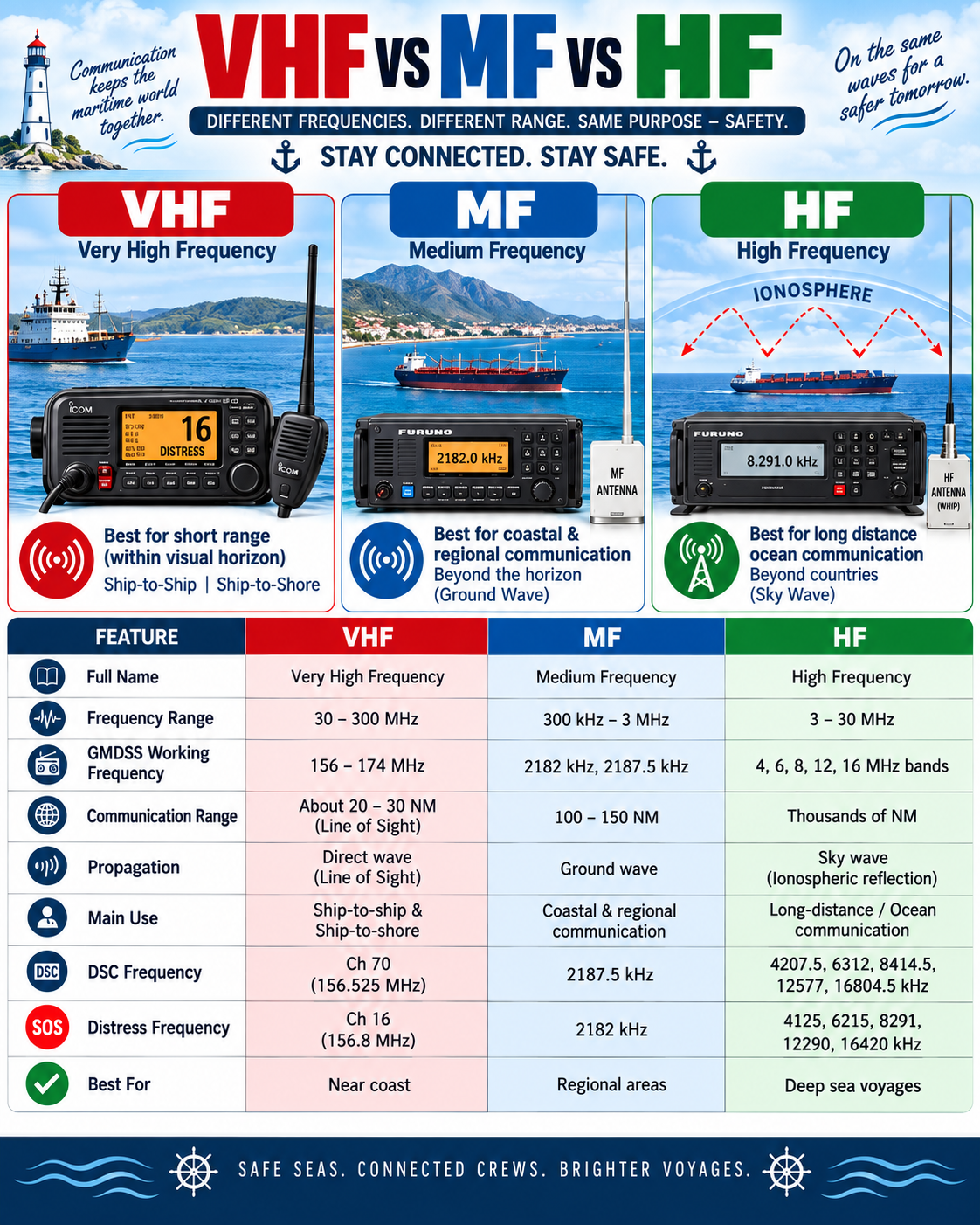
VHF vs MF vs HF: Understanding
Maritime Radio Communication
ARTICLE CODE: GRN-013
Modern ships depend on reliable radio communication for navigation, operational coordination and, most importantly, safety at sea.
The three main maritime communication ranges are:
VHF — Very High Frequency
MF — Medium Frequency
HF — High Frequency
All three systems have the same general purpose — keeping ships connected — but they differ in frequency, range, propagation and practical use.
1. VHF — Very High Frequency
VHF stands for Very High Frequency.
Its general frequency range is approximately:
30–300 MHz
In maritime communication, the commonly used VHF marine band is approximately:
156–174 MHz
VHF is mainly used for short-range communication.
It works mostly by line of sight. This means the radio signal travels almost directly from one antenna to another.
Because the Earth is curved, the signal eventually disappears beyond the radio horizon.
Typical practical range is approximately:
20–30 nautical miles
The actual distance depends on antenna height, weather conditions, transmitter power and other factors.
VHF is commonly used for:
- Ship-to-ship communication
- Ship-to-shore communication
- Port operations
- Pilot communication
- Tug operations
- Vessel Traffic Services
- Safety communication near the coast
- Distress and emergency communication
One of the most important maritime radio channels is:
VHF Channel 16 — 156.8 MHz
Channel 16 is internationally used for:
- distress calls;
- urgency calls;
- safety calls;
- initial calling between vessels and coast stations.
Digital Selective Calling — DSC — for marine VHF operates on:
Channel 70 — 156.525 MHz
VHF is best suited for:
near-coastal and short-range communication.
2. MF — Medium Frequency
MF means Medium Frequency.
Its general frequency range is approximately:
300 kHz–3 MHz
MF can communicate over greater distances than VHF.
Unlike VHF, which relies mainly on direct line-of-sight propagation, MF can travel by ground wave.
A ground wave can follow the curvature of the Earth, allowing communication beyond the visual horizon.
Typical practical maritime communication distances may reach approximately:
100–150 nautical miles
The actual range depends on atmospheric conditions, transmitter power and antenna configuration.
MF is useful for:
- coastal communication;
- regional maritime communication;
- communication beyond VHF range;
- communication between ships and coastal radio stations;
- distress and safety communication.
One of the most important MF frequencies in GMDSS is:
2187.5 kHz — DSC
This frequency is used for digital distress, urgency and safety alerting.
The associated radiotelephony distress frequency is:
2182 kHz
MF is best used when a vessel is:
too far from the coast for reliable VHF communication but still operating within a regional maritime area.
3. HF — High Frequency
HF means High Frequency.
Its general frequency range is:
3–30 MHz
HF is designed for long-distance maritime communication.
The main difference between HF and the other systems is its ability to use the Earth’s ionosphere.
Certain HF signals travel upward toward the ionosphere and are then refracted back toward the Earth.
This process is commonly known as:
Sky-Wave Propagation
Because the signal can return to Earth hundreds or thousands of kilometres away, HF communication can cover very large distances.
HF radio communication may extend:
thousands of nautical miles.
Maritime HF communication commonly uses frequency bands around:
- 4 MHz
- 6 MHz
- 8 MHz
- 12 MHz
- 16 MHz
Important HF DSC distress and safety frequencies include:
- 4207.5 kHz
- 6312 kHz
- 8414.5 kHz
- 12577 kHz
- 16804.5 kHz
Important HF radiotelephony distress and safety frequencies include approximately:
- 4125 kHz
- 6215 kHz
- 8291 kHz
- 12290 kHz
- 16420 kHz
HF is best used for:
- deep-sea voyages;
- ocean passages;
- communication far from coastal stations;
- long-distance ship-to-shore communication;
- emergency communication when other systems are unavailable.
4. Why Do Ships Need Three Different Systems?
It may seem easier to use only one radio system.
However, radio frequencies behave differently.
A simple way to remember them is:
VHF = short distance
MF = medium distance
HF = long distance
A vessel approaching a port will mainly depend on VHF.
A vessel farther offshore may use MF.
A vessel crossing an ocean may require HF or satellite communication.
Together, these systems provide several layers of maritime communication.
5. Radio-Wave Propagation
The main reason these systems have different ranges is radio-wave propagation.
VHF — Direct Wave
VHF normally travels directly from antenna to antenna.
Therefore:
higher antenna = potentially greater range
MF — Ground Wave
MF signals can travel along the Earth’s surface.
This allows communication beyond the normal visual horizon.
HF — Sky Wave
HF signals can interact with the ionosphere.
The signal may travel:
Ship → Ionosphere → Earth
This makes long-distance communication possible.
6. GMDSS and Maritime Safety
VHF, MF and HF radios are important components of the Global Maritime Distress and Safety System — GMDSS.
GMDSS was developed to ensure that ships in distress can quickly transmit alerts and receive assistance.
Depending on the vessel and operating area, GMDSS equipment may include:
- VHF radio with DSC
- MF/HF radio with DSC
- satellite communication equipment
- EPIRB
- SART or AIS-SART
- NAVTEX
- portable VHF radios
The required equipment depends partly on the ship’s designated GMDSS Sea Area.
7. GMDSS Sea Areas
GMDSS divides maritime operating areas into four categories.
Sea Area A1
An area within coverage of at least one VHF coast station providing continuous DSC alerting.
Main communication:
VHF
Sea Area A2
An area outside A1 but within MF coast-station DSC coverage.
Main communication:
MF
Sea Area A3
An area outside A1 and A2 but within recognised satellite-service coverage.
Satellite and long-range systems become important.
Sea Area A4
Areas outside A1, A2 and A3, traditionally including remote polar regions.
Long-range communication equipment becomes especially important.
8. Ship-to-Ship Communication
Radio communication between vessels is essential for safe navigation.
Ships use radio to coordinate:
- passing arrangements;
- collision avoidance;
- pilot boarding;
- towing operations;
- search and rescue;
- emergency assistance;
- vessel movements.
For normal short-range ship-to-ship communication, VHF is generally the primary system.
9. Ship-to-Shore Communication
Ships also need continuous communication with organisations ashore.
This may include:
- port authorities;
- Vessel Traffic Services;
- coast radio stations;
- shipowners;
- ship managers;
- maritime rescue coordination centres.
The system used depends mainly on distance.
Near the coast:
VHF
Farther offshore:
MF
Long-distance or ocean areas:
HF or satellite communication
10. Distress Communication
The most important purpose of maritime communication equipment is protecting human life.
A distress situation may involve:
- fire;
- flooding;
- collision;
- grounding;
- abandoning ship;
- serious medical emergency;
- loss of propulsion;
- other immediate danger to the vessel or crew.
The internationally recognised spoken distress signal is:
MAYDAY
Modern GMDSS equipment can also transmit a digital distress alert using DSC.
This alert may contain:
- vessel identity;
- position;
- nature of distress;
- time of alert.
11. Why Radio Knowledge Is Important for Seafarers
Modern equipment is increasingly automated, but seafarers still need to understand the basic principles behind maritime communication.
A crew member should understand:
- which communication system to use;
- which channel or frequency is appropriate;
- the limitations of each radio band;
- basic distress procedures;
- correct radio terminology;
- how to avoid unnecessary radio traffic.
Correct radio operation can make the difference between a routine situation and a serious maritime emergency.
12. Simple Comparison
VHF
Very High Frequency
Best for:
Short-range / Near Coast
Propagation:
Direct wave / Line of sight
Typical use:
Ship-to-Ship and Ship-to-Shore
MF
Medium Frequency
Best for:
Coastal and Regional Communication
Propagation:
Ground wave
Typical use:
Communication beyond VHF range
HF
High Frequency
Best for:
Long-Distance / Deep-Sea Communication
Propagation:
Sky wave via the ionosphere
Typical use:
Ocean and worldwide maritime communication
Conclusion
VHF, MF and HF are not competing technologies. They are complementary communication systems, each designed for a different operating range.
The easiest way to remember them is:
VHF — Near
MF — Regional
HF — Far
Together with satellite systems and other GMDSS equipment, they form an essential part of modern maritime safety.
For every professional seafarer, understanding these basic differences is part of understanding how ships stay connected and stay safe at sea.
ARTICLE CODE: GRN-013
PROFESSIONAL GROWTH NETWORK
Online Promotion Agent: www.marinex-agent.net