
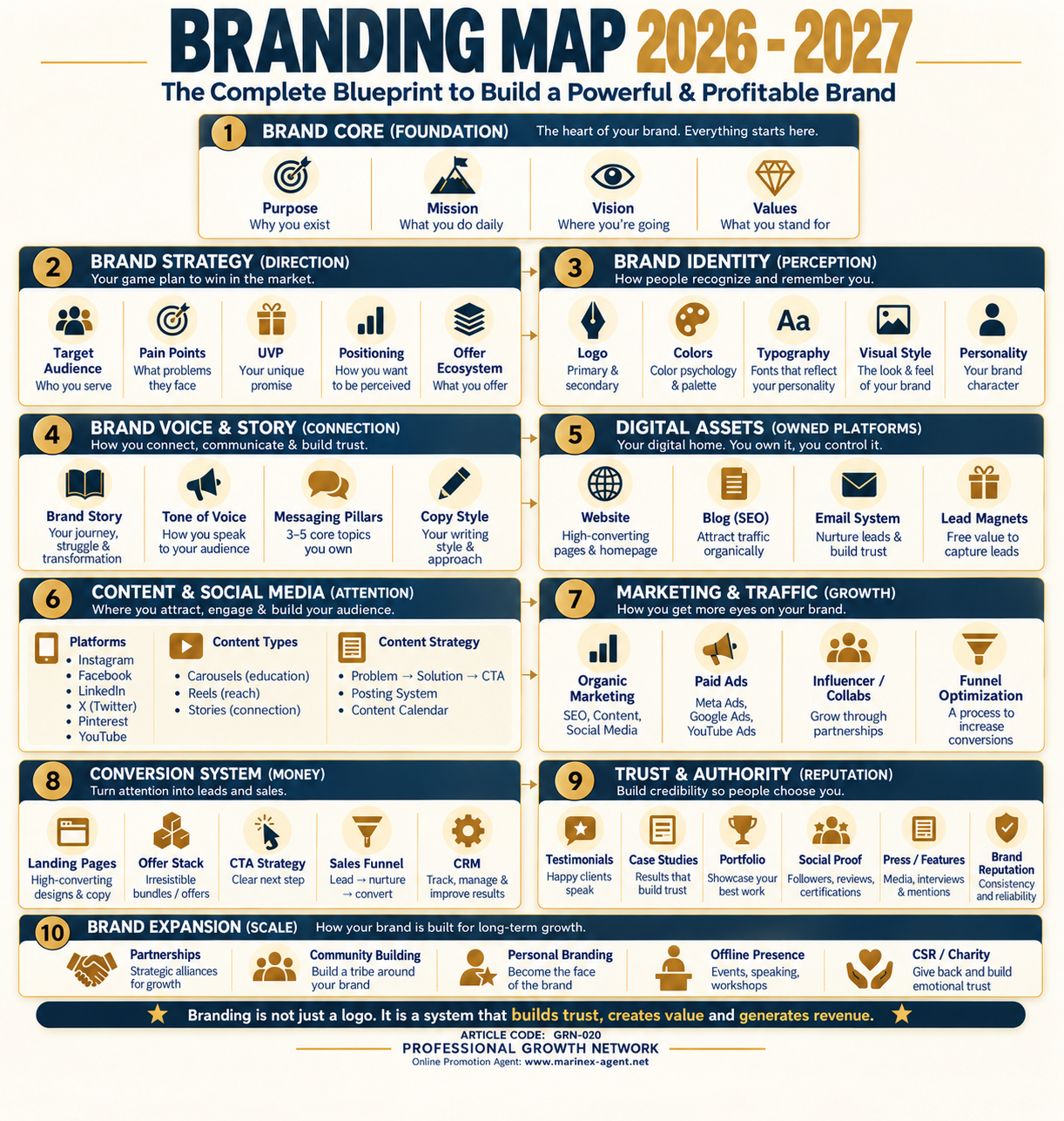
Branding Map 2026–2027 — The Complete Blueprint to Build a Powerful & Profitable Brand
ARTICLE CODE: GRN-020
Category: PROFESSIONAL GROWTH NETWORK
A strong brand is much more than a logo, company name, or attractive design. It is a complete business system that combines strategy, identity, communication, digital presence, marketing, sales, reputation, and long-term development.
The Branding Map 2026–2027 presents ten interconnected areas that can help entrepreneurs, professionals, and companies build a recognizable, trustworthy, and commercially effective brand.
1. Brand Core — Foundation
The Brand Core is the foundation of everything that follows. Before developing advertising, social media, websites, or visual identity, a company should clearly understand what it represents.
Purpose
Purpose explains why the brand exists.
It should answer questions such as:
- What problem do we want to solve?
- What value do we create?
- Why should our business exist beyond simply generating revenue?
A clear purpose gives the brand direction and meaning.
Mission
The mission describes what the company does every day to fulfil its purpose.
A good mission statement should be practical, understandable, and closely connected with the company’s actual activities.
Vision
Vision explains where the brand is going.
It describes the desired future position of the business and helps management make long-term strategic decisions.
Values
Values define what the brand stands for.
They may include:
- Reliability
- Professionalism
- Innovation
- Responsibility
- Transparency
- Quality
- Customer focus
Values should influence real decisions and behaviour, not exist only as promotional words.
2. Brand Strategy — Direction
Brand strategy determines how a company intends to compete, differentiate itself, and create value for customers.
Target Audience
A business must clearly understand who it serves.
Important factors may include:
- Industry
- Profession
- Geographic market
- Age group
- Business size
- Purchasing behaviour
- Customer needs
Trying to communicate with everyone usually results in weak communication with everyone.
Pain Points
Pain points are the problems, difficulties, or frustrations experienced by the target audience.
Understanding them helps a company create relevant products, services, and marketing messages.
Unique Value Proposition — UVP
A UVP explains why a customer should choose you instead of an alternative.
It should communicate:
- What you offer
- Who it is for
- What problem it solves
- What makes it different
Positioning
Positioning is how you want your brand to be perceived in the market.
For example, a company may position itself around:
- Premium quality
- Low cost
- Speed
- Expertise
- Innovation
- Reliability
- Personal service
Offer Ecosystem
A strong brand usually develops more than one isolated product.
An offer ecosystem may include:
- Entry-level products
- Core services
- Premium services
- Consulting
- Subscriptions
- Additional support
- Related products
This creates more opportunities for long-term customer relationships.
3. Brand Identity — Perception
Brand identity determines how people visually recognize and remember the company.
Logo
A professional logo should be:
- Recognizable
- Simple
- Scalable
- Appropriate for the business
- Suitable for digital and printed materials
Primary and secondary logo versions may be useful for different formats.
Colors
Colors influence perception and emotional response.
A consistent color palette helps create visual recognition across:
- Websites
- Business cards
- Social media
- Presentations
- Advertising
- Documents
Typography
Fonts contribute to brand personality.
Typography should remain consistent and readable across digital and printed materials.
Visual Style
Visual style includes:
- Photography
- Illustrations
- Icons
- Infographics
- Layout
- Graphic elements
Consistency makes different materials look like parts of the same professional system.
Brand Personality
A brand can be perceived as:
- Professional
- Innovative
- Friendly
- Premium
- Traditional
- Dynamic
- Authoritative
The personality should correspond to the target audience and market position.
4. Brand Voice & Story — Connection
People often remember stories and emotions better than technical descriptions.
Brand Story
A brand story may explain:
- How the company started
- What problem inspired its creation
- What difficulties were overcome
- How the business developed
- What it wants to achieve
A genuine story can make a company more understandable and memorable.
Tone of Voice
Tone of voice defines how the brand communicates.
It may be:
- Formal
- Friendly
- Educational
- Technical
- Inspirational
- Direct
The tone should remain reasonably consistent across communication channels.
Messaging Pillars
Messaging pillars are several core subjects the brand communicates repeatedly.
For example:
- Expertise
- Reliability
- Innovation
- Customer support
- International cooperation
These pillars help maintain consistency.
Copy Style
Copy style determines how written communication is structured.
It includes:
- Sentence length
- Vocabulary
- Headlines
- Calls to action
- Technical terminology
- Degree of formality
5. Digital Assets — Owned Platforms
A professional brand should not depend entirely on third-party platforms.
Owned digital assets provide greater control.
Website
The website is often the central digital platform of a company.
It should clearly explain:
- Who you are
- What you offer
- Who you serve
- Why customers should trust you
- How to contact you
Blog and SEO
A professional blog can:
- Demonstrate expertise
- Answer customer questions
- Improve search visibility
- Build long-term website traffic
- Create material for social media
Search Engine Optimization helps relevant content become discoverable.
Email System
Email remains an important direct communication channel.
It can support:
- Business correspondence
- Newsletters
- Customer follow-up
- Offers
- Relationship building
Unlike social media, an email contact database is generally under the company’s direct control.
Lead Magnets
A lead magnet provides useful information in exchange for contact details.
Examples include:
- Guides
- Checklists
- Reports
- Templates
- Catalogues
- Free consultations
6. Content & Social Media — Attention
Content attracts attention and helps maintain communication with an audience.
Platforms
Businesses may use:
- X
- YouTube
Not every company needs every platform. The best channels depend on the target audience.
Content Types
Useful formats include:
- Educational posts
- Carousels
- Short videos
- Reels
- Stories
- Articles
- Infographics
- Interviews
Different formats serve different objectives.
Content Strategy
A simple content structure is:
Problem → Solution → Call to Action
A consistent system may include:
- Regular publishing
- Content calendar
- Reusable topics
- Defined categories
- Performance analysis
7. Marketing & Traffic — Growth
Even a strong brand needs visibility.
Organic Marketing
Organic marketing may include:
- SEO
- Blog content
- Social media
- Professional networking
- Public relations
- Community participation
It often requires time but can create sustainable long-term visibility.
Paid Advertising
Paid advertising can accelerate reach.
Channels may include:
- Meta Ads
- Google Ads
- YouTube Ads
- Other digital advertising platforms
Campaigns should be measured against clear commercial objectives.
Influencers and Collaborations
Partnerships with other professionals, companies, communities, and content creators can introduce a brand to new audiences.
Funnel Optimization
A marketing funnel describes the path from first contact to purchase.
A simplified model is:
Attention → Interest → Consideration → Action
Each stage should make it easy for the customer to move to the next step.
8. Conversion System — Money
Visibility alone does not generate business results. Attention must be converted into enquiries and sales.
Landing Pages
A landing page should focus on one clear objective.
It normally includes:
- Strong headline
- Clear value proposition
- Benefits
- Supporting evidence
- Call to action
Offer Stack
An offer stack combines products, services, bonuses, or additional value into a stronger commercial proposition.
CTA Strategy
Every important page or communication should make the next action clear.
Examples:
- Contact Us
- Request a Quote
- Apply Online
- Book a Consultation
- Download the Catalogue
- Learn More
Sales Funnel
A typical sales process may be:
Lead → Qualification → Follow-Up → Proposal → Negotiation → Sale → Repeat Business
CRM
A Customer Relationship Management system helps organize:
- Leads
- Contacts
- Follow-ups
- Sales opportunities
- Customer history
- Results
As business volume grows, systematic contact management becomes increasingly important.
9. Trust & Authority — Reputation
Customers usually prefer companies they consider credible and reliable.
Testimonials
Customer testimonials provide evidence of real experience.
Case Studies
Case studies explain:
- The initial problem
- The solution
- The process
- The result
They can be especially valuable in B2B markets.
Portfolio
A portfolio demonstrates completed work, projects, products, or professional achievements.
Social Proof
Social proof may include:
- Reviews
- Client numbers
- Professional memberships
- Certifications
- Partnerships
- Followers
Press and Features
Media coverage, interviews, articles, and professional publications can strengthen authority.
Brand Reputation
Reputation develops through consistent behaviour over time.
Important factors include:
- Reliability
- Quality
- Professional communication
- Customer support
- Fulfilment of commitments
10. Brand Expansion — Scale
Once the core branding system is functioning, the company can focus on expansion.
Partnerships
Strategic alliances can provide:
- New customers
- New markets
- Additional expertise
- Distribution channels
- Joint projects
Community Building
A strong community can transform customers and followers into long-term supporters of the brand.
Personal Branding
In many businesses, the founder, director, consultant, or expert can become an important public face of the company.
Personal branding can strengthen trust and recognition.
Offline Presence
Digital branding can be supported by:
- Conferences
- Exhibitions
- Workshops
- Business meetings
- Speaking engagements
- Industry events
CSR and Charity
Corporate Social Responsibility can demonstrate that a company contributes positively to society.
Responsible charitable and social initiatives can also strengthen emotional trust when they are genuine and transparent.
Conclusion
A successful brand is not created by one logo, one advertisement, or one social media page.
It is created through a connected system:
Brand Core → Strategy → Identity → Voice & Story → Digital Assets → Content → Marketing → Conversion → Reputation → Expansion
Each element supports the others.
A company with attractive design but no strategy may struggle. A company with good products but weak visibility may remain unknown. A company with strong marketing but poor reputation may lose customers.
The strongest brands combine all of these elements into one consistent professional system.
Branding is not just a logo. It is a system that builds trust, creates value, and generates revenue.
ARTICLE CODE: GRN-020
PROFESSIONAL GROWTH NETWORK
Online Promotion Agent: www.marinex-agent.net