
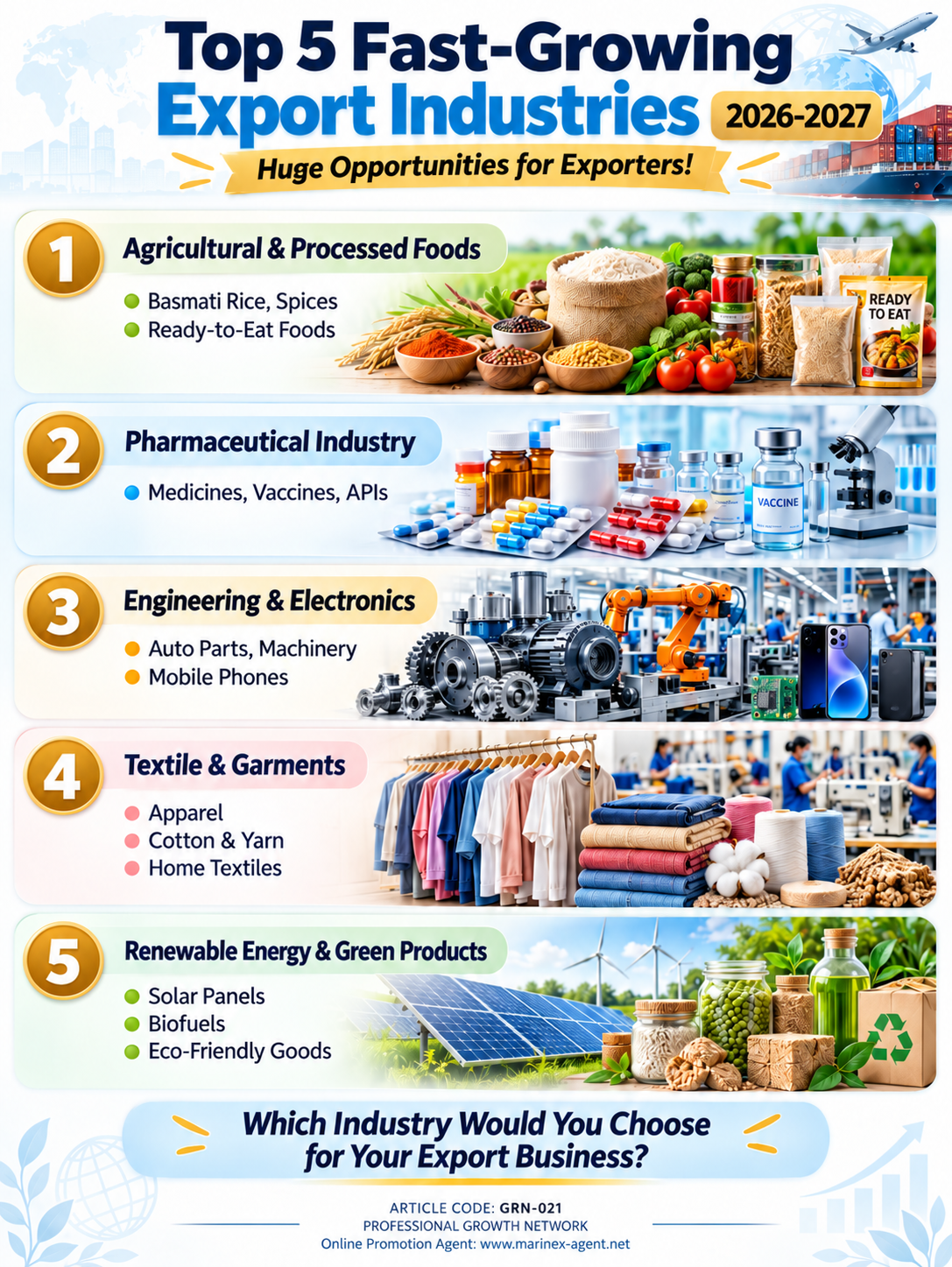
Top 5 Fast-Growing Export Industries 2026–2027
ARTICLE CODE: GRN-021
Category: PROFESSIONAL GROWTH NETWORK
International trade continues to create new opportunities for manufacturers, distributors, entrepreneurs, and companies looking to expand beyond their domestic markets.
For 2026–2027, several industries stand out because of strong global demand, technological development, changing consumer preferences, and the continued growth of international supply chains.
Below are five sectors that may offer attractive opportunities for exporters.
1. Agricultural & Processed Foods
Food remains one of the most stable categories in international trade because demand exists in every market.
Basmati Rice and Other Premium Food Products
Basmati rice, spices, grains, pulses, and specialty agricultural products can have strong export potential when they meet international quality and certification requirements.
Important factors include:
- Product quality
- Stable supply
- Competitive pricing
- Packaging
- Shelf life
- Certification
- Logistics
Spices
Spices are widely used by households, restaurants, food manufacturers, and food-processing companies.
Export opportunities may include:
- Turmeric
- Chili
- Pepper
- Cardamom
- Cumin
- Mixed spices
- Specialty seasonings
Ready-to-Eat Foods
Ready-to-eat and convenience foods continue to attract consumers who value speed and simplicity.
Products may include:
- Prepared meals
- Packaged traditional foods
- Instant food products
- Snacks
- Frozen foods
- Shelf-stable meals
Export Opportunity
A successful food exporter should combine competitive pricing with reliable quality, professional packaging, regulatory compliance, and efficient logistics.
2. Pharmaceutical Industry
The pharmaceutical industry is one of the most important sectors of international trade because healthcare demand remains constant worldwide.
Medicines
Export markets may require:
- Generic medicines
- Prescription products
- Over-the-counter products
- Hospital medicines
- Specialized treatments
Pharmaceutical exports usually require strict regulatory approval and documentation.
Vaccines
Vaccines remain strategically important for:
- National health systems
- Hospitals
- International organizations
- Humanitarian programs
- Public health initiatives
APIs — Active Pharmaceutical Ingredients
APIs are the essential components used to manufacture medicines.
They form an important part of the international pharmaceutical supply chain.
Export Opportunity
Companies working in this sector should focus particularly on:
- Regulatory compliance
- GMP standards
- Quality assurance
- Product registration
- Stable production
- Reliable documentation
- International distribution
Pharmaceutical exports can offer significant opportunities, but they require a high level of professional and regulatory preparation.
3. Engineering & Electronics
Engineering and electronics continue to play a central role in industrial development, transportation, manufacturing, telecommunications, and consumer markets.
Auto Parts
The international automotive industry creates demand for:
- Engine components
- Filters
- Bearings
- Brake components
- Electrical systems
- Replacement parts
- Accessories
Aftermarket spare parts can be especially attractive because vehicles require maintenance throughout their operating life.
Machinery
Industrial machinery is used in almost every major economic sector.
Export opportunities may include:
- Production equipment
- Agricultural machinery
- Pumps
- Motors
- Compressors
- Industrial components
- Processing equipment
Mobile Phones and Electronics
Global demand for electronic products continues to create opportunities in:
- Mobile phones
- Accessories
- Components
- Circuit boards
- Consumer electronics
- Communication devices
Export Opportunity
Engineering exporters should emphasize:
- Technical specifications
- Certification
- Warranty
- Spare parts availability
- After-sales service
- Delivery reliability
In B2B markets, technical support can be as important as the product itself.
4. Textile & Garments
Textiles and garments remain a major international trading sector serving consumers, retailers, hotels, hospitals, industrial companies, and many other markets.
Apparel
Export categories may include:
- Casual clothing
- Business clothing
- Workwear
- Sportswear
- Uniforms
- Children’s clothing
- Fashion products
Cotton and Yarn
Raw and semi-processed textile materials are essential inputs for manufacturers.
These may include:
- Cotton
- Yarn
- Fibers
- Fabric
- Textile components
Home Textiles
Home textile exports may include:
- Bed linen
- Towels
- Curtains
- Blankets
- Table linen
- Decorative fabrics
They may also serve hotels, hospitals, cruise vessels, and other institutional customers.
Export Opportunity
Successful textile exporters usually compete through a combination of:
- Price
- Quality
- Design
- Production capacity
- Delivery time
- Custom manufacturing
- Private-label production
The ability to manufacture according to a buyer’s specification can provide an important competitive advantage.
5. Renewable Energy & Green Products
The global transition toward cleaner energy and more sustainable products is creating new international business opportunities.
Solar Panels
Solar power equipment can include:
- Solar panels
- Inverters
- Batteries
- Mounting systems
- Controllers
- Monitoring equipment
Demand may come from households, companies, hospitals, municipalities, industrial facilities, and infrastructure projects.
Biofuels
Biofuels and biomass products may include:
- Biodiesel
- Bioethanol
- Wood pellets
- Agricultural biomass
- Alternative fuel materials
These products may support efforts to reduce dependence on traditional fossil fuels.
Eco-Friendly Goods
Demand is also increasing for products designed to reduce environmental impact.
Examples include:
- Recyclable packaging
- Biodegradable products
- Reusable products
- Natural materials
- Sustainable household goods
- Energy-efficient products
Export Opportunity
This sector is closely connected with:
- Energy security
- Environmental policy
- Sustainability
- Infrastructure modernization
- Corporate ESG objectives
- International development programs
For exporters, technical documentation, certification, environmental standards, and product reliability are especially important.
Conclusion
The five sectors presented in GRN-021 illustrate how different types of businesses can participate in international trade.
The opportunities can be summarized as:
Agricultural & Processed Foods → Pharmaceutical Industry → Engineering & Electronics → Textile & Garments → Renewable Energy & Green Products
Each industry requires a different export strategy.
A successful exporter should carefully evaluate:
- Target country
- Market demand
- Competition
- Import regulations
- Certification
- Pricing
- Logistics
- Payment terms
- Local partners
- Marketing and promotion
The most attractive industry is not necessarily the largest one. It is the industry where a company can combine competitive products, reliable supply, professional presentation, and strong international business contacts.
Which Industry Would You Choose for Your Export Business?
A good starting point is to identify the sector where you already have:
- Reliable suppliers
- Competitive prices
- Product knowledge
- Export documentation
- Potential buyers
- A professional Internet presence
From there, international promotion can gradually transform a product offer into a sustainable export business.
ARTICLE CODE: GRN-021
PROFESSIONAL GROWTH NETWORK
Online Promotion Agent: www.marinex-agent.net