
EVALZNOW MARITIME: Professional Competency Assessment for Deck and Engine Officers
ARTICLE CODE: GRN-023
Category: PROFESSIONAL GROWTH NETWORK
Project Concept: EVALZNOW MARITIME — Competency Assessment and Performance Monitoring
1. Introduction — A New Approach to Maritime Competency Assessment
The international maritime industry depends on the professional knowledge, practical skills, experience, and decision-making abilities of seafarers.
This is particularly important for Deck Officers responsible for navigation and Engine Officers responsible for operating and maintaining a vessel’s machinery and technical systems.
International standards, including the Standards of Training, Certification and Watchkeeping for Seafarers (STCW Convention), establish minimum requirements for maritime training, certification, and professional competence.
However, holding a valid Certificate of Competency does not necessarily demonstrate how effectively an individual officer will perform in a specific operational or emergency situation.
The concept of EVALZNOW MARITIME proposes an additional approach: structured professional competency assessment using measurable performance indicators, practical exercises, and continuous monitoring.
The concept is inspired by the EvalzNow competency assessment platform developed by Rick Butler.
EVALZNOW MARITIME is currently a proposed maritime application of this technology, not an existing certified maritime assessment product.
2. The EvalzNow Concept — Competency Accounting
The central idea behind EvalzNow is Competency Accounting.
Traditional accounting systems measure and record financial transactions, assets, liabilities, and business performance.
Competency Accounting applies a comparable structured approach to evaluating human knowledge, skills, capabilities, and professional development.
The EvalzNow concept includes several types of performance measurements:
- Proficiency Metrics: assessment of current knowledge and professional competence.
- Growth Metrics: measurement of progress and development over time.
- Hybrid Metrics: combined analysis of existing competence and professional growth.
For maritime applications, these approaches could provide a systematic method of recording and comparing the performance of officers during professional assessments.
The objective would not be to replace maritime certification but to provide additional information about an officer’s practical readiness.
3. Navigation Bridge — Assessment of Deck Officers
The Navigation Bridge is the operational center from which a vessel is navigated and controlled.
Deck Officers must continuously assess navigational information, identify risks, communicate effectively, and make timely decisions.
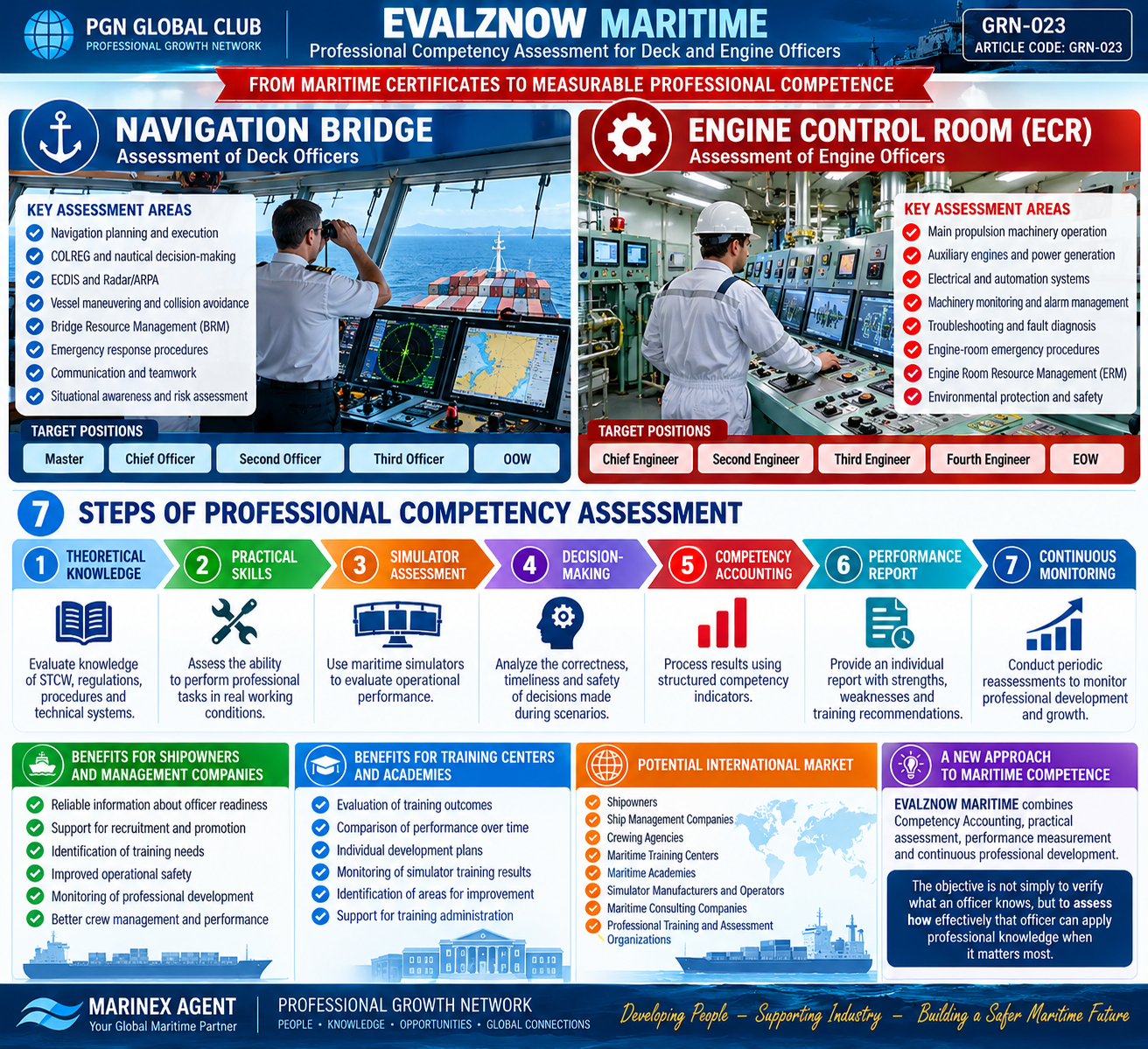
A proposed EVALZNOW MARITIME assessment system could evaluate the following positions:
- Master
- Chief Officer
- Second Officer
- Third Officer
- Other Officers of the Watch
Main Assessment Areas
- Navigation planning and execution.
- International Regulations for Preventing Collisions at Sea (COLREG).
- Electronic Chart Display and Information Systems (ECDIS).
- Radar and Automatic Radar Plotting Aids (ARPA).
- Vessel maneuvering and collision avoidance.
- Bridge Resource Management (BRM).
- Emergency response procedures.
- Communication and teamwork.
- Situational awareness and decision-making.
Assessment results could be recorded and analyzed using standardized competency indicators.
This would allow maritime employers and training organizations to identify both strong professional abilities and areas requiring additional training.
4. Engine Control Room — Assessment of Engine Officers
The Engine Control Room (ECR) is a central location for monitoring and controlling a vessel’s machinery and engineering systems.
Engine Officers must understand complex technical processes, recognize abnormal operating conditions, and respond appropriately to equipment failures and emergencies.
A maritime competency assessment program could cover:
- Chief Engineer
- Second Engineer
- Third Engineer
- Fourth Engineer
- Engineering Officers of the Watch
Main Assessment Areas
- Main propulsion machinery operation.
- Auxiliary engines and power generation.
- Electrical and automation systems.
- Machinery monitoring and alarm management.
- Engine-room emergency procedures.
- Equipment troubleshooting and fault diagnosis.
- Planned maintenance and technical documentation.
- Engine Room Resource Management (ERM).
- Environmental protection and operational safety.
A structured assessment system could help identify whether an officer has the necessary theoretical knowledge, practical understanding, and decision-making skills for specific engineering responsibilities.
5. Practical Assessment Using Maritime Simulators
One of the most promising applications of the proposed EVALZNOW MARITIME concept is its potential integration with existing maritime simulators.
Modern maritime training centers use Navigation Bridge Simulators and Engine Room Simulators to reproduce realistic operating conditions.
These simulators allow instructors to assess how officers respond to routine operations, equipment failures, and emergency situations.
Example — Navigation Bridge Assessment
A Second Officer is presented with a simulated navigation scenario involving restricted visibility, heavy traffic, and a developing collision risk.
The assessment may consider:
- Timely identification of navigational hazards.
- Correct application of COLREG.
- Appropriate use of radar, ARPA, and ECDIS.
- Evaluation of Closest Point of Approach (CPA) and Time to Closest Point of Approach (TCPA).
- Selection of safe and timely maneuvering actions.
- Communication with other members of the bridge team.
Example — Engine Control Room Assessment
A Second Engineer is presented with a simulated machinery malfunction involving abnormal temperatures, pressure changes, or a power generation failure.
The assessment may evaluate:
- Recognition of the developing malfunction.
- Interpretation of alarms and operating parameters.
- Identification of probable technical causes.
- Selection of appropriate corrective actions.
- Communication with the Chief Engineer and other personnel.
- Compliance with established safety procedures.
In both examples, the assessment results could be processed through a structured competency evaluation framework.
The feasibility of integrating EvalzNow with maritime simulator systems would require technical evaluation and confirmation by the developer.
6. Seven Steps of Professional Competency Assessment
The proposed maritime assessment process could be organized into seven stages.
Step 1 — Theoretical Knowledge
Evaluate the officer’s understanding of STCW requirements, operational procedures, maritime regulations, and relevant technical systems.
Step 2 — Practical Skills
Assess the ability to perform professional tasks under normal working conditions.
Step 3 — Simulator Assessment
Use appropriate maritime simulators to evaluate operational performance.
Step 4 — Decision-Making
Analyze the correctness, timeliness, and safety of decisions made during operational scenarios.
Step 5 — Competency Accounting
Organize the assessment results into a structured record of professional competencies.
Step 6 — Performance Report
Prepare an individual report identifying strengths, weaknesses, and recommended areas for improvement.
Step 7 — Continuous Monitoring
Conduct periodic reassessments to monitor professional development and training effectiveness.
This approach could provide a more comprehensive view of professional competence than a single examination or interview.
7. Benefits for Shipowners and Ship Management Companies
Shipowners and Ship Management Companies require reliable information about the professional readiness of officers before assigning them to vessels.
A structured competency assessment system could provide additional support for:
- Recruitment and selection of Deck and Engine Officers.
- Assessment before promotion to senior ranks.
- Identification of individual training requirements.
- Evaluation of operational readiness.
- Monitoring of professional development.
- Improvement of safety management and crew training programs.
For example, a Ship Management Company considering the promotion of a Second Officer to Chief Officer could review a structured competency assessment report alongside certificates, sea-service records, references, and other relevant information.
Such reports should support professional judgment rather than replace the decisions of qualified maritime assessors.
8. Opportunities for Maritime Training Centers and Academies
Maritime Training Centers and Academies could also benefit from structured competency assessment.
The proposed system could support:
- Evaluation of training outcomes.
- Comparison of performance before and after training.
- Identification of subjects requiring additional instruction.
- Individual professional development plans.
- Monitoring of simulator training results.
- Preparation of reports for training administrators.
A particularly valuable feature could be the measurement of professional growth over time.
Instead of recording only whether a participant passed or failed an assessment, the system could show how particular competencies developed through repeated training.
Any use for formal STCW assessment would need to comply with applicable requirements for approved training, assessment, and certification.
9. Potential International Market
The international maritime industry includes a wide range of organizations that could potentially benefit from professional competency assessment services.
Potential Customers and Partners
- Shipowners.
- Ship Management Companies.
- Crewing Agencies.
- Maritime Training Centers.
- Maritime Academies.
- Simulator Manufacturers and Operators.
- Maritime Consulting Companies.
- Organizations involved in professional training and assessment.
The potential market includes both established maritime centers and developing regions seeking to improve maritime education, professional training, and crew management.
However, market demand, pricing, technical feasibility, and commercial viability would need to be validated before launching a maritime-specific product.
10. Potential Cooperation with PROFESSIONAL GROWTH NETWORK
The PROFESSIONAL GROWTH NETWORK (PGN) concept is based on connecting knowledge, professional experience, business opportunities, and international cooperation.
The proposed EVALZNOW MARITIME initiative could become an example of cooperation between a technology developer and maritime industry specialists.
Possible Areas of Cooperation
- Technical discussions with EvalzNow developer Rick Butler.
- Evaluation of the platform’s suitability for maritime applications.
- Consultation with experienced Deck and Engine Officers.
- Identification of maritime training centers interested in pilot assessments.
- Development of STCW-aligned competency assessment criteria.
- Exploration of simulator data integration.
- International presentation and promotion of the concept.
Through its maritime industry experience, South-Star-Ltd could potentially contribute practical knowledge concerning maritime qualifications, professional responsibilities, and crew assessment requirements.
MARINEX AGENT could support international presentation, networking, and promotion of the proposed project.
Any commercial cooperation would be subject to agreement between the participating organizations.
Conclusion — From Maritime Certificates
to Measurable Professional Competence
Professional maritime certification remains an essential part of international shipping safety.
However, the maritime industry also needs reliable methods for understanding how officers apply their knowledge and skills in real operational situations.
The proposed EVALZNOW MARITIME concept combines the principles of Competency Accounting, practical assessment, performance measurement, and continuous professional development.
Its potential applications include both the Navigation Bridge and the Engine Control Room.
The next step would be to establish whether the EvalzNow technology can be adapted to maritime assessment requirements and integrated with existing simulator systems.
If technically feasible and professionally validated, this approach could become a useful additional tool for maritime training organizations, shipowners, and ship management companies.
The objective is not simply to verify what an officer knows, but to assess how effectively that officer can apply professional knowledge when it matters most.
PROFESSIONAL GROWTH NETWORK
Online Promotion Agent: https://www.marinex-agent.net
ARTICLE CODE: GRN-023