METRIC BOLTS & NUTS: DIN SIZE REFERENCE TABLE
Category: PROFESSIONAL GROWTH NETWORK
Article Code: GRN-025
1. Introduction
Metric bolts and nuts are widely used in mechanical engineering, industrial equipment, automotive maintenance, fitness machines, and household repairs.
Understanding standard metric thread sizes helps technicians and equipment owners select suitable fasteners and tools.
2. Metric Thread Sizes (M5–M24)
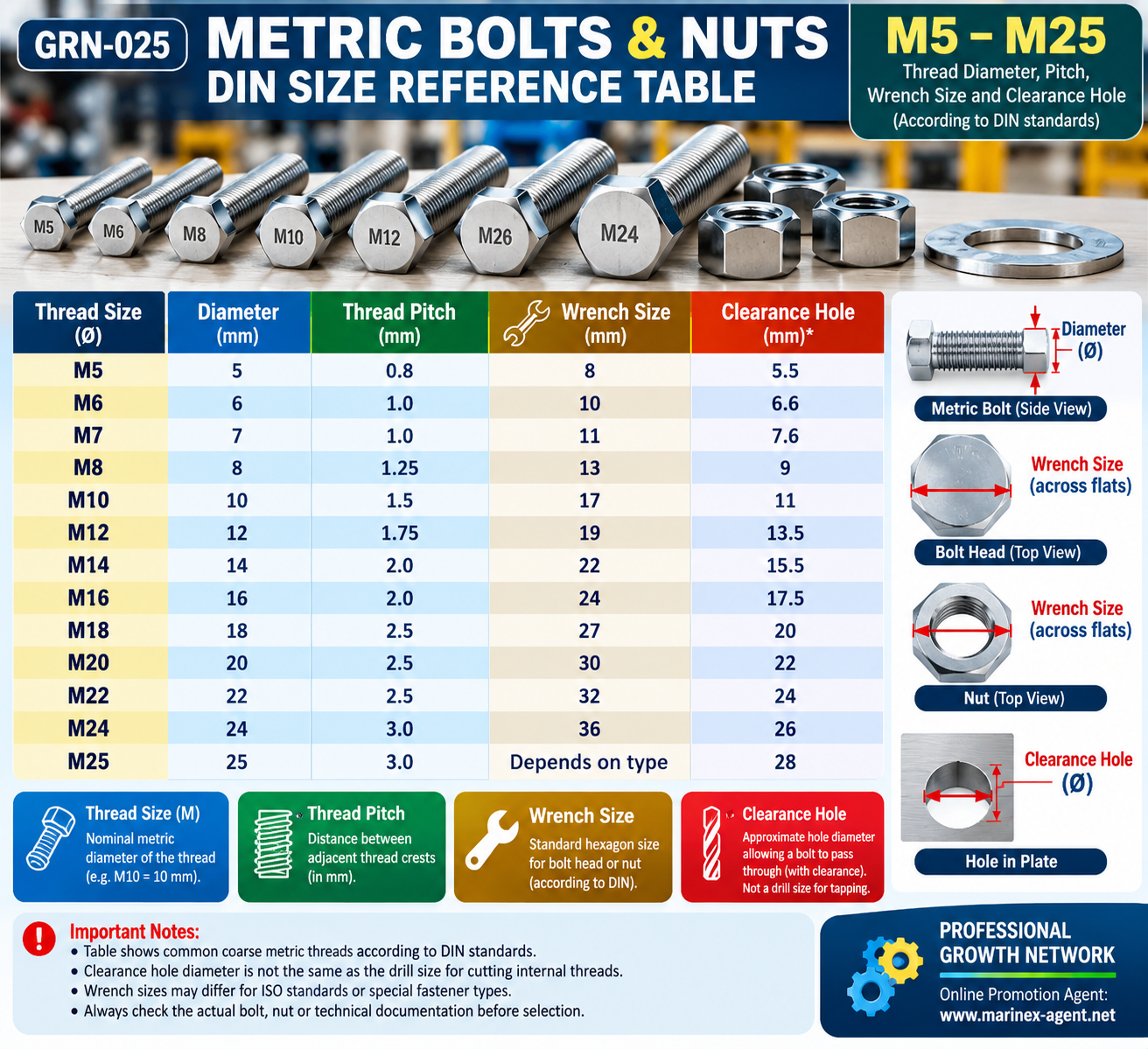
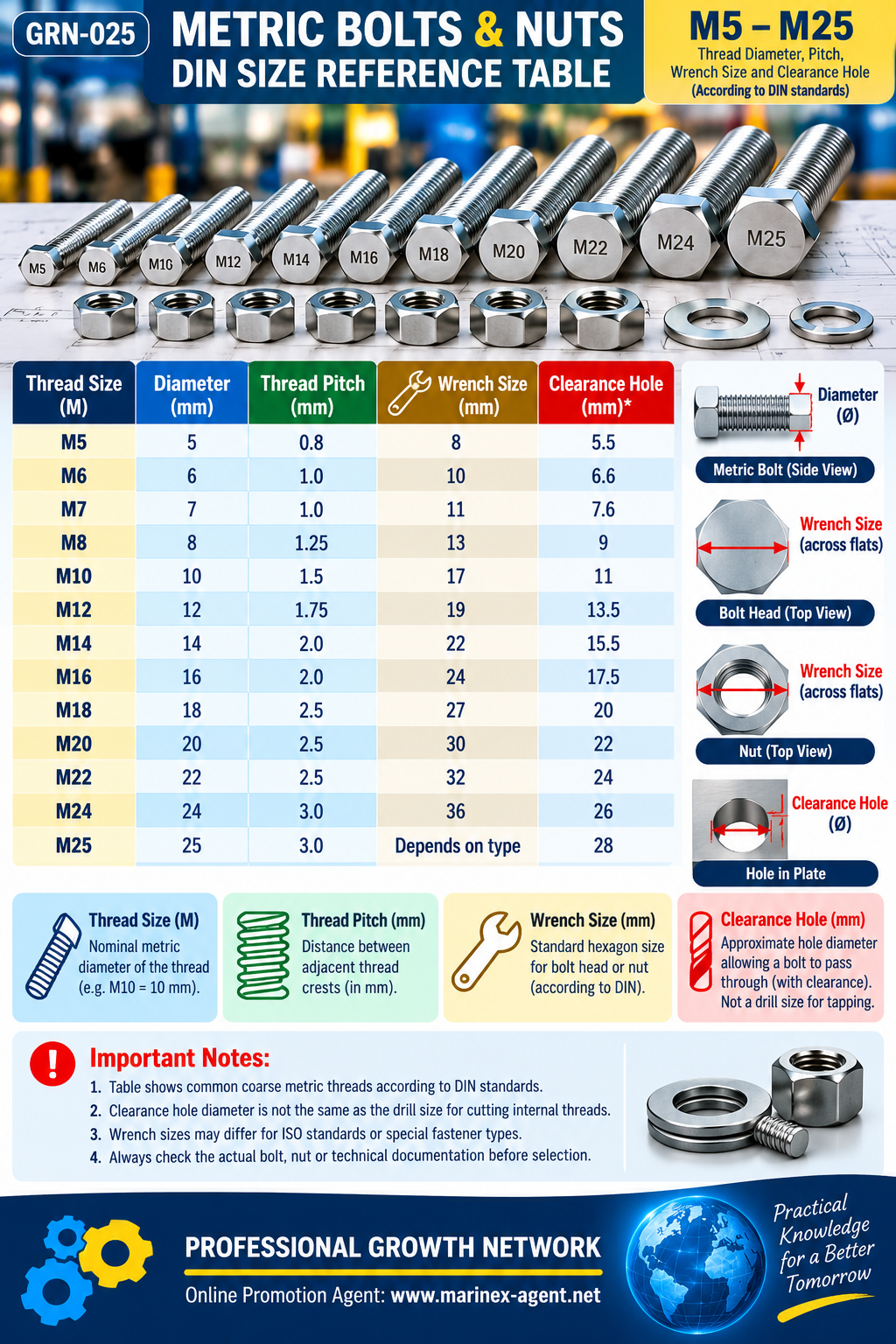
The reference table presents the main dimensions of commonly used metric bolts and nuts according to traditional DIN specifications.
It includes five essential parameters:
- Thread Size (M) — nominal metric thread designation.
- Diameter (mm) — nominal external thread diameter.
- Thread Pitch (mm) — distance between adjacent thread crests.
- Wrench Size (mm) — distance across the flats of a standard hexagonal bolt head or nut.
- Clearance Hole (mm) — approximate hole diameter allowing a bolt to pass through.
3. DIN Standards and Wrench Selection
Traditional DIN hexagonal fasteners commonly use the following wrench sizes:
- M6 — 10 mm
- M8 — 13 mm
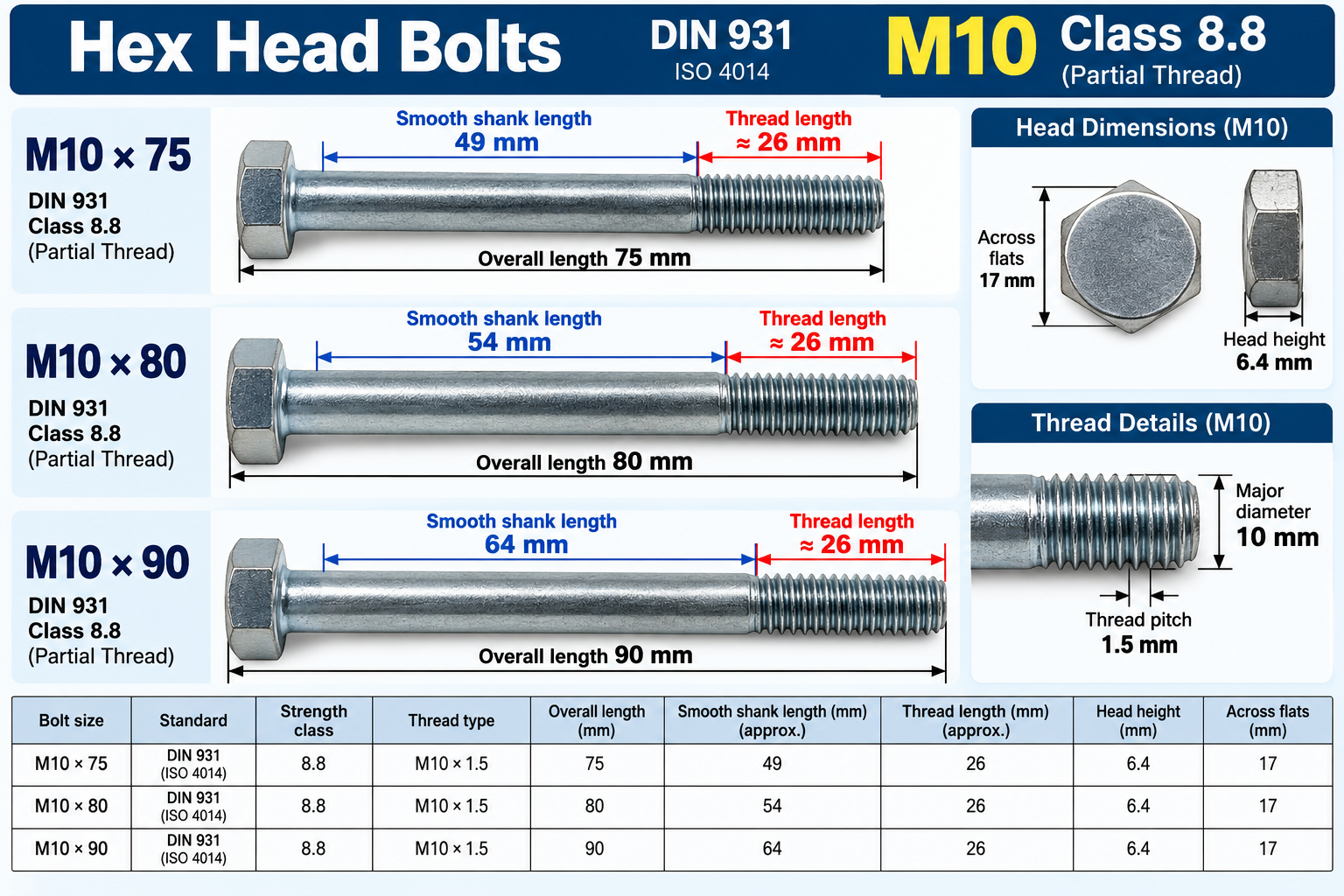
- M10 — 17 mm
- M12 — 19 mm
- M16 — 24 mm
- M20 — 30 mm
- M24 — 36 mm
Modern ISO fasteners may have different wrench dimensions. Always check the actual bolt head or nut before selecting a tool.
4. Practical Applications
This reference table is useful for:
- Repairing elliptical trainers and other fitness equipment.
- Maintaining mechanical assemblies and moving joints.
- Selecting replacement bolts, nuts, and washers.
- Identifying suitable spanners and sockets.
- Performing routine workshop maintenance.
For moving or vibration-prone assemblies, suitable self-locking nuts or approved thread-locking methods may help prevent loosening.
5. Important Technical Notes
Thread pitch must match between the bolt and nut.
Clearance-hole dimensions are not the same as drill sizes required for tapping internal threads.
The reference table covers common coarse metric threads and traditional DIN wrench dimensions. Exact specifications should be checked against the applicable fastener standard.
Conclusion
Metric fastener identification is an essential practical skill for equipment maintenance and mechanical repairs.
The GRN-025 DIN Metric Bolts & Nuts Reference Table provides a convenient guide to commonly used thread sizes, wrench dimensions, and clearance holes.
Correct fastener selection contributes to safer maintenance, reliable assembly, and longer equipment service life.
PROFESSIONAL GROWTH NETWORK
Online Promotion Agent: www.marinex-agent.net
Practical Example:
M10 Hex Head Bolts with Partial Thread (DIN 931)
Main Types of Non-Metallic Washers
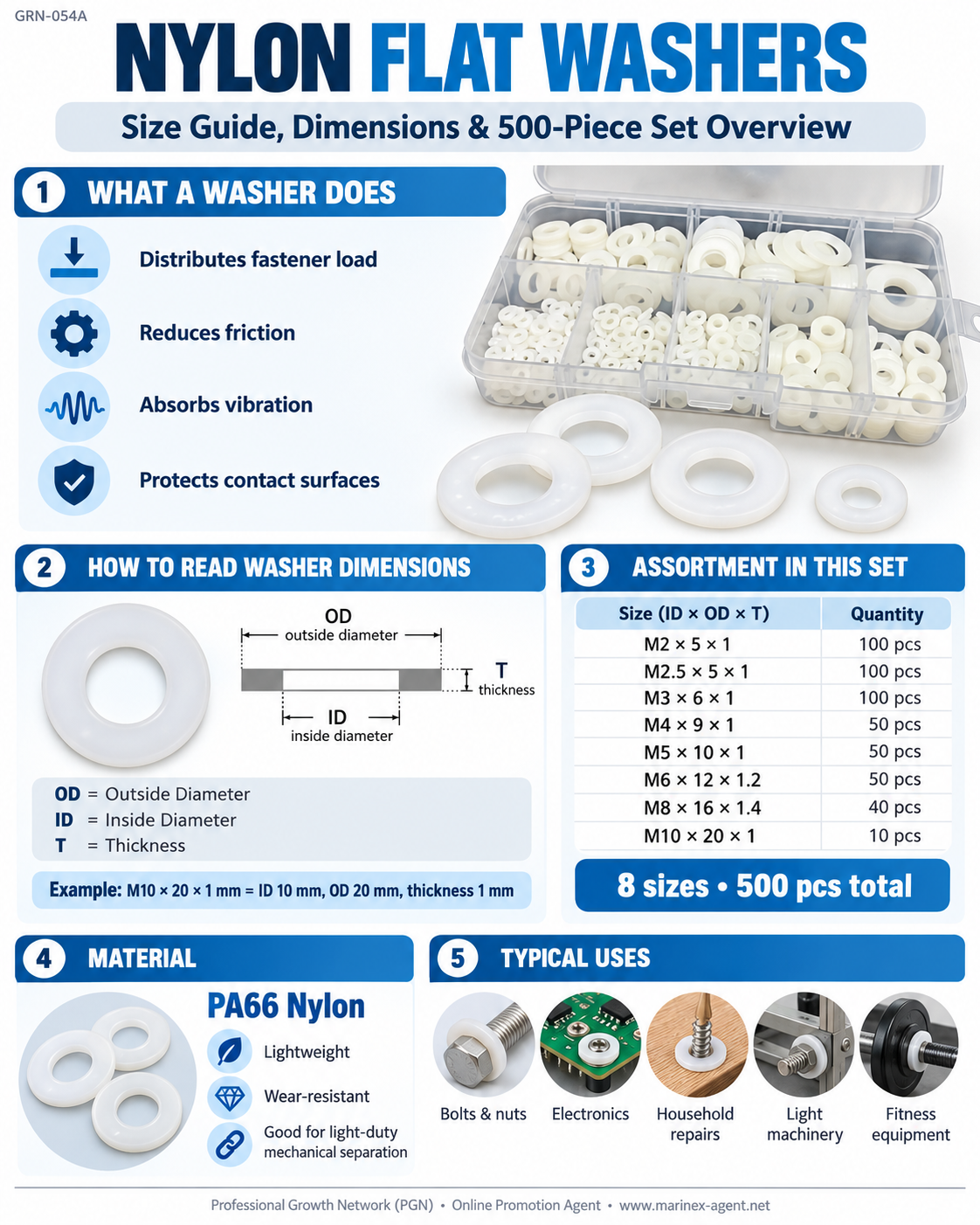
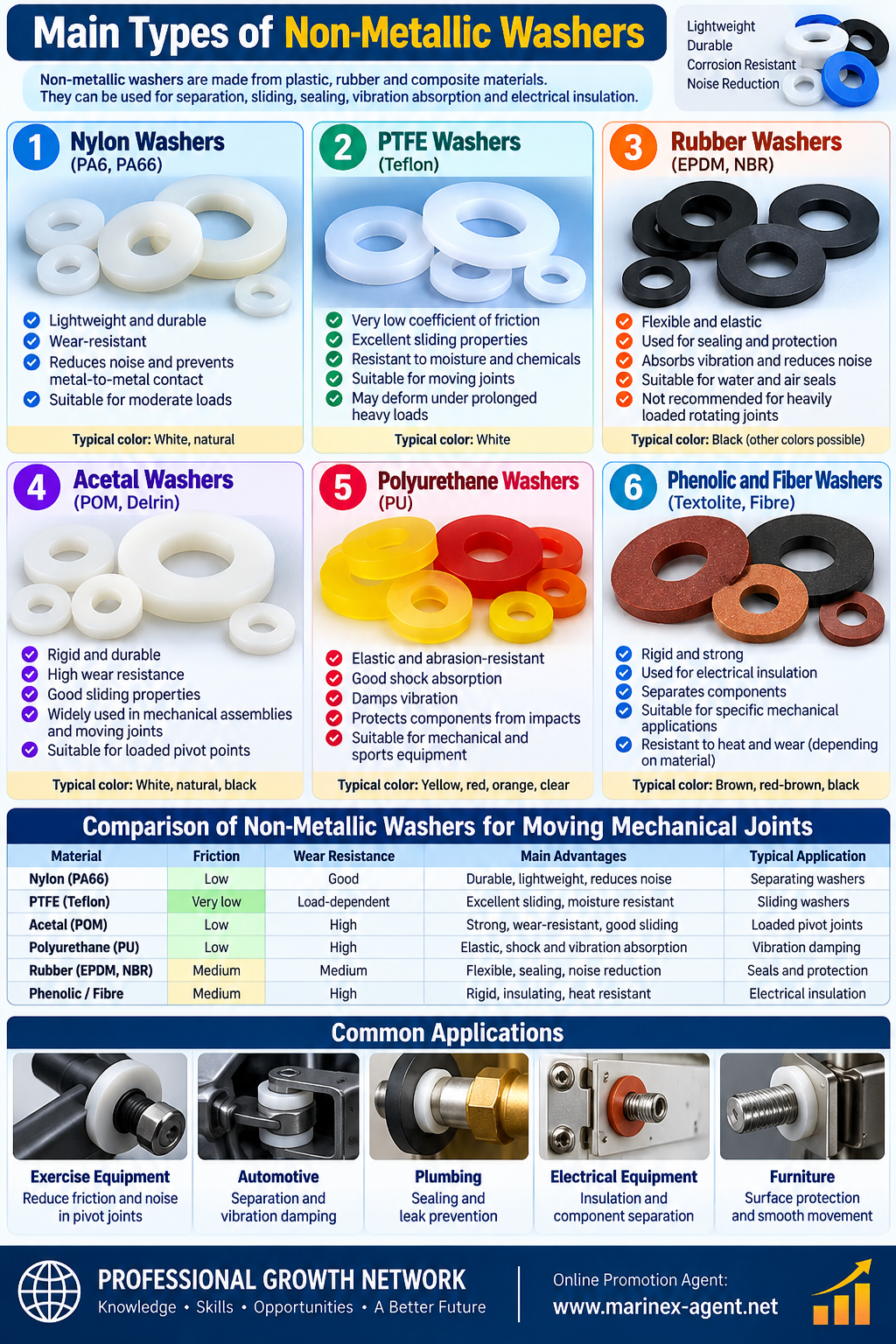
1. Nylon Washers (PA6, PA66)
Lightweight, durable, and wear-resistant. Used to separate metal components, reduce noise, and prevent direct metal-to-metal contact. Suitable for moderate mechanical loads.
2. PTFE Washers (Teflon)
Made from polytetrafluoroethylene (PTFE). Feature an extremely low coefficient of friction, excellent sliding properties, and resistance to moisture. Suitable for moving joints, although they may deform under prolonged heavy loads.
3. Rubber Washers (EPDM, NBR)
Flexible and elastic. Used for sealing, vibration absorption, noise reduction, and surface protection. Generally unsuitable for heavily loaded rotating joints.
4. Acetal Washers (POM, Delrin)
Rigid, durable, and highly wear-resistant, with excellent sliding properties. Commonly used in mechanical assemblies, bushings, and moving joints.
5. Polyurethane Washers (PU)
Elastic and abrasion-resistant. Suitable for shock absorption, vibration damping, and protecting mechanical components against impacts.
6. Phenolic and Fiber Washers
Rigid insulating washers made from composite or fiber-based materials. Used for electrical insulation, component separation, and selected mechanical applications.
Recommended Materials for Moving Mechanical Joints
| Material | Friction | Wear Resistance | Typical Application |
|---|---|---|---|
| Nylon (PA66) | Low | Good | Separating washers |
| PTFE (Teflon) | Very low | Load-dependent | Sliding washers |
| Acetal (POM) | Low | High | Loaded pivot joints |
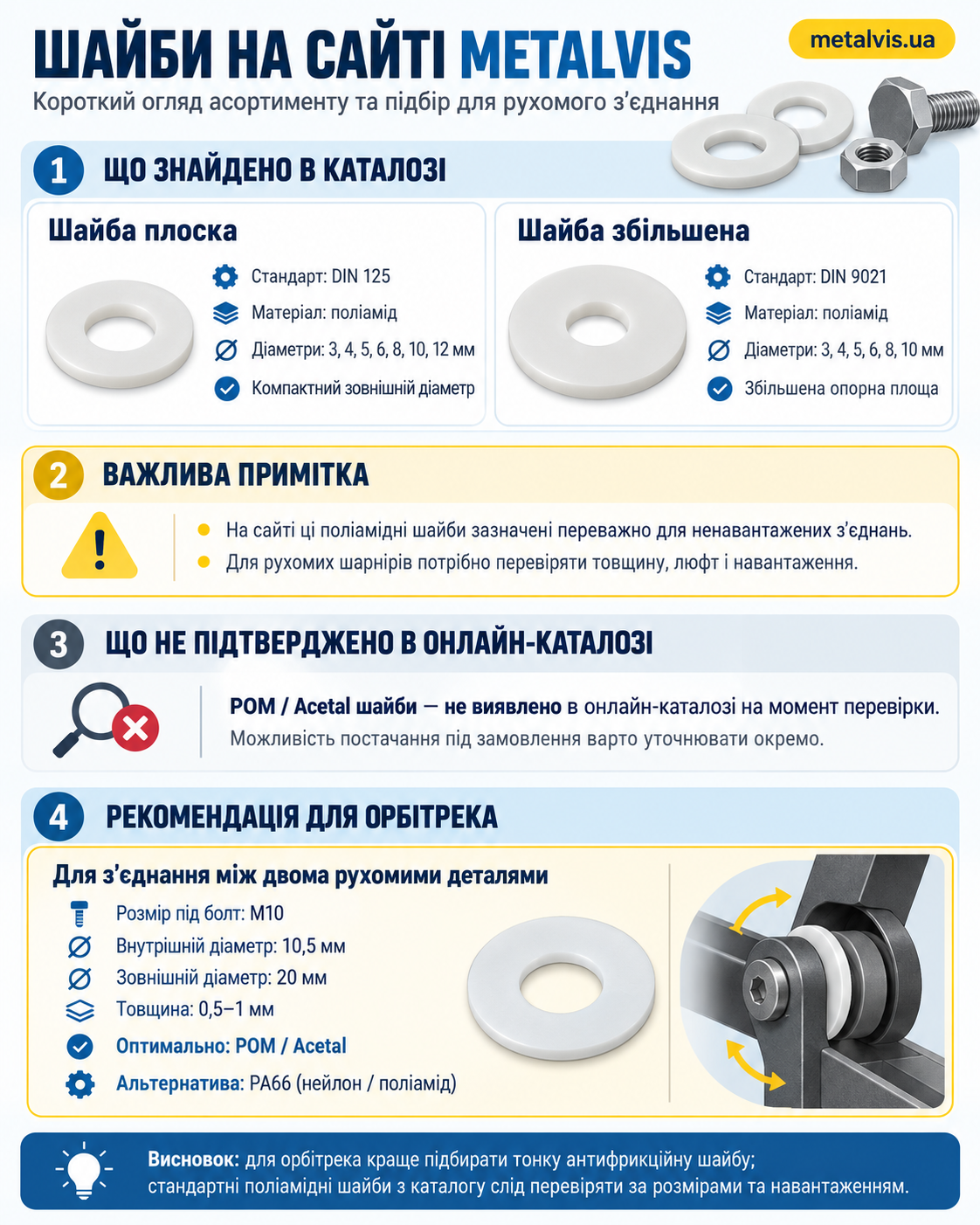
Practical Recommendation: For moving mechanical joints, particularly exercise equipment such as elliptical trainers, POM (Delrin) or PA66 nylon washers may be suitable where the joint design permits their use.
However, original metal washers should not be replaced without checking their structural function, load requirements, and installation dimensions.