
DROPSHIPPING AS A SMALL BUSINESS:
HOW TO START, GROW AND BUILD YOUR OWN INTERNATIONAL BUSINESS
Parent Category: PROFESSIONAL GROWTH NETWORK
Category: Personal Growth & Self-Development
Article Code: GRN-045
Introduction — A Small Business With Global Opportunities
Millions of people around the world dream of starting their own business.
However, many potential entrepreneurs face the same problems: limited capital, lack of business experience, insufficient knowledge of international markets, and uncertainty about where to begin.
Dropshipping offers one possible solution.
It is a business model that allows entrepreneurs to sell products without purchasing and storing large quantities of inventory in advance.
Instead of maintaining their own warehouse, sellers cooperate with manufacturers, wholesalers, or other suppliers who ship products directly to customers.
This model can reduce initial inventory investment and create opportunities for people interested in online commerce, international trade, and self-employment.
However, dropshipping is not automatic income. It requires market research, customer service, financial planning, reliable suppliers, and continuous business development.
The most important principle is:
FIRST PROMOTE YOURSELF — THEN PROMOTE THE PRODUCTS AND SERVICES YOU REPRESENT.
1. What Is Dropshipping?
Dropshipping is a retail fulfillment model in which the seller accepts a customer’s order and arranges for a third-party supplier to deliver the product directly to the buyer.
The entrepreneur normally does not physically handle the merchandise.
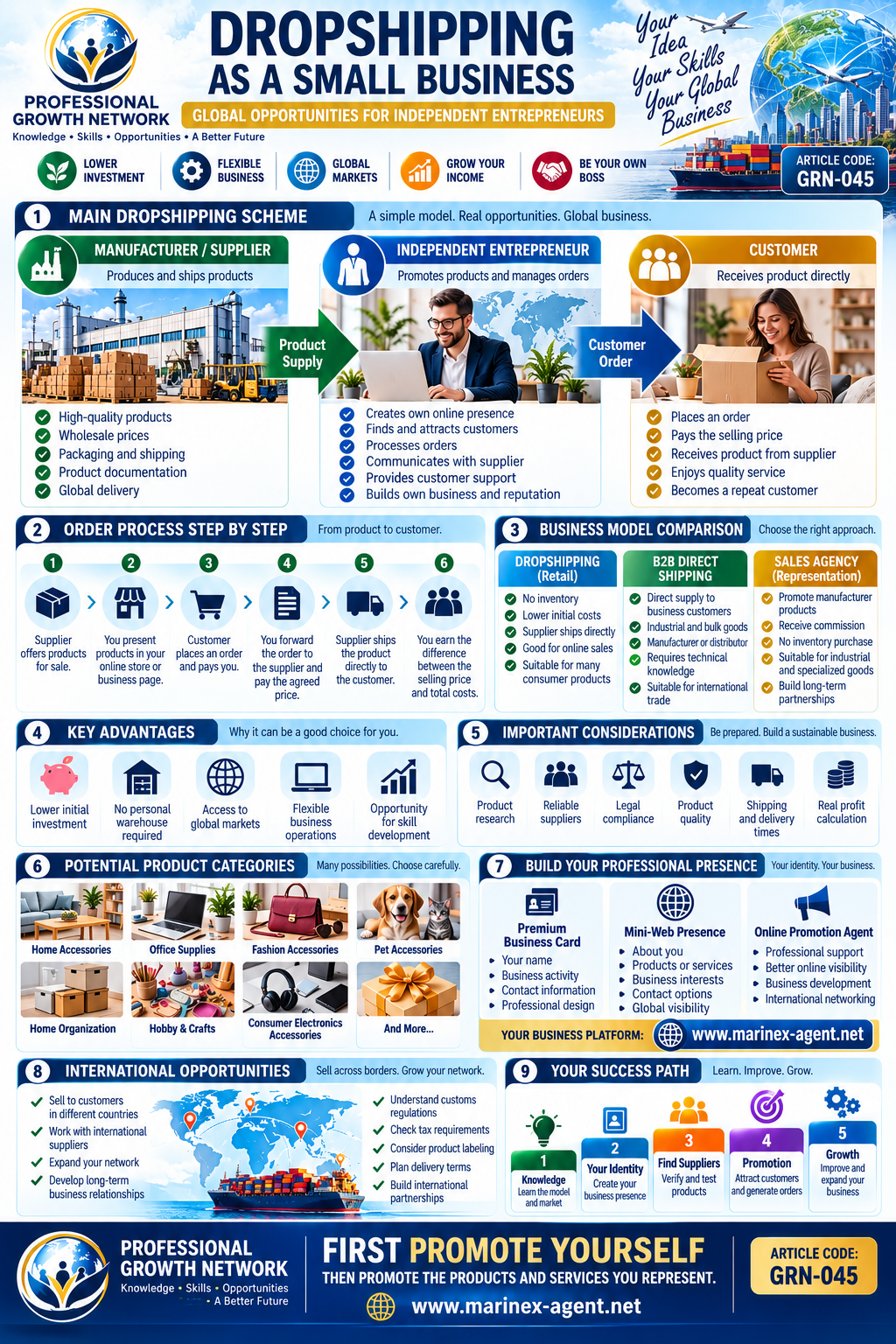
The basic process includes five stages:
- A supplier offers products for sale.
- An entrepreneur selects products and presents them through an online store or another suitable sales channel.
- A customer places an order with the entrepreneur.
- The entrepreneur forwards the order to the supplier and pays the agreed purchase price.
- The supplier ships the product directly to the customer.
The entrepreneur earns the difference between the selling price and the total cost of fulfilling the order, after accounting for expenses.
Important: The seller generally remains responsible to the customer for the transaction, even when another company handles shipping.
2. How the Dropshipping Business Model Works
Consider a simplified example.
An entrepreneur discovers a product offered by a manufacturer for $40.
The entrepreneur creates a professional online presentation and offers the product to customers for $70.
A customer places an order.
The entrepreneur purchases the product from the supplier, who ships it directly to the buyer.
Example of One Transaction
| Description | Amount |
|---|---|
| Customer selling price | $70 |
| Supplier product cost | $40 |
| Shipping expenses | $8 |
| Payment processing | $2 |
| Advertising expenses | $10 |
| Illustrative operating profit | $10 |
This example excludes other potential expenses, including returns, taxes, software, customer support, and business administration.
It demonstrates that sales revenue is not the same as profit.
Successful dropshipping depends on maintaining a sustainable margin after all relevant costs.
3. Why Dropshipping Can Be Attractive for Small Entrepreneurs
Dropshipping has several characteristics that make it worth considering.
3.1. Lower Initial Inventory Investment
Traditional retailers often purchase inventory before they know whether customers will buy it.
Dropshipping can reduce this requirement because products are generally ordered from suppliers after customers place orders.
However, entrepreneurs may still need funds for website development, advertising, business registration, payment processing, refunds, and working capital.
3.2. No Personal Warehouse Required
In a typical dropshipping arrangement, the supplier manages storage, packaging, and dispatch.
This can reduce the entrepreneur’s operational responsibilities.
3.3. Access to International Markets
Online commerce can connect entrepreneurs with customers and suppliers in different countries.
International selling nevertheless requires attention to customs regulations, taxes, delivery times, product compliance, and payment systems.
3.4. Flexible Business Operations
Many dropshipping activities can be managed remotely through a computer and internet connection.
3.5. Opportunities for Business Development
Entrepreneurs can gradually develop marketing, negotiation, customer service, product research, and international trade skills.
These skills remain valuable even if they later move beyond dropshipping.
4. The Three Main Participants in Dropshipping
A successful dropshipping transaction generally involves three parties.
4.1. Manufacturer or Supplier
The supplier produces, stocks, or distributes the merchandise.
Its responsibilities may include:
- Product availability.
- Agreed wholesale prices.
- Packaging and fulfillment.
- Shipping arrangements.
- Product documentation.
- Quality control.
- Handling supplier-related problems under the agreement.
4.2. Independent Entrepreneur
The entrepreneur develops the commercial relationship with the customer.
Typical responsibilities include:
- Selecting suitable products.
- Creating a professional business presentation.
- Promoting products.
- Attracting customers.
- Processing orders.
- Communicating with suppliers.
- Handling customer inquiries and complaints.
- Managing financial results.
4.3. Customer
The customer purchases the product based on the seller’s offer, pricing, delivery conditions, and reputation.
The customer’s satisfaction is essential for repeat business and long-term growth.
5. Choosing the Right Products
Selecting suitable products is one of the most important decisions.
Not every product is appropriate for dropshipping.
Entrepreneurs should evaluate:
Market Demand: Is there sufficient interest in the product?
Competition: How many other sellers offer similar products?
Profit Margin: Can the product be sold profitably after all expenses?
Shipping: Is delivery affordable, reliable, and reasonably fast?
Product Quality: Can the supplier demonstrate consistent quality?
Regulatory Requirements: Can the product legally be sold and delivered in the intended market?
Returns and Warranty: How will defective products and customer complaints be handled?
Potential Product Categories
Depending on the target market, suitable categories may include:
- Home accessories.
- Office supplies.
- Selected fashion accessories.
- Pet accessories.
- Home organization products.
- Hobby and craft supplies.
- Non-regulated lifestyle products.
- Selected consumer electronics accessories.
Beginners should be particularly careful with food, cosmetics, medical products, chemicals, batteries, and other regulated or potentially hazardous goods.
Such products may require additional testing, certifications, permits, or specialized logistics.
6. How to Find Reliable Suppliers
A successful business depends heavily on its suppliers.
Entrepreneurs should avoid choosing suppliers based only on the lowest advertised price.
A reliable supplier should provide clear information about:
- Legal company identity.
- Product specifications.
- Wholesale prices.
- Minimum order requirements.
- Stock availability.
- Shipping methods.
- Delivery times.
- Return and refund procedures.
- Warranty responsibilities.
- Customer support and communication.
Whenever practical, entrepreneurs should order product samples before offering merchandise to customers.
Supplier verification should include checking company registration, business reputation, documentation, and payment conditions.
7. Dropshipping Versus Traditional Retail
| Business Feature | Dropshipping | Traditional Retail |
|---|---|---|
| Inventory ownership | Usually supplier-held before sale | Usually purchased in advance |
| Warehouse requirement | Often unnecessary | Frequently necessary |
| Initial inventory investment | Generally lower | Generally higher |
| Shipping operations | Usually handled by supplier | Usually handled by retailer or logistics provider |
| Product quality control | More dependent on supplier | Often greater direct control |
| Customer relationship | Managed by seller | Managed by retailer |
| Profitability | Depends on margins and costs | Depends on margins and costs |
| Business risk | Present | Present |
Neither model guarantees success.
Dropshipping reduces certain operational requirements but introduces greater dependence on supplier performance.
8. Creating Your Own Professional Online Presence
One of the biggest mistakes made by beginning entrepreneurs is trying to sell products before establishing their own professional identity.
A serious entrepreneur should be able to answer several basic questions:
- Who am I?
- What business do I represent?
- What products or services do I offer?
- Where can customers find information about me?
- How can potential partners contact me?
- Why should they trust my business?
This is why PROFESSIONAL GROWTH NETWORK emphasizes professional online visibility.
Your Full Style — Professional Business Identity
A practical business presentation can include:
1. Premium Business Card
A professional card containing the entrepreneur’s name, business activity, and contact information.
2. Mini-Web Presence
A dedicated online page presenting the entrepreneur, products, services, business interests, and contact details.
3. Personal Online Promotion Agent
A professional promotional service supporting the entrepreneur’s online visibility and business development.
A Mini-Web Presence is not a substitute for a fully functioning e-commerce store when online checkout, order processing, and consumer protection requirements are necessary.
However, it can serve as an initial professional introduction for networking and business-to-business cooperation.
9. How to Promote a Dropshipping Business
Product promotion is a continuous activity.
Entrepreneurs should develop a marketing strategy rather than depend entirely on occasional social media posts.
Search Engine Visibility
Create useful product descriptions, informative articles, and properly structured website pages.
Social Media Marketing
Use relevant platforms to present products, communicate with customers, and develop brand recognition.
Pinterest can be useful for visually appealing product categories, such as home accessories, fashion, crafts, and lifestyle products.
Facebook and Instagram
These platforms can support product discovery, community engagement, and advertising, subject to their current commerce policies.
LinkedIn can be especially relevant for professional networking, manufacturers, distributors, and B2B partnerships.
Email Marketing
Permission-based email communication can help maintain relationships with existing customers and interested prospects.
The objective is not simply to attract attention but to establish credibility and generate qualified business inquiries.
10. Dropshipping and International Trade
International dropshipping creates opportunities beyond domestic markets.
An entrepreneur in one country may cooperate with a manufacturer in another country and sell products to customers elsewhere.
However, cross-border transactions require careful planning.
Important considerations include:
- Import duties and customs clearance.
- Value-added tax or sales tax.
- Product labeling requirements.
- Consumer protection regulations.
- Delivery terms.
- Payment methods.
- Currency conversion.
- Returns and warranties.
- Data protection.
- Product liability.
Entrepreneurs should understand which party is responsible for import formalities, taxes, and delivery obligations before accepting customer orders.
11. Dropshipping, B2B Direct Shipping and Sales Agency
These business models are related but not identical.
Retail Dropshipping
The entrepreneur sells merchandise to an end customer, while a supplier fulfills the order.
B2B Direct Shipping
A supplier delivers industrial or commercial goods directly to a business customer, sometimes through a distributor or trading company.
Independent Sales Agency
An agent introduces potential customers or promotes products on behalf of a manufacturer.
The agent may receive a commission for completed transactions without purchasing or reselling the merchandise.
This distinction is especially important for PROFESSIONAL GROWTH NETWORK.
Industrial chemicals, minerals, machinery, and other specialized goods may be more suitable for B2B distribution or authorized sales representation than conventional retail dropshipping.
The appropriate model should be agreed upon with the manufacturer.
12. Opportunities for Cooperation With Manufacturers
Many manufacturers are interested in expanding their international customer base.
They may seek:
- New distributors.
- Independent commercial representatives.
- Online product promoters.
- Regional business development partners.
- Qualified industrial buyers.
- Long-term international customers.
An organized network of independent entrepreneurs could potentially support these objectives.
For manufacturers, cooperation with a professional business network may provide additional market visibility and access to new contacts.
For entrepreneurs, such cooperation may provide access to product information, supplier relationships, and business development opportunities.
However, these arrangements require commercial agreements.
No manufacturer should be presented as an authorized PGN partner without its consent.
13. PROFESSIONAL GROWTH NETWORK — Supporting New Entrepreneurs
PROFESSIONAL GROWTH NETWORK (PGN) is developing a community focused on knowledge, professional growth, international networking, and business opportunities.
Dropshipping and related commercial models fit naturally within this broader mission.
PGN can help interested individuals explore the essential stages of small-business development.
Stage 1 — Knowledge
Understand how online commerce, product sourcing, pricing, and customer relationships work.
Stage 2 — Personal Business Identity
Develop a professional business presentation, including a business card and Mini-Web Presence.
Stage 3 — Supplier Research
Identify manufacturers and distributors offering suitable products and commercial terms.
Stage 4 — Market Selection
Research target customers, product demand, competition, and regulatory requirements.
Stage 5 — Promotion
Develop online visibility and begin professional communication with potential customers.
Stage 6 — Business Cooperation
Negotiate supplier agreements, fulfillment procedures, and commercial responsibilities.
Stage 7 — Growth
Evaluate results, improve marketing, strengthen customer relationships, and gradually expand operations.
PGN’s role is to encourage informed entrepreneurship and professional development, not to guarantee income or customers.
14. Can Manufacturers Become Business Development Sponsors?
An additional opportunity involves cooperation between manufacturers and business development communities.
Some manufacturers may be interested in supporting training or promotional programs that help independent entrepreneurs develop the skills needed to represent products professionally.
Potential sponsorship activities could include:
- Product education.
- Technical training.
- Access to catalogs and product documentation.
- Product samples.
- Support for online business presentations.
- Promotional materials.
- Participation in international business networking activities.
Such support would benefit entrepreneurs while potentially helping manufacturers develop new commercial relationships.
However, sponsorship must be voluntary, transparent, and based on a mutually agreed program.
A manufacturer is not automatically a sponsor simply because its products are suitable for international promotion.
15. A Practical 30-Day Starting Plan
| Period | Recommended Activities |
|---|---|
| Days 1–5 | Learn the dropshipping model and select a potential business niche |
| Days 6–10 | Research suppliers, products, customers, and competitors |
| Days 11–15 | Develop a professional business identity and online presentation |
| Days 16–20 | Verify supplier conditions, calculate costs, and test product suitability |
| Days 21–25 | Prepare product presentations and marketing materials |
| Days 26–30 | Launch a small, controlled market test and evaluate results |
This schedule is illustrative.
Some activities, including registration, compliance checks, supplier approval, and technical integration, may take considerably longer.
The goal of the first month is to establish a foundation, not to promise immediate sales.
16. Common Mistakes to Avoid
Beginning entrepreneurs should be particularly careful about the following mistakes.
Mistake 1 — Expecting Easy Money
Dropshipping is a business activity requiring real work and financial responsibility.
Mistake 2 — Choosing Products Without Research
High demand does not automatically mean profitable sales.
Mistake 3 — Trusting Unverified Suppliers
Poor supplier performance can damage the seller’s reputation.
Mistake 4 — Ignoring Delivery Times
Customers expect accurate information about shipping and delivery.
Mistake 5 — Forgetting Taxes and Regulations
Legal compliance is essential for sustainable operations.
Mistake 6 — Spending Too Much on Advertising
Advertising expenses can quickly eliminate profit margins.
Mistake 7 — Selling Before Building Trust
A professional online presence helps customers understand who is responsible for the business.
Mistake 8 — Relying on a Single Supplier
Supplier disruption can interrupt customer orders.
Mistake 9 — Ignoring Customer Service
Customer satisfaction affects reputation, refunds, and repeat business.
Mistake 10 — Failing to Calculate Real Profit
Entrepreneurs must account for all costs, not only the supplier’s price.
17. The Future of Dropshipping and Independent Entrepreneurship
The future of dropshipping will likely be influenced by several developments:
Artificial Intelligence: AI tools can assist with product research, content creation, customer communication, and business analysis.
Digital Commerce: Online sales channels continue to create opportunities for independent businesses.
International Manufacturing Networks: Entrepreneurs can explore relationships with manufacturers and suppliers in different countries.
Specialized Markets: Businesses that understand a particular customer group may differentiate themselves more effectively than general-purpose sellers.
Professional Branding: Customers increasingly need clear information about the businesses they purchase from.
Business Communities: Networking and shared knowledge can help entrepreneurs learn, find partners, and avoid common mistakes.
Technology can support these activities, but it cannot replace reliable suppliers, responsible management, and customer trust.
18. The Main Principle — Promote Yourself First
Dropshipping is often presented as a way to sell somebody else’s products.
But a successful entrepreneur should aim to build something more valuable than a collection of product listings.
The entrepreneur must build a professional identity, reputation, and network of business relationships.
Products may change.
Suppliers may change.
Markets may change.
But the entrepreneur’s knowledge, credibility, customer relationships, and professional online presence can continue to develop over time.
This is the philosophy behind our approach:
FIRST PROMOTE YOURSELF — THEN PROMOTE THE PRODUCTS AND SERVICES YOU REPRESENT.
A professional Mini-Web Presence can become the entrepreneur’s electronic business card — a place to introduce themselves to potential suppliers, customers, and international partners.
Conclusion — From a Small Idea to an International Business
Dropshipping can provide an accessible entry point into small-business entrepreneurship, particularly for individuals who want to explore online commerce without maintaining large inventories.
However, sustainable success depends on preparation, supplier reliability, product selection, marketing, customer service, financial discipline, and legal compliance.
For some entrepreneurs, traditional retail dropshipping may be appropriate.
For others, B2B direct shipping, distribution, or independent sales representation may offer a better business model.
PROFESSIONAL GROWTH NETWORK aims to encourage people to acquire knowledge, develop professional skills, establish their own online identity, and explore international business opportunities.
Our message to future entrepreneurs is simple:
START SMALL. LEARN CONTINUOUSLY. BUILD YOUR REPUTATION. DEVELOP INTERNATIONAL CONNECTIONS.
And above all:
PROMOTE YOURSELF FIRST — THEN PROMOTE YOUR BUSINESS.
Further Reading and Resources
- Shopify: https://www.shopify.com — E-commerce tools and educational resources.
- WooCommerce: https://woocommerce.com — Online store solutions for WordPress.
- Google Trends: https://trends.google.com — Research into search interest and market trends.
- International Chamber of Commerce: https://iccwbo.org — International trade resources and Incoterms information.
- World Trade Organization: https://www.wto.org — International trade information and resources.
- PROFESSIONAL GROWTH NETWORK: https://www.marinex-agent.net — Professional growth, business networking, and online promotion.
PROFESSIONAL GROWTH NETWORK
Knowledge • Skills • Opportunities • A Better Future
Online Promotion Agent: www.marinex-agent.net
Article Code: GRN-045