
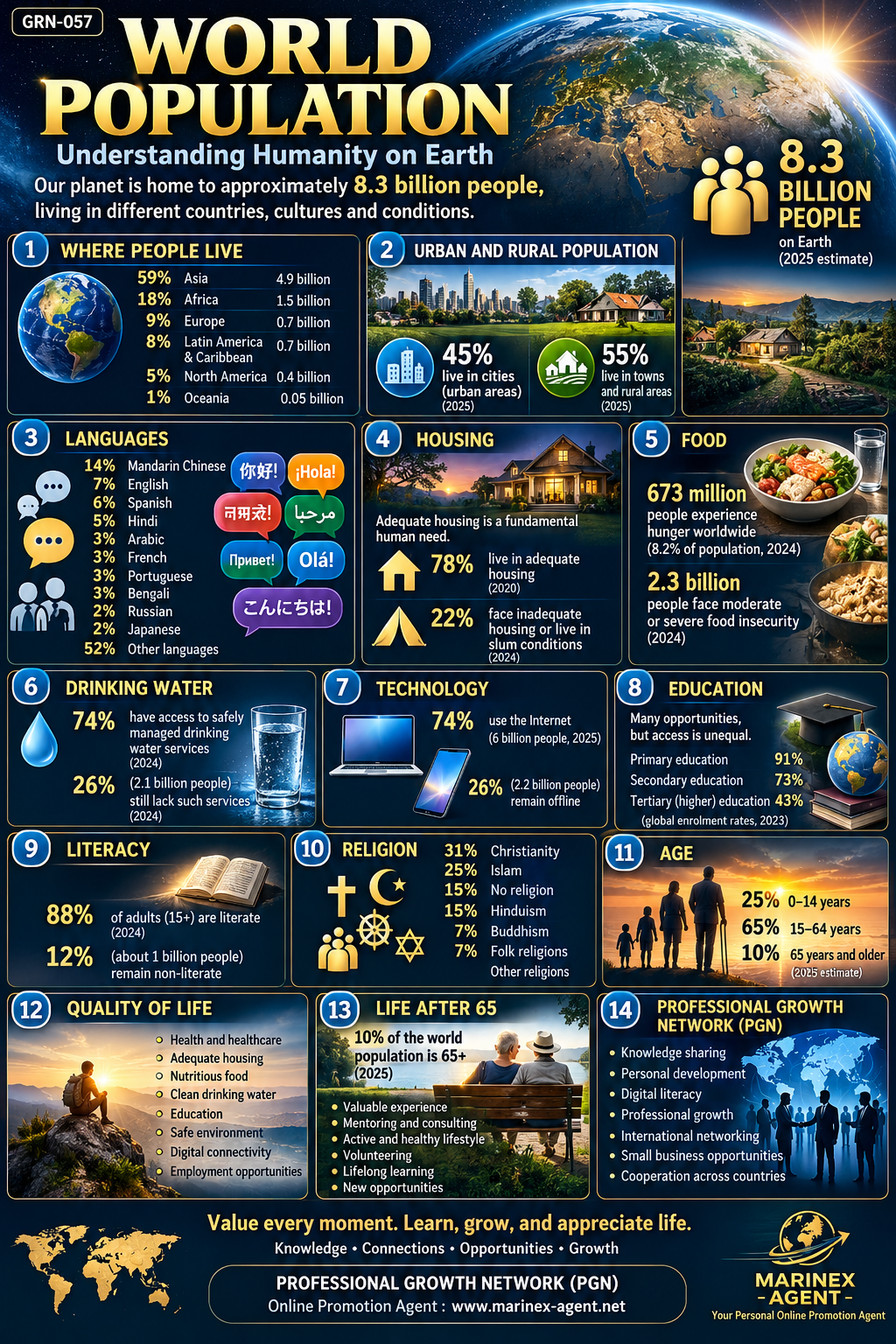
WORLD POPULATION — UNDERSTANDING HUMANITY
ON EARTH
Parent Category: PROFESSIONAL GROWTH NETWORK
Category: Personal Growth & Self-Development
Article Code: GRN-057
A Global Overview of Population, Languages, Living Conditions, Education, Technology & Human Development
Our planet is home to approximately 8.3 billion people, living in different countries, cultures, economic environments, and social conditions.
Although humanity shares the same planet, people’s living standards, educational opportunities, access to technology, and economic circumstances vary significantly.
Understanding global population trends helps us appreciate the diversity of human society and recognize the importance of education, cooperation, sustainable development, and personal growth.
This article examines the major characteristics of the world’s population and the challenges facing humanity.
1. World Population — Where People Live
Approximately 8.3 Billion People Share Our Planet
The world’s population continues to grow, although growth rates differ considerably between countries and regions.
Asia remains the most populated continent, followed by Africa, Europe, North America, South America, and Oceania.
Important Global Trends:
- Asia contains the largest share of the world’s population.
- Africa has significant long-term population growth potential.
- Many European and East Asian societies are experiencing population aging.
- International migration influences population distribution.
- Economic opportunities and living conditions affect where people choose to live.
Understanding these demographic trends is important for governments, businesses, educational institutions, and international organizations.
2. Urban and Rural Population
Humanity Is Becoming Increasingly Urbanized
People live in cities, towns, villages, and rural communities.
Urban areas generally offer greater access to employment, specialized healthcare, educational institutions, and infrastructure.
Rural communities remain important for agriculture, food production, environmental protection, and local economic development.
According to the United Nations World Urbanization Prospects 2025, approximately 45% of the global population lived in cities, using the UN’s updated city classification. Towns and rural areas account for the remainder.
Major Challenges:
- Housing affordability.
- Urban transportation.
- Public infrastructure.
- Environmental pollution.
- Employment opportunities.
- Sustainable rural development.
Key Principle: Sustainable development requires attention to both urban and rural communities.
3. Languages — Connecting Humanity
Language Is One of the Most Important Tools for Human Communication
Thousands of languages are spoken around the world.
Among the major languages used internationally are:
- English
- Mandarin Chinese
- Spanish
- Hindi
- Arabic
- French
- Portuguese
- Bengali
- Russian
- Japanese
Each language represents an important part of human culture, history, and identity.
Why Learning Languages Matters:
- Improves international communication.
- Expands educational opportunities.
- Supports international trade.
- Encourages cultural understanding.
- Facilitates professional networking.
- Opens opportunities for employment and entrepreneurship.
English plays an especially important role in international business, maritime operations, aviation, science, and digital communication.
Key Principle: Learning another language can expand your professional and personal opportunities.
4. Housing and Living Conditions
Adequate Housing Is a Fundamental Human Need
Access to safe, stable, and affordable housing remains an important global development challenge.
While many people live in comfortable homes with modern infrastructure, others experience overcrowding, inadequate housing, or unstable living conditions.
Major Housing Challenges:
- High property prices.
- Rising rental costs.
- Limited access to affordable housing.
- Inadequate infrastructure.
- Homelessness.
- Housing destruction caused by armed conflicts and natural disasters.
Improving housing conditions requires cooperation between governments, private businesses, local communities, and international development organizations.
Key Principle: Safe housing provides an important foundation for health, education, and economic stability.
5. Food — Global Nutrition and Food Security
Food Security Remains a Major Challenge for Humanity
Food production and distribution are essential components of the global economy.
Despite significant agricultural and technological progress, hunger and inadequate nutrition continue to affect millions of people.
According to the FAO and other United Nations agencies, approximately 673 million people experienced hunger in 2024, representing about 8.2% of the world’s population.
Around 2.3 billion people experienced moderate or severe food insecurity during the same year.
Major Challenges:
- Poverty and income inequality.
- Armed conflicts.
- Climate-related disruptions.
- Food price inflation.
- Agricultural productivity.
- Transportation and distribution problems.
- Food waste.
Key Principle: Sustainable food security requires reliable production, affordable prices, efficient distribution, and access to adequate nutrition.
6. Drinking Water — An Essential Resource
Clean Drinking Water Is Fundamental to Human Health
Access to safe drinking water is essential for survival, sanitation, agriculture, and economic development.
According to the WHO/UNICEF Joint Monitoring Programme, approximately 74% of the world’s population had access to safely managed drinking water services in 2024.
This means around 2.1 billion people still lacked such services.
Major Challenges:
- Water contamination.
- Inadequate sanitation.
- Water shortages.
- Climate change.
- Aging infrastructure.
- Unequal access between urban and rural communities.
Key Principle: Clean drinking water is not a luxury. It is an essential requirement for human life and sustainable development.
7. Technology and Digital Connectivity
Digital Technology Is Transforming Human Society
The Internet, mobile communications, artificial intelligence, and digital platforms have significantly changed how people work, communicate, study, and conduct business.
According to the International Telecommunication Union (ITU), approximately 6 billion people, or 74% of the global population, used the Internet in 2025.
Nevertheless, around 2.2 billion people remained offline.
Digital Technologies Create Opportunities For:
- Online education.
- Remote employment.
- International business.
- Digital entrepreneurship.
- Professional communication.
- Access to information.
- Financial services.
- International networking.
However, unequal access to technology continues to create a digital divide between different countries and communities.
Key Principle: Digital literacy is becoming an essential skill for personal and professional development.
8. Education — Developing Human Potential
Education Creates Opportunities for Individuals and Societies
Education is one of the most important foundations of economic development and social progress.
It helps people develop knowledge, professional skills, critical thinking, and the ability to solve practical problems.
Important Areas of Education:
- Primary education.
- Secondary education.
- Vocational training.
- Higher education.
- Digital literacy.
- Professional certification.
- Lifelong learning.
Access to quality education remains unequal across the world.
Economic conditions, family income, geographical location, armed conflicts, and educational infrastructure can influence learning opportunities.
Key Principle: Education is not limited to schools and universities. Learning should continue throughout life.
9. Literacy — A Foundation for Development
Reading and Writing Skills Are Essential for Participation in Modern Society
Literacy allows individuals to understand information, communicate effectively, pursue education, and participate in economic activities.
According to UNESCO’s 2026 global education monitoring data, adult literacy reached approximately 88% worldwide in 2024.
However, literacy levels differ significantly between countries, age groups, and socioeconomic conditions.
Literacy Supports:
- Employment opportunities.
- Financial independence.
- Access to healthcare information.
- Personal development.
- Digital communication.
- Civic and community participation.
Key Principle: Literacy provides the foundation for continuous education and professional advancement.
10. Religion and Cultural Diversity
Humanity Includes Many Religious and Cultural Traditions
Religion, philosophy, and cultural traditions play important roles in the lives of billions of people.
Major religious traditions include:
- Christianity.
- Islam.
- Hinduism.
- Buddhism.
- Judaism.
- Traditional and other religious beliefs.
A significant part of the world’s population does not identify with any particular religion.
Why Cultural Understanding Matters:
- Encourages mutual respect.
- Supports peaceful cooperation.
- Improves international communication.
- Helps build professional relationships.
- Promotes cultural awareness.
Key Principle: Respect for different cultures, beliefs, and traditions is essential for constructive international cooperation.
11. Age — A Changing World Population
Population Aging Is Becoming an Important Global Trend
The world’s population includes children, young adults, working-age people, and older generations.
Population age structures differ considerably across countries.
Some societies have relatively young populations, while others experience increasing proportions of older adults.
Major Demographic Challenges:
- Employment opportunities for young people.
- Access to education and vocational training.
- Healthcare requirements.
- Pension sustainability.
- Workforce development.
- Support for older people.
People aged 65 and older represent a growing part of the global population.
This demographic shift influences healthcare systems, public finances, housing, employment policies, and long-term economic planning.
Key Principle: Every generation contributes knowledge, experience, and value to society.
12. Quality of Life — Appreciating What We Have
Human Well-Being Depends on More Than Financial Wealth
A person’s quality of life is influenced by many factors, including health, education, income, housing, safety, social relationships, and access to essential services.
For many people around the world, basic necessities remain difficult to obtain.
These include:
- Nutritious food.
- Safe drinking water.
- Adequate shelter.
- Healthcare.
- Education.
- Reliable electricity.
- Digital connectivity.
- Employment opportunities.
Recognizing these differences can encourage gratitude, responsible personal development, and greater concern for the well-being of others.
Key Principle: Appreciate the resources and opportunities available to you while recognizing the challenges faced by others.
13. Life After 65 — Experience, Knowledge and New Opportunities
Personal Growth Does Not End at Retirement
Longer life expectancy and improved healthcare have created new opportunities for people to remain professionally, intellectually, and socially active later in life.
Older adults contribute valuable experience, professional knowledge, practical skills, and historical understanding.
Opportunities for Continued Development Include:
- Consulting and advisory services.
- Mentoring younger professionals.
- Online education.
- Small business activities.
- Volunteering.
- International networking.
- Digital entrepreneurship.
- Lifelong learning.
Retirement does not necessarily mean the end of professional growth or meaningful activity.
Key Principle: Knowledge, experience, and curiosity can remain valuable throughout life.
14. Professional Growth Network — Connecting People Worldwide
The Professional Growth Network (PGN) is based on the idea that knowledge, professional experience, personal development, and international connections can help people discover new opportunities.
Our community encourages:
- Knowledge sharing.
- Personal growth.
- Digital literacy.
- Professional development.
- International networking.
- Small business entrepreneurship.
- Cooperation between people from different countries and cultures.
Through Marinex-Agent and our Personal Online Promotion Agent project, we encourage individuals to develop their professional identity and establish an online presence.
Our Business Principle:
First, Promote Yourself. Then, Promote Your Products or Services.
A professional online presentation can help individuals introduce their experience, knowledge, services, and business interests to an international audience.
Knowledge • Connections • Opportunities • Growth
Conclusion
The world’s population represents an extraordinary diversity of cultures, languages, traditions, economic systems, and living conditions.
Despite differences between societies, humanity shares common needs for food, water, shelter, education, healthcare, security, and opportunities for personal development.
Understanding global demographic and social trends helps us recognize both the achievements of modern civilization and the challenges that remain.
Knowledge Is Valuable. Understanding Creates Awareness. Cooperation Creates Opportunities.
Value Every Moment. Learn, Grow, and Appreciate Life.
PROFESSIONAL GROWTH NETWORK (PGN)
Online Promotion Agent: www.marinex-agent.net
Article Code: GRN-057