
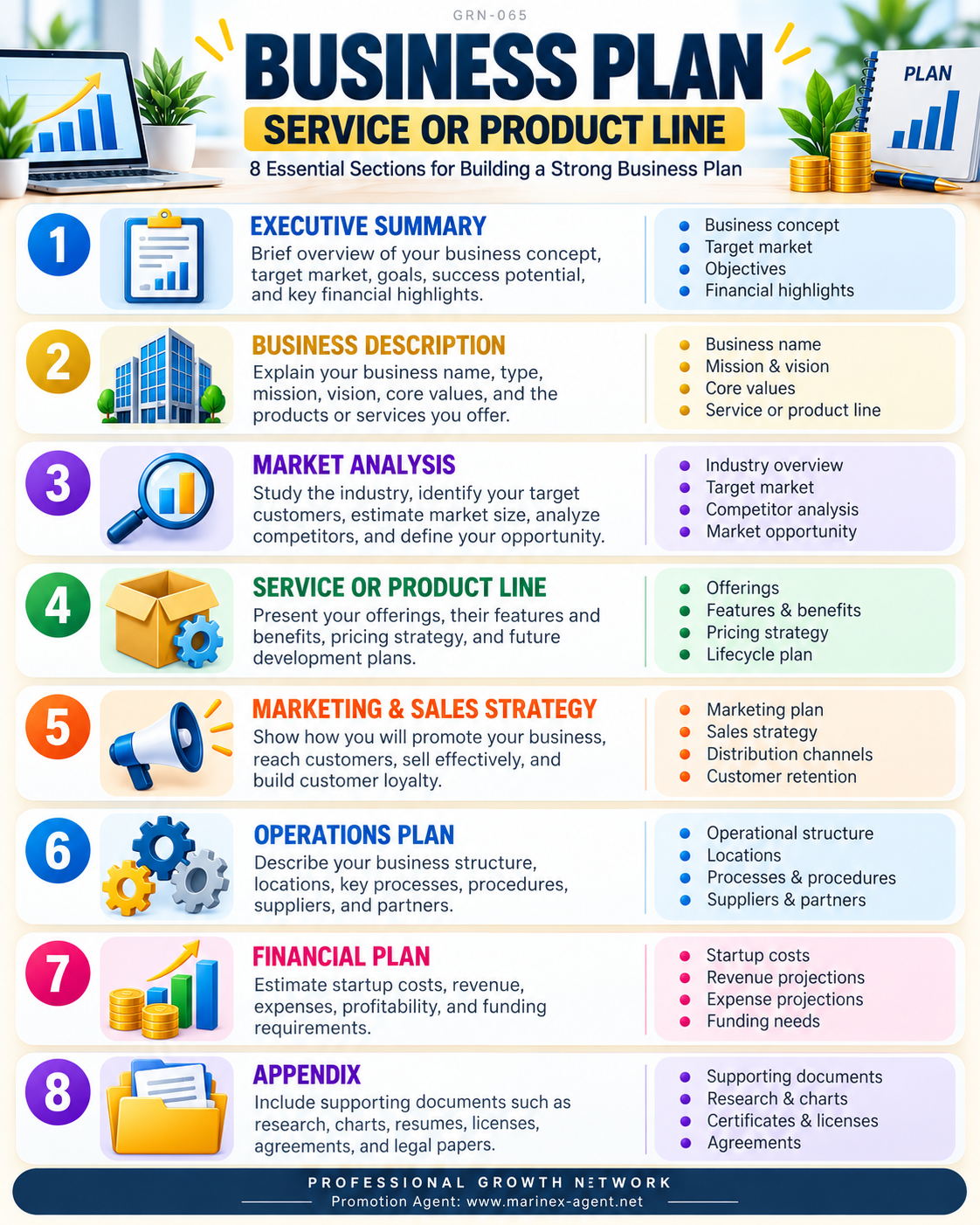
BUSINESS PLAN — SERVICE OR PRODUCT LINE
Parent Category: PROFESSIONAL GROWTH NETWORK (PGN)
Category: Personal Growth & Self-Development
Article Code: GRN-065
Introduction
A business plan is an essential document for anyone planning to start, develop, or expand a business.
It provides a structured overview of a business concept, its products or services, target customers, operational requirements, marketing strategy, and financial expectations.
A well-prepared business plan can help entrepreneurs evaluate opportunities, identify potential risks, communicate with business partners, and present their projects to investors or financial institutions.
Whether you are developing a small online business, launching a new product, or establishing an international trading company, the following eight sections provide a practical framework for preparing your business plan.
1. EXECUTIVE SUMMARY
The Executive Summary provides a concise overview of the entire business plan.
Although it appears at the beginning of the document, it is often useful to prepare this section after completing the other parts of the plan.
Key Information to Include:
- Business Concept: Explain the main idea behind your business.
- Service or Product Line: Describe what your company intends to offer.
- Target Market: Identify the customers or markets you plan to serve.
- Key Objectives: Outline the most important short-term and long-term business goals.
- Success Potential: Summarize the main advantages and opportunities that could contribute to business success.
- Financial Highlights: Present key financial expectations, including initial investment requirements and potential revenue.
Recommendation: Keep the Executive Summary clear, professional, and focused on the most important information.
Potential investors and business partners often use this section to decide whether they want to study the complete business plan.
2. BUSINESS DESCRIPTION
This section explains the identity, purpose, and strategic direction of your business.
It should help readers understand what your company does, why it exists, and what makes it valuable.
Key Elements:
Business Name
Specify the official or proposed name of your business.
Business Type
Describe the nature of your business activities, such as:
- Manufacturing
- International Trading
- Consulting
- Online Promotion
- Digital Services
- E-commerce
- Professional Services
Mission Statement
Define your company’s purpose and the value it intends to provide to customers.
Vision Statement
Describe the long-term goals and future direction of your business.
Core Values
Identify the fundamental principles guiding your business, such as quality, transparency, reliability, innovation, and customer satisfaction.
Description of Service or Product Line
Explain the products or services your company intends to offer, including their main features and benefits.
Recommendation: A clear business description helps establish your professional identity and communicates the value of your business to potential customers and partners.
3. MARKET ANALYSIS
Market analysis helps entrepreneurs understand the economic environment in which their businesses will operate.
This section should identify market opportunities, customer needs, industry trends, and potential competitors.
Industry Overview
Describe your industry, its current conditions, and important market developments.
Consider technological changes, customer preferences, and other factors influencing the industry.
Target Market
Identify your ideal customers and market segments.
Possible customer categories include:
- Individual Consumers
- Small and Medium-Sized Enterprises
- Manufacturers
- Importers and Exporters
- Distributors and Wholesalers
- Corporate Clients
Market Size
Estimate the potential size of your market and its opportunities for growth.
Where possible, support your estimates with reliable market research and statistical information.
Competitor Analysis
Identify your main competitors and evaluate their strengths and weaknesses.
Consider their products, pricing, market positioning, customer service, and promotional strategies.
Market Opportunity
Explain which customer needs remain insufficiently satisfied and how your products or services can address them.
Recommendation: Effective market analysis should be based on evidence rather than assumptions.
Understanding your market can help reduce business risks and improve strategic decision-making.
4. SERVICE OR PRODUCT LINE
This section provides a detailed description of the products or services that your business intends to offer.
It should explain what customers will receive and why they might choose your company.
Offerings
List and describe each product or service included in your business activities.
For example:
- Physical Products
- Digital Products
- Consulting Services
- Online Promotion Services
- Import and Export Services
- Technical Support
- Educational Services
Features & Benefits
Describe the main characteristics of your products or services and explain how they solve customer problems.
Focus not only on technical features but also on practical customer benefits.
Pricing Strategy
Explain how your company will establish prices.
Possible approaches include:
- Cost-Based Pricing
- Market-Based Pricing
- Competitive Pricing
- Value-Based Pricing
Your pricing policy should consider operating expenses, market conditions, customer expectations, and the need for sustainable profitability.
Lifecycle Plan
Outline your plans for developing, expanding, or improving your products or services.
These plans may include product upgrades, new service categories, entry into additional markets, or improvements in customer support.
Recommendation: Clearly communicate the advantages of your offerings and explain why customers should consider your business.
5. MARKETING & SALES STRATEGY
Even an excellent product or service requires effective marketing and sales activities.
This section explains how your company intends to attract potential customers, generate sales, and develop long-term business relationships.
Marketing Plan
Describe how you will promote your products or services.
Possible marketing channels include:
- Company Website
- Business Blog
- Search Engine Optimization (SEO)
- Social Media
- Online Advertising
- Email Marketing
- Professional Networking
- Online Business Presentations
Sales Strategy
Explain how your company will convert potential customers into actual buyers.
Describe your customer acquisition process, communication methods, commercial proposals, and sales procedures.
Distribution Channels
Identify how your products or services will reach customers.
Possible channels include direct sales, online platforms, wholesalers, distributors, and authorized representatives.
Customer Retention
Describe how you will maintain customer loyalty and encourage repeat business.
Important factors include product quality, reliable communication, customer service, and professional after-sales support.
Recommendation: Develop a professional online presence that allows potential customers and business partners to find information about your company and contact you directly.
An effective marketing strategy should support both immediate sales objectives and long-term business growth.
6. OPERATIONS PLAN
The Operations Plan explains how your business will function in practice.
It describes the organizational structure, daily activities, responsibilities, resources, and operational procedures necessary to deliver your products or services.
Operational Structure
Define your business structure and identify key management and operational roles.
Location
Specify where your company operates.
Depending on your business model, this may include:
- Registered Office
- Production Facilities
- Warehouses
- Distribution Centres
- Regional Representative Offices
- Online Business Operations
Processes & Procedures
Describe the principal activities required to deliver your products or services.
These may include order processing, procurement, production, quality control, logistics, customer communication, and financial administration.
Suppliers & Partners
Identify your main suppliers, service providers, contractors, and business partners.
Explain how their participation supports your operations.
Recommendation: Clearly define responsibilities and operational procedures to improve efficiency, coordination, and service quality.
A well-organized operational system is particularly important when a business works with international suppliers, customers, and partners.
7. FINANCIAL PLAN
The Financial Plan is one of the most important sections of a business plan.
It explains how much money is required to establish and operate the business, how revenue may be generated, and when the business could become profitable.
Startup Costs
Estimate the initial investment required to launch your business.
Possible expenses include:
- Business Registration
- Equipment and Technology
- Website Development
- Initial Inventory
- Office or Warehouse Expenses
- Marketing and Promotion
- Professional Services
Revenue Projections
Prepare estimates of expected revenue over a defined period.
Revenue forecasts should be based on realistic assumptions regarding customer demand, sales volume, and pricing.
Expense Projections
Identify expected fixed and variable operating expenses.
Fixed expenses may include rent, subscriptions, and salaries, while variable expenses may include materials, transport, packaging, and sales-related costs.
Profitability Analysis
Calculate projected profitability and identify the expected break-even point.
The break-even point represents the level of sales required to cover total operating costs.
Funding Requirements
Specify how much funding your business requires and explain how these resources will be used.
Potential funding sources may include:
- Personal Investment
- Business Partners
- Bank Financing
- Private Investors
- Grants and Support Programs
Recommendation: Prepare realistic financial forecasts and consider different business scenarios.
Financial planning should include an assessment of possible risks and sufficient working capital to support ongoing operations.
8. APPENDIX
The Appendix contains supporting documents that provide additional information about the business plan.
These materials help potential investors, lenders, partners, and other interested parties evaluate the business proposal in greater detail.
Possible Supporting Documents:
- Company Registration Documents
- Product Catalogues
- Service Descriptions
- Market Research Reports
- Financial Tables and Charts
- Management Resumes
- Professional Certificates
- Licences and Permits
- Supplier Information
- Commercial Agreements
- Technical Specifications
- Relevant Legal Documents
Recommendation: Include only documents that are relevant to your business proposal.
Organize supporting materials clearly so that interested parties can locate the information they require.
Conclusion
A professional business plan is more than a document prepared for investors or banks.
It is a practical management tool that helps entrepreneurs organize their business ideas, evaluate market opportunities, estimate financial requirements, and establish clear development objectives.
The eight essential sections are:
- Executive Summary
- Business Description
- Market Analysis
- Service or Product Line
- Marketing & Sales Strategy
- Operations Plan
- Financial Plan
- Appendix
A business plan should be reviewed and updated as market conditions, customer requirements, and business objectives change.
For entrepreneurs developing small businesses, digital services, international trade, or online promotion activities, a structured business plan provides a foundation for more informed decisions and sustainable development.
Your Business Idea → Your Business Plan → Your Business Strategy → Your Business Growth.
Parent Category: PROFESSIONAL GROWTH NETWORK (PGN)
Category: Personal Growth & Self-Development
Article Code: GRN-065