
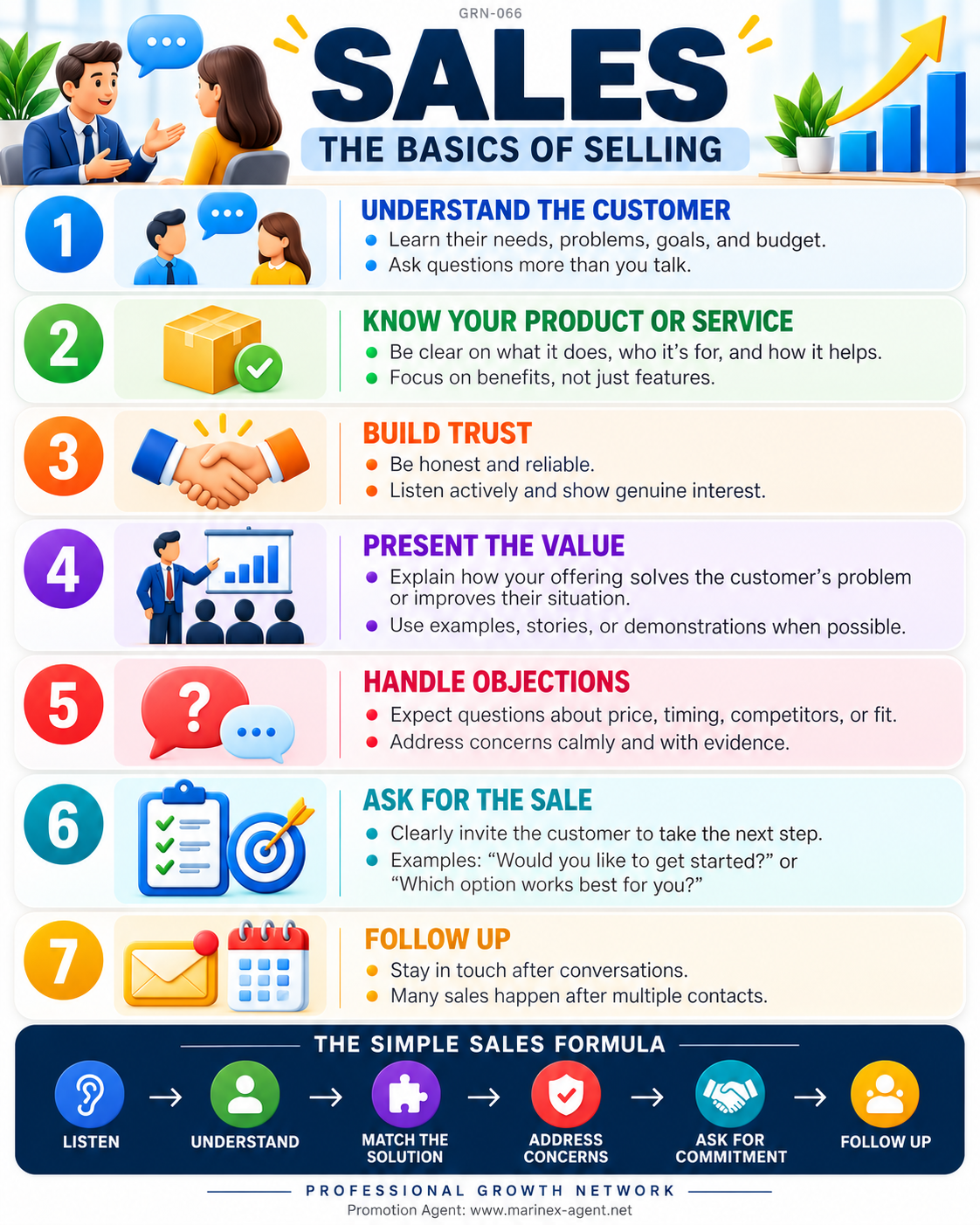
SALES — THE BASICS OF SELLING
Parent Category: PROFESSIONAL GROWTH NETWORK (PGN)
Category: Personal Growth & Self-Development
Article Code: GRN-066
Introduction
Sales is one of the most important skills in business, entrepreneurship, and professional development.
Whether you are selling physical products, professional services, digital solutions, or business ideas, successful selling requires more than simply presenting an offer and requesting payment.
Effective sales is about understanding customer needs, providing valuable solutions, building trust, and establishing mutually beneficial business relationships.
Anyone can improve their sales skills through knowledge, practical experience, communication, and continuous learning.
The following seven principles explain the fundamentals of professional selling.
1. UNDERSTAND THE CUSTOMER
Successful selling begins with understanding the customer rather than immediately promoting a product or service.
Every potential customer has specific needs, problems, goals, expectations, and financial limitations.
Your first responsibility is to identify these factors.
Key Principles:
- Learn about the customer’s needs and priorities.
- Understand their problems and business objectives.
- Identify their available budget.
- Ask relevant questions.
- Listen carefully to their answers.
Useful Questions:
- What problem are you trying to solve?
- What are your main business objectives?
- What difficulties are you currently experiencing?
- What results would you like to achieve?
- What budget have you allocated for this project?
Recommendation: Ask more questions than you talk.
The better you understand your customer, the easier it becomes to identify an appropriate solution.
2. KNOW YOUR PRODUCT OR SERVICE
A professional salesperson should understand exactly what they are offering.
Customers expect clear explanations about products, services, capabilities, limitations, and practical benefits.
Product knowledge helps you communicate confidently and respond to customer questions.
Key Principles:
- Understand what your product or service does.
- Know who it is designed for.
- Explain how it works.
- Identify its main advantages.
- Understand its limitations.
- Focus on customer benefits rather than technical features alone.
Features vs. Benefits
A feature describes what a product or service offers.
A benefit explains why that feature matters to the customer.
Example — Online Business Promotion:
Feature: A professional online business presentation accessible through the Internet.
Benefit: Potential customers and business partners can learn about the company, its products, and its services through a single online presentation.
Recommendation: Customers are generally more interested in how your offering can help them than in a long list of technical characteristics.
3. BUILD TRUST
Trust is one of the foundations of successful selling.
Customers are more willing to consider a business proposal when they believe the seller is professional, reliable, transparent, and genuinely interested in their needs.
Building trust takes time, but losing trust can happen quickly.
Key Principles:
- Be honest and transparent.
- Provide accurate information.
- Avoid unrealistic promises.
- Listen actively.
- Demonstrate genuine interest.
- Respect customer decisions.
- Fulfil your commitments.
Practical Example:
If a customer asks whether your company can deliver a product within a specific period, provide a realistic answer.
Do not promise immediate delivery unless you have confirmed the necessary arrangements.
Recommendation: Long-term customer relationships are built through consistent professional behaviour, not aggressive selling.
A satisfied customer may become a repeat buyer and recommend your business to others.
4. PRESENT THE VALUE
Customers rarely purchase products or services simply because they have an impressive list of features.
They purchase solutions that address their needs, improve their situation, or help them achieve specific objectives.
Your sales presentation should clearly explain the value of your offer.
Key Principles:
- Identify the customer’s main problem.
- Explain how your product or service addresses that problem.
- Describe the expected benefits.
- Use practical examples.
- Provide demonstrations whenever possible.
- Support important claims with relevant evidence.
Example — Personal Online Promotion Agent:
A potential customer may need greater online visibility.
Instead of simply offering a webpage, explain how a professional online presentation can help potential buyers, suppliers, and business partners discover information about their business.
Features: Company profile, product descriptions, business contacts, and online presentation.
Potential Benefits: Better accessibility of company information, a more professional online presence, and additional opportunities for business inquiries.
Recommendation: Present the value of your offering from the customer’s perspective.
Explain how your proposal may improve their business operations, solve problems, or create new opportunities.
5. HANDLE OBJECTIONS
Customer objections are a normal part of the sales process.
A potential buyer may have questions about pricing, timing, product quality, competitors, or the reliability of a service.
An objection does not necessarily mean that the customer is rejecting your offer.
Sometimes it indicates that additional information or clarification is required.
Common Objections:
- Your price is too high.
- I need more time to decide.
- I am comparing other suppliers.
- I am not sure this product meets my requirements.
- I need approval from my business partner.
- How can I be sure your company is reliable?
How to Handle Objections:
- Listen carefully without interrupting.
- Identify the customer’s real concern.
- Ask clarifying questions.
- Respond calmly and professionally.
- Provide relevant facts or evidence.
- Confirm whether the concern has been addressed.
Practical Example:
Customer: “Your service is too expensive.”
Salesperson: “I understand your concern. May I ask which part of our proposal you consider expensive compared with the alternatives?”
This approach can help identify whether the objection relates to price, perceived value, available budget, or competing offers.
Recommendation: Never treat customer objections as personal criticism.
Use them as opportunities to clarify your proposal and improve communication.
6. ASK FOR THE SALE
One of the most important steps in selling is inviting the customer to make a decision.
A salesperson may explain a product perfectly but still fail to achieve a sale if the next step is never clearly discussed.
After understanding the customer’s requirements and addressing their concerns, propose a practical next action.
Key Principles:
- Clearly explain the next step.
- Confirm that the customer understands the offer.
- Ask whether they are ready to proceed.
- Make the purchasing process straightforward.
- Avoid unnecessary pressure.
Examples of Professional Closing Questions:
- “Would you like to get started?”
- “Which option works best for you?”
- “Shall we prepare the agreement?”
- “Would you like us to send the commercial invoice?”
- “Are you ready to proceed with the next step?”
Example — Professional Services:
After presenting an online promotion service, you might ask:
“Would you like us to prepare your personal business web presentation?”
Recommendation: Be confident and clear, but always respect the customer’s freedom to decide.
A professional sales process should make purchasing easier rather than pressure the customer into making an immediate commitment.
7. FOLLOW UP
Many business opportunities require several conversations before a final decision is made.
Customers may need time to compare offers, review commercial conditions, consult partners, or arrange financing.
Professional follow-up helps maintain communication and demonstrates your continued interest in cooperation.
Key Principles:
- Stay in touch after initial conversations.
- Send information requested by the customer.
- Answer additional questions.
- Provide relevant updates.
- Confirm agreed next steps.
- Respect the customer’s preferred communication schedule.
Follow-Up Methods:
- Telephone
- Scheduled Online Meetings
Example — Follow-Up Email:
Dear Mr. Smith,
Thank you for your interest in our services.
Following our recent conversation, I would like to ask whether you have had an opportunity to review our proposal.
Please let us know if you require any additional information.
We look forward to the possibility of cooperation.
Best regards,
Sales Representative
Recommendation: Follow up regularly when appropriate, but avoid excessive messages or unwanted communication.
The purpose is to maintain a professional business relationship and help the customer make an informed decision.
THE SIMPLE SALES FORMULA
The seven principles can be summarized in a practical sales formula:
LISTEN → UNDERSTAND → MATCH THE SOLUTION → ADDRESS CONCERNS → ASK FOR COMMITMENT → FOLLOW UP
Listen: Pay attention to the customer.
Understand: Identify their needs, problems, and objectives.
Match the Solution: Recommend an appropriate product or service.
Address Concerns: Answer questions and resolve uncertainties.
Ask for Commitment: Invite the customer to agree on the next step.
Follow Up: Maintain professional communication and develop the relationship.
This formula can be applied to many different business activities, including retail sales, international trading, consulting, digital services, and online promotion.
Conclusion
Successful selling is not simply the ability to persuade someone to purchase a product or service.
It is the ability to understand customer requirements, identify suitable solutions, communicate value, and build trust through professional relationships.
The seven essential principles are:
- Understand the Customer.
- Know Your Product or Service.
- Build Trust.
- Present the Value.
- Handle Objections.
- Ask for the Sale.
- Follow Up.
These principles are particularly valuable for entrepreneurs, small business owners, sales representatives, consultants, and professionals engaged in international business development.
Continuous improvement in sales skills can help individuals communicate more effectively, strengthen business relationships, and identify new commercial opportunities.
Understand Your Customer → Provide Value → Build Trust → Develop Long-Term Business Relationships.
Parent Category: PROFESSIONAL GROWTH NETWORK (PGN)
Category: Personal Growth & Self-Development
Article Code: GRN-066