
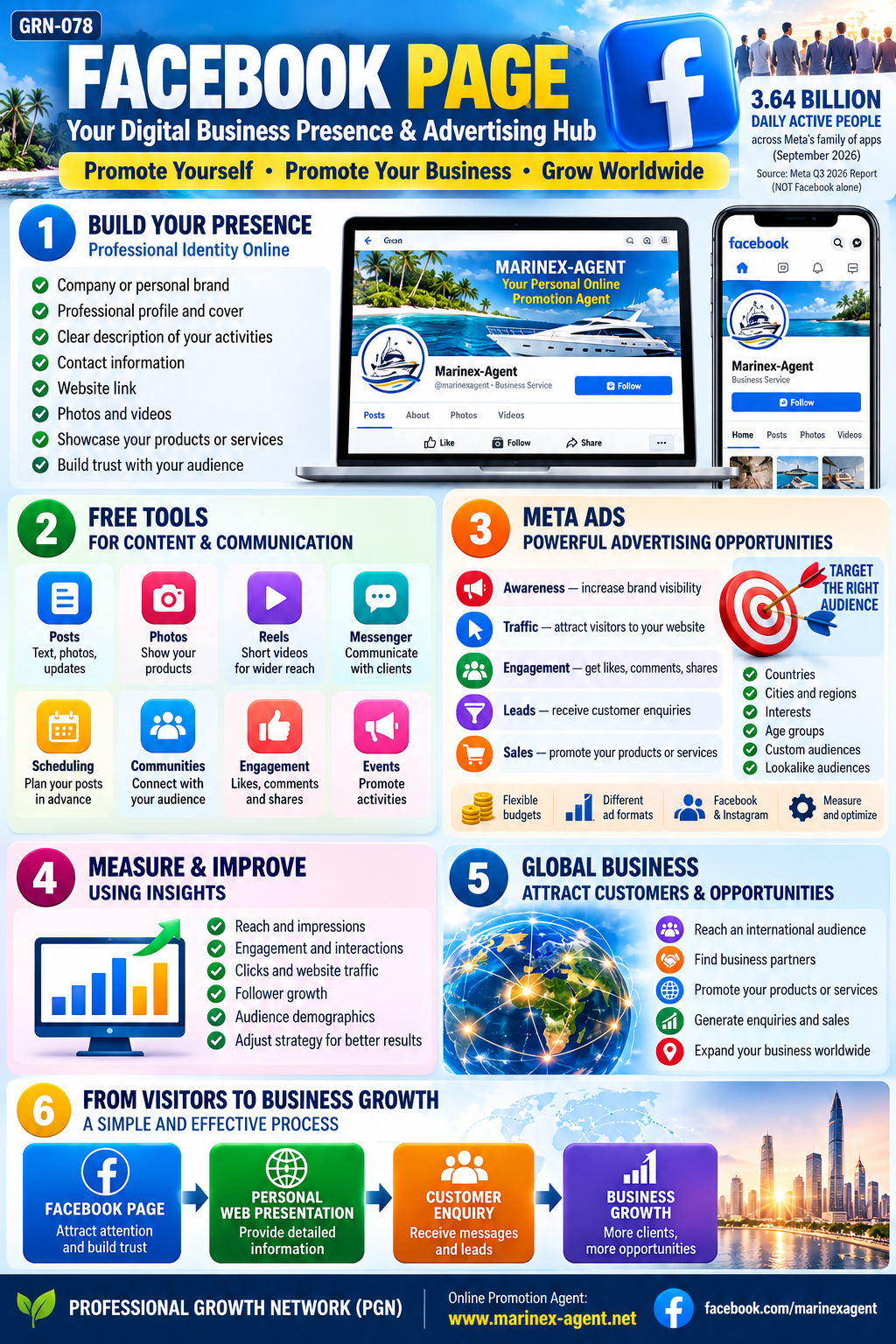
Facebook Page — Benefits, Advertising Opportunities
& Global Business Growth (2026–2027)
Parent Category: PROFESSIONAL GROWTH NETWORK (PGN)
Category: Computer Skills & Digital Literacy / Personal Growth & Self-Development
Article Code: GRN-078
Meta’s Global Reach (September 2026): Meta reported an average of 3.64 billion daily active people across its Family of Apps, including Facebook, Instagram, WhatsApp, and Messenger. This is a combined ecosystem figure, not the number of Facebook-only users.
Источник: Meta — Third Quarter 2026 Results, October 21, 2026
Hub Article — A Complete Guide to Facebook Pages, Meta Advertising, Personal Branding, and International Business Promotion
Introduction
A Facebook Page is much more than a public profile on a social network. It is a powerful digital tool that individuals, entrepreneurs, companies, consultants, and organizations can use to build their professional identity, communicate with customers, promote products and services, and develop international business opportunities.
Facebook is part of Meta’s global ecosystem, which includes Instagram, WhatsApp, Messenger, and other services. Together, these platforms reach billions of people.
For small businesses, a professionally managed Facebook Page can provide a valuable combination of free online visibility, communication tools, targeted advertising, and performance analytics.
The key principle is simple: First, promote yourself. Then, promote your products or services.
This article explores the major advantages of Facebook Pages and explains how to use them as part of a long-term digital promotion strategy.
1. What Is a Facebook Page?
A Facebook Page is a public presence designed for businesses, brands, organizations, public figures, and professional activities.
Unlike a personal Facebook profile, a Page is structured to support public communication and professional promotion.
A Facebook Page may include:
- Business or professional name.
- Company logo or profile image.
- Cover photograph.
- Business description.
- Contact information.
- Official website link.
- Photos, videos, and Reels.
- News and business updates.
- Product and service presentations.
- Customer communication tools.
A Facebook Page can become an important extension of a company’s official website or an individual’s personal web presentation.
2. Major Advantages of a Facebook Page
Free creation
Creating a Facebook Page generally does not require a subscription or an initial advertising investment.
Professional representation
A well-designed Page helps visitors understand who you are, what you do, and how they can contact you.
Public visibility
Public Page information and posts can be discovered by Facebook users, and some content may also appear in external search engines.
Audience development
A Facebook Page allows a business to develop an audience of followers without the personal-profile friend limit.
Direct communication
Customers can contact a business through available messaging and contact options.
Business analytics
Professional tools provide insights into content performance and audience engagement.
Paid advertising
A Facebook Page can serve as a foundation for advertising campaigns using Meta’s professional advertising tools.
International reach
Businesses can present their services to potential customers and partners in different countries.
These advantages make Facebook Pages especially valuable for small and medium-sized enterprises.
3. Building Your Professional Identity Online
One of the most important functions of a Facebook Page is establishing a professional identity.
Potential customers often want answers to several basic questions:
- Who are you?
- What is your professional background?
- What company or organization do you represent?
- What products or services do you offer?
- Where do you operate?
- How can people contact you?
- Do you have an official website?
A professionally developed Facebook Page helps organize this information into a clear public presentation.
For international business, it is particularly useful to connect the Facebook Page to a personal or corporate website.
A Facebook Page introduces your business; a professional website explains it in greater detail.
4. Professional Page Design and Branding
First impressions are important in digital business.
A well-designed Facebook Page should use consistent visual branding and provide accurate information.
Profile Picture
Use a recognizable company logo, brand symbol, or suitable professional photograph.
Cover Photo
Use a high-quality visual that communicates the main purpose of the company or professional activity.
Page Name
Choose a clear and appropriate name that represents the brand or organization.
Business Description
Explain what the business does and who its services are intended for.
Contact Information
Provide relevant contact details and communication channels.
Website Link
Connect the Page to the official website or professional web presentation.
Action Button
Where available, configure an appropriate button that encourages visitors to contact the business, send a message, or visit the website.
Consistent branding across websites, Facebook Pages, and other social platforms makes a business easier to recognize.
5. Free Content Promotion
Facebook Pages allow businesses to publish various types of information without paying for every post.
Examples include:
- Company announcements.
- Product presentations.
- Service descriptions.
- Educational articles.
- Infographics.
- Business news.
- Event announcements.
- Photos and videos.
- Links to relevant website pages.
- Professional advice and practical guides.
However, free publication does not guarantee a large audience.
Organic reach depends on multiple factors, including content relevance, user engagement, and Facebook’s distribution systems.
The objective should be to create content that is genuinely useful to the intended audience.
6. Photos, Videos, Reels, and Infographics
Different forms of content serve different promotional purposes.
Photographs
Useful for presenting products, offices, projects, business meetings, and completed work.
Videos
Useful for product demonstrations, educational explanations, and professional introductions.
Facebook Reels
Short vertical videos can help attract attention and introduce new audiences to a brand.
Infographics
Infographics are particularly valuable for:
- Educational materials.
- Business instructions.
- Technical explanations.
- Product comparisons.
- Statistical summaries.
- Marketing presentations.
- Professional development articles.
For Professional Growth Network (PGN), infographics are an important method of making knowledge accessible, attractive, and easy to share.
7. Meta Business Suite — Professional Page Management
Meta Business Suite is a centralized platform for managing various business activities across Facebook and Instagram.
Depending on account configuration and available features, it can help users:
- Manage Facebook Pages.
- Connect professional Instagram accounts.
- Create and schedule posts.
- Review comments and messages.
- Monitor audience engagement.
- Analyze performance.
- Manage certain business settings.
- Coordinate daily publishing activities.
Main advantage: multiple business communication and content-management tasks can be organized through one interface.
Official website: https://business.facebook.com/
8. Content Scheduling and Publishing Strategy
Regular publication helps maintain an active professional presence.
Meta Business Suite provides scheduling tools for eligible accounts and content formats.
A simple weekly publishing plan might look like this:
| Day | Recommended Content |
|---|---|
| Monday | Educational article |
| Tuesday | Business or service presentation |
| Wednesday | Professional development advice |
| Thursday | Infographic |
| Friday | International networking update |
| Saturday | Practical business tips |
| Sunday | Weekly review or useful resources |
A planned approach helps ensure that Facebook Page activity supports a broader business strategy.
It also reduces the need to prepare every publication at the last minute.
9. Facebook Insights — Understanding Your Audience
Facebook provides professional analytics that help Page administrators evaluate content performance.
Available metrics may include:
- Reach.
- Impressions or views.
- Audience engagement.
- Reactions, comments, and shares.
- Follower development.
- Content performance.
- Certain audience characteristics.
- Website-related actions.
Analytics can answer important business questions:
Which topics attract the most interest?
Which publications generate meaningful interactions?
What types of content encourage visitors to contact the business?
How does audience engagement change over time?
The purpose of analytics is to replace guesswork with measurable information.
10. Meta Ads — Professional Advertising Opportunities
One of the most valuable commercial advantages of a Facebook Page is access to Meta’s advertising ecosystem.
Businesses can promote:
- Their professional identity.
- A company or brand.
- Products and services.
- An online store.
- A personal web presentation.
- Professional consultations.
- Educational programs.
- Business events.
- International networking opportunities.
Depending on the campaign and placement settings, advertising may appear across Facebook, Instagram, Messenger, and other supported Meta placements.
Paid advertising helps businesses reach selected audiences, but advertising expenditure does not guarantee sales or commercial success.
11. Main Meta Advertising Objectives
Meta Ads Manager organizes campaigns around several principal advertising objectives.
| Advertising Objective | Main Purpose |
|---|---|
| Awareness | Increase recognition and visibility |
| Traffic | Attract visitors to a website or other destination |
| Engagement | Encourage interactions and communication |
| Leads | Generate potential customer enquiries |
| App Promotion | Encourage app installations or actions |
| Sales | Drive purchases and other measurable conversions |
For example:
A consultant seeking visitors for a professional website might consider a Traffic campaign.
A company seeking customer enquiries might consider a Leads campaign.
An online retailer may find the Sales objective more suitable.
The correct objective depends on the business’s intended result.
12. Geographic Advertising Targeting
Meta advertising tools allow advertisers to define supported geographic audiences.
Depending on the advertising category and applicable restrictions, targeting options may include:
- Countries.
- Regions.
- Cities.
- Other supported geographic areas.
Business example
A professional service provider based in India wants to introduce services to potential clients in the United Arab Emirates.
Instead of advertising to a global audience, the provider may create a geographically focused campaign for an eligible audience in the UAE.
Main advantage: advertising resources can be concentrated on markets that are relevant to the business.
13. Audience Interests and Characteristics
Meta advertising offers audience-selection and optimization tools.
Depending on the campaign and applicable rules, available parameters may include:
- Geographic location.
- Age ranges.
- Languages.
- Selected interests.
- Certain audience characteristics.
- Previous interactions with a business.
Meta also uses automated systems and machine learning to optimize advertisement delivery.
Some targeting controls may be limited or unavailable for particular regions, audiences, or advertising categories.
The central idea is to reach people who are more likely to be interested in the promoted business.
14. Custom Audiences — Reaching Interested People Again
A Custom Audience can be created from supported sources of customer information or interaction data, subject to Meta’s policies and privacy requirements.
Examples may include:
- People who interacted with a Facebook Page.
- Website visitors tracked through properly configured tools.
- People who engaged with videos.
- Eligible customer contact lists used with appropriate permissions.
Custom Audiences can support remarketing campaigns.
For example, a business may advertise a new service to people who previously visited its website.
All such activities must comply with applicable privacy legislation and Meta’s advertising rules.
15. Lookalike Audiences — Finding New Potential Customers
A Lookalike Audience is designed to help advertisers find new people whose characteristics resemble those of an existing source audience.
For example, a business might use an eligible customer or engagement audience as the basis for identifying similar potential customers.
Availability and controls can vary according to country, account, and campaign settings.
Main advantage: the opportunity to expand beyond an existing customer or follower network.
16. Website Traffic — Connecting Facebook to Your Website
A Facebook Page is especially useful when connected to a professional website.
A typical promotional process may be:
Facebook Advertisement → Personal Web Presentation → Customer Enquiry → Business Communication
The advertisement introduces the service.
The website provides additional information.
The visitor evaluates the offer.
Interested visitors may then contact the company.
A professional website can provide:
- Detailed company information.
- Professional background.
- Product catalogues.
- Service descriptions.
- Business documents.
- Contact details.
- Enquiry forms.
Facebook attracts attention. Your website develops professional credibility and provides the next step toward business cooperation.
17. Lead Generation — Attracting Potential Customers
Lead-generation advertising focuses on encouraging interested people to submit enquiries or take other relevant actions.
Depending on the campaign setup, businesses may use:
- Instant forms.
- Website forms.
- Messaging conversations.
- Other supported lead-generation methods.
Example
A company offers professional web presentation services.
An advertisement invites entrepreneurs to request additional information.
Interested visitors submit enquiries.
The company reviews those enquiries and contacts suitable prospective clients.
The most important metric is not simply the number of leads, but their quality and commercial relevance.
18. Messenger — Direct Business Communication
Messenger can provide a convenient communication channel between businesses and prospective customers.
Potential uses include:
- Answering questions.
- Explaining services.
- Discussing product requirements.
- Sharing website links.
- Providing initial consultations.
- Following up on enquiries.
Some accounts can also configure automated greetings and responses.
Professional communication should be clear, accurate, respectful, and responsive.
Sensitive business and customer information must be handled carefully.
19. WhatsApp Business and Facebook Page
Businesses that use WhatsApp Business may benefit from connecting it with their Facebook presence where supported.
This can make it easier for potential customers to contact them through familiar communication tools.
Example communication process
Facebook Advertisement → WhatsApp Business → Customer Enquiry → Commercial Negotiation
This can be particularly helpful for international trading agents, consultants, and small businesses.
The availability of WhatsApp-related Page features and advertising options depends on region, account eligibility, and configuration.
20. Boost Post — Simplified Advertising
Boost Post provides a relatively simple way to promote an existing eligible Facebook Page publication.
Depending on the available settings, Page administrators can select:
- A promotional goal.
- An audience.
- A budget.
- A campaign duration.
Boosted posts may be suitable for straightforward promotional activities.
However, Meta Ads Manager generally provides more advanced controls for professional advertising.
Recommendation: use boosted posts for simple objectives and Ads Manager when greater campaign control is required.
21. Meta Ads Manager — Advanced Campaign Management
Meta Ads Manager is designed for the professional creation, management, and evaluation of advertising campaigns.
Its campaign structure typically consists of:
Campaign → Ad Set → Ad
Campaign
Defines the principal advertising objective.
Ad Set
Contains relevant settings for audience, placements, budget or scheduling, and optimization, depending on campaign configuration.
Ad
Contains the actual creative material, such as text, images, videos, links, and available calls to action.
This structure supports organized testing, campaign adjustments, and performance measurement.
Official website: https://www.facebook.com/adsmanager/
22. Facebook Advertising Formats
Meta supports several advertising formats, depending on objective, placement, and account eligibility.
Image Ads
Advertisements using a single image.
Video Ads
Advertisements designed around video content.
Carousel Ads
Advertisements containing multiple cards, often used to present different products or features.
Collection Ads
A format for presenting products or content in supported shopping and advertising experiences.
Stories Ads
Vertical advertisements for Stories placements.
Reels Ads
Advertisements appearing in supported short-form video environments.
Different formats should be tested according to the business objective and available creative materials.
23. Advertising Budgets and Cost Management
One advantage of Meta advertising is the ability to control campaign spending.
Depending on the campaign setup, advertisers may use daily or lifetime budgets.
Illustrative testing plan
| Stage | Approach |
|---|---|
| Initial test | Consider a small daily budget, such as $3–5, where permitted |
| Early analysis | Review campaign performance after sufficient data is collected |
| Optimization | Improve targeting, creative content, and landing pages |
| Scaling | Increase expenditure only when business results justify it |
These figures are examples, not universal minimum advertising requirements.
Actual advertising costs vary according to factors such as market competition, campaign objectives, placements, and audience characteristics.
A sensible principle is to test first, measure carefully, and scale only when the results support further investment.
24. Measuring Advertising Performance
The success of an advertising campaign should be evaluated through meaningful performance indicators.
| Metric | Meaning |
|---|---|
| Reach | Number of people reached |
| Impressions | Number of times advertisements are displayed |
| CTR | Click-through rate |
| CPC | Average cost per click |
| CPM | Cost per thousand impressions |
| CPL | Cost per lead |
| Conversions | Tracked target actions |
| ROAS | Return on advertising spend |
For a business, the most important result may be the number of qualified enquiries, actual sales, or profitable customer relationships.
High visibility without commercial relevance does not necessarily represent successful advertising.
25. Facebook Page and Search Engines
Public Facebook Page information may appear in search engine results.
This creates another potential route for people to discover a business.
A Page should therefore include:
- A clear business name.
- An accurate description.
- Relevant professional terminology.
- Contact details.
- An official website link.
- Useful and regularly updated content.
Search visibility is not guaranteed, and a Facebook Page should not be treated as a complete substitute for an independent website.
26. Facebook Page vs. Facebook Group
Facebook Pages and Facebook Groups serve different but complementary purposes.
| Facebook Page | Facebook Group |
|---|---|
| Public business representation | Community interaction |
| Brand promotion | Thematic discussions |
| Advertising tools | Member participation |
| Business communications | Professional networking |
| Performance analytics | Community management |
| Product and service presentations | Knowledge sharing |
An effective strategy can combine a Facebook Page for professional representation with a Facebook Group for building a community.
27. International Business Promotion
Facebook can help businesses introduce themselves to potential customers and partners in other markets.
Indian entrepreneurs
May promote professional services and establish new international contacts.
Chinese manufacturers
May introduce products and increase brand visibility abroad.
Ukrainian professionals
May develop an international presence for consulting, technical, or other services.
African trading agents
May present their professional activities and seek suppliers, buyers, and partners.
International advertising must comply with applicable laws, platform requirements, and market-specific restrictions.
A professional presentation increases the chances of being taken seriously, but does not replace due diligence or the verification of business partners.
28. Facebook Page and the Personal Online Promotion Agent Concept
The Marinex-Agent model is built around a straightforward principle:
First, Promote Yourself. Then, Promote Your Products or Services.
Before promoting somebody else’s goods or business opportunities, an individual should establish a credible professional presence online.
Our proposed promotional structure includes:
Step 1 — Personal Web Presentation
Build a professional online presentation that explains who you are and what you do.
Step 2 — Facebook Page
Develop a public professional identity and distribute useful content.
Step 3 — Meta Advertising
Use carefully selected advertising campaigns to attract relevant audiences.
Step 4 — Business Communication
Communicate with interested people through suitable channels.
Step 5 — Business Development
Transform qualified enquiries into professional relationships and potential commercial opportunities.
A Facebook Page should support your personal business identity rather than replace it.
29. Facebook Page and Professional Growth Network (PGN)
Professional Growth Network (PGN) focuses on knowledge, personal development, entrepreneurship, international cooperation, and professional networking.
Facebook Pages can help PGN:
- Present its educational mission.
- Share valuable articles.
- Promote Hub Articles and Supporting Articles.
- Publish professional infographics.
- Introduce new educational topics.
- Attract interested readers.
- Expand international professional connections.
- Direct visitors to the Marinex-Agent knowledge library.
Our integrated approach:
Marinex-Agent Blog → Facebook Page → Facebook Group → International Networking
The blog serves as a structured knowledge library.
The Facebook Page provides professional public visibility.
The Facebook Group supports discussions and community interaction.
International networking creates opportunities for professional and commercial cooperation.
30. Can You Make Money with a Facebook Page?
A Facebook Page can support several legitimate income-generating activities.
Selling Products
Attract potential customers for physical or digital goods.
Selling Professional Services
Promote consulting, design, education, marketing, and other services.
Affiliate Marketing
Earn commissions through eligible partner programs.
Advertising Services
Provide advertising and campaign-management services to clients.
Sponsored Content
Work with brands on properly disclosed commercial collaborations.
Content Monetization
Eligible creators may be able to participate in Meta’s available content monetization programs, subject to applicable rules and invitations or eligibility requirements.
Business Development
Use the Page to attract enquiries and develop customer relationships.
Important: creating a Facebook Page does not automatically generate income. Financial results depend on the business model, the quality of the offer, audience demand, and actual performance.
31. Common Mistakes to Avoid
Mistake 1 — Incomplete Page Information
An unfinished Page can appear unprofessional.
Mistake 2 — Publishing Only Advertisements
Audiences generally benefit from a mix of useful information and promotional material.
Mistake 3 — Depending Entirely on Facebook
A business should maintain its own website and appropriate independent communication channels.
Mistake 4 — Poor Audience Selection
Advertising to an unsuitable audience may waste money.
Mistake 5 — Ignoring Analytics
Without measurement, campaign optimization becomes difficult.
Mistake 6 — Irregular Activity
Long periods of inactivity may reduce opportunities for audience engagement.
Mistake 7 — Misleading Claims
Inaccurate advertising, copyright infringement, and deceptive commercial messages can damage reputation and lead to account restrictions.
32. Facebook Page Security and Administration
A professional Facebook Page is a valuable digital business asset.
Recommended protective measures include:
- Using strong, unique passwords.
- Enabling two-factor authentication.
- Reviewing access permissions.
- Assigning appropriate administrative roles.
- Avoiding unnecessary sharing of credentials.
- Checking suspicious messages and links.
- Following Meta’s security and advertising policies.
- Protecting confidential business and customer information.
Businesses should periodically review who has access to their Facebook Page and associated advertising accounts.
33. Practical Facebook Page Development Plan
Stage 1 — Create the Page
Select a suitable name and business category.
Stage 2 — Complete the Profile
Add a logo, cover image, description, website, and contact details.
Stage 3 — Prepare Initial Content
Publish approximately 5–10 useful and relevant posts.
Stage 4 — Connect Your Website
Provide visitors with access to a detailed professional presentation.
Stage 5 — Develop Organic Activity
Share useful information and communicate with interested users.
Stage 6 — Test Advertising
Launch a small campaign with a clearly defined objective and appropriate budget.
Stage 7 — Measure Results
Review enquiries, conversions, advertising expenses, and customer quality.
Stage 8 — Improve and Expand
Refine the promotional strategy based on measured business outcomes.
34. Facebook Page as a Long-Term Business Asset
A Facebook Page is most valuable when treated as part of a long-term business development strategy.
Over time, it can help build:
- Professional identity.
- Brand recognition.
- A history of useful publications.
- A community of interested followers.
- Business communication channels.
- Customer relationships.
- Additional sources of enquiries.
- International visibility.
Its greatest value comes from being connected to a broader infrastructure that includes a professional website, email, messaging tools, educational materials, and reliable business processes.
Conclusion
A Facebook Page is much more than a social media profile. It is a practical instrument for professional representation, digital advertising, customer communication, and international business development.
For individuals and small enterprises, its major advantage is the opportunity to establish a public online presence without a substantial initial financial investment.
When combined with Meta Business Suite, Ads Manager, website promotion, and performance analytics, it can become a valuable component of a structured business strategy.
However, success does not depend on advertising alone. It requires clear professional positioning, useful content, reliable products or services, and ongoing customer trust.
For Professional Growth Network and Marinex-Agent, the guiding principle remains:
FIRST, PROMOTE YOURSELF. THEN, PROMOTE YOUR PRODUCTS OR SERVICES.
Facebook Page • Personal Web Presentation • Meta Advertising • International Networking
Research Once • Organize Knowledge • Find Anytime • Use Repeatedly
PROFESSIONAL GROWTH NETWORK (PGN)
Online Promotion Agent: www.marinex-agent.net
Facebook: https://www.facebook.com/marinexagent
Article Code: GRN-078
Official Information Resources
- Meta Business Suite: https://business.facebook.com/
- Meta Ads Manager: https://www.facebook.com/adsmanager/
- Meta Advertising: https://www.facebook.com/business/ads
- Meta Advertising Standards: https://transparency.meta.com/policies/ad-standards/
- Meta Blueprint: https://www.facebook.com/business/learn
Note: Meta’s tools, advertising controls, eligibility rules, and monetization programs may change over time and vary by country and account.