
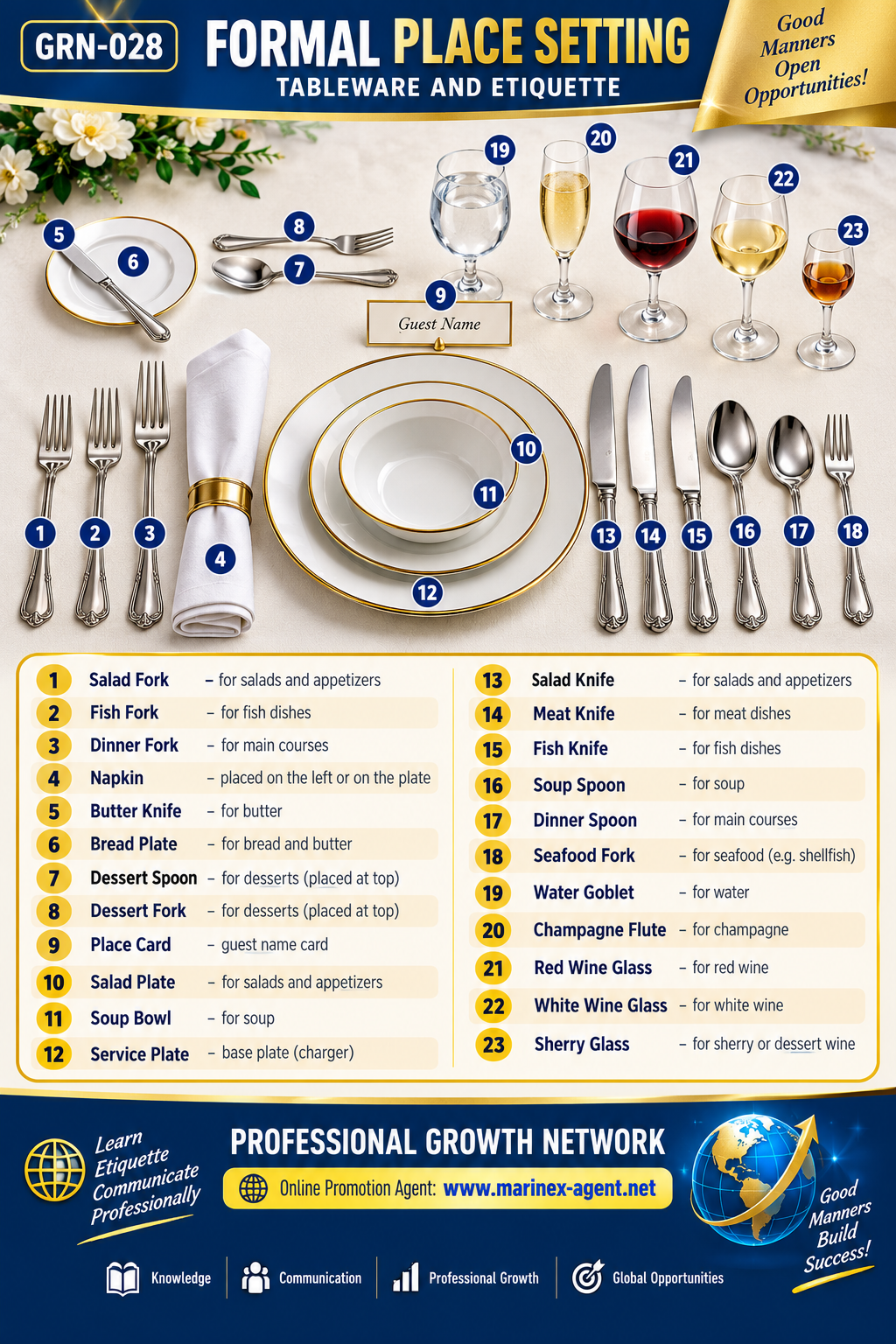
FORMAL PLACE SETTING:
TABLEWARE AND ETIQUETTE
Category: PROFESSIONAL GROWTH NETWORK
Article Code: GRN-028
Good Manners Open Opportunities!
Introduction
Formal dining etiquette is an important part of professional communication, international hospitality, business meetings, and social relationships.
Knowing how to arrange and use tableware demonstrates cultural awareness, confidence, respect for others, and attention to detail.
Formal table settings are commonly associated with diplomatic receptions, business dinners, luxury hotels, restaurants, cruise ships, and special events.
The GRN-028 infographic illustrates 23 essential elements of a formal place setting, including cutlery, plates, glasses, a napkin, and a guest place card.
1. Forks — Left Side of the Place Setting
Forks are traditionally positioned to the left of the main plate. Their arrangement generally follows the sequence of courses, with utensils used first placed farthest from the plate.
1. Salad Fork
The salad fork is used for salads and certain appetizers.
It is usually smaller than the main dinner fork and may be positioned on the outside when the salad is served before the main course.
2. Fish Fork
The fish fork is designed for fish dishes.
Its shape can make it easier to separate delicate fish flesh from the bones.
3. Dinner Fork
The dinner fork is used for the main course, including meat, poultry, vegetables, and other principal dishes.
It is generally the largest fork in the setting and is placed closest to the plate.
2. Napkin and Bread Service
4. Napkin
The napkin is an essential part of a formal dining arrangement.
It may be placed to the left of the forks or on the main plate.
After being seated, guests normally place the napkin on their lap.
During the meal, it is used discreetly to dab the lips rather than wipe the face.
5. Butter Knife
The butter knife is placed on the bread plate.
It is used for spreading butter or similar accompaniments onto bread.
6. Bread Plate
The bread plate is positioned above the forks, to the upper left of the main place setting.
It is used for bread rolls, slices of bread, and butter.
3. Dessert Cutlery and Guest Identification
7. Dessert Spoon
The dessert spoon is used for desserts such as pudding, mousse, ice cream, and other soft dishes.
In a formal setting, it may be placed horizontally above the main plate.
8. Dessert Fork
The dessert fork is designed for cakes, pastries, and other desserts.
It may be arranged horizontally above the plate together with the dessert spoon.
9. Place Card
The place card identifies the guest’s assigned seat.
It is particularly useful during official receptions, diplomatic events, weddings, and business dinners.
Place cards help organizers manage seating arrangements and introduce guests according to the event’s protocol.
4. Plates and Bowls
10. Salad Plate
The salad plate is smaller than the main dinner plate.
It is used for salads, appetizers, and lighter courses.
Depending on the menu and service style, it may be placed on top of the service plate or brought to the table separately.
11. Soup Bowl
The soup bowl is used for serving soup and certain liquid dishes.
In formal dining, it may be positioned on an appropriate underplate or service plate.
12. Service Plate (Charger)
The service plate, also known as a charger, is the large decorative plate placed at the center of the setting.
It serves as a base for other dishes and contributes to the formal appearance of the table.
The charger is generally not used for eating directly.
Its removal depends on the restaurant’s service procedure and the sequence of courses.
5. Knives and Spoons — Right Side of the Place Setting
Knives and spoons are generally placed to the right of the main plate.
Knife blades traditionally face inward, toward the plate.
13. Salad Knife
The salad knife is used for salads and appetizers that require cutting.
It is usually smaller than the main dinner knife.
14. Meat Knife
The meat knife, or dinner knife, is used for the main course.
It is designed for cutting meat and other substantial foods.
15. Fish Knife
The fish knife has a distinctive shape suitable for separating fish flesh and assisting with fish dishes.
Unlike a conventional meat knife, it is not primarily designed for cutting through tough food.
16. Soup Spoon
The soup spoon is used for consuming soup and similar liquid dishes.
Its bowl is generally rounded or oval, depending on the design.
17. Dinner Spoon
The dinner spoon is used for certain main-course dishes, sauces, and foods that require a larger spoon.
Its presence depends on the menu and the type of service.
18. Seafood Fork
The seafood fork is a small specialized utensil used for certain seafood dishes, particularly shellfish.
It may be placed to the right of the main setting when required by the menu.
6. Glassware — Upper Right Side
Glasses are normally arranged above the knives, toward the upper right of the place setting.
The number and types of glasses depend on the beverages offered during the meal.
19. Water Goblet
The water goblet is used for serving drinking water.
It is commonly the largest glass in the arrangement and is generally placed above the main knife.
20. Champagne Flute
The champagne flute is a tall, narrow glass traditionally used for champagne and other sparkling wines.
Its shape helps preserve carbonation and presents the beverage elegantly.
Other glass styles may also be used for sparkling wine.
21. Red Wine Glass
The red wine glass typically has a relatively large bowl.
Its design provides space for the wine’s aromas to develop.
Different shapes may be selected depending on the type of red wine.
22. White Wine Glass
The white wine glass is often smaller and narrower than the red wine glass.
It is designed to suit the serving characteristics of white wines.
23. Sherry Glass
The sherry glass is a smaller glass traditionally used for fortified wines such as sherry.
It may also be used for certain aperitifs or dessert wines, depending on the establishment’s service standards.
7. Essential Rules of Formal Dining Etiquette
Understanding tableware is only one part of formal dining. Professional behavior at the table is equally important.
Use Cutlery from the Outside In
Begin with the utensils farthest from the plate and move inward as each course is served.
This arrangement generally corresponds to the planned menu.
Follow the Host
At formal business dinners or official receptions, guests should observe the host’s lead when beginning the meal.
Maintain Good Posture
Sit comfortably and upright, avoiding unnecessary leaning over the table.
Use the Napkin Correctly
Place the napkin on your lap and use it discreetly during the meal.
Avoid Unnecessary Distractions
Keep mobile phones silent and avoid checking messages during important conversations.
Communicate Respectfully
Listen attentively, speak politely, and avoid interrupting other guests.
Respect Cultural Differences
Dining customs vary between countries, cultures, and establishments.
Professional etiquette requires awareness, flexibility, and respect for local traditions.
8. Formal Dining in International Business and Hospitality
Knowledge of formal dining etiquette is particularly valuable for professionals working in international environments.
Examples include:
- International business representatives and entrepreneurs.
- Diplomatic and government personnel.
- Hotel and restaurant managers.
- Cruise ship hospitality personnel.
- Yacht stewards and stewardesses.
- Catering and event management specialists.
- Sales representatives and business consultants.
For maritime hospitality professionals, understanding table settings and table service can be especially important when working aboard cruise ships, luxury yachts, and passenger vessels.
Professional service requires not only knowledge of utensils but also communication skills, attention to detail, and an understanding of guest expectations.
9. Practical Recommendations
For individuals wishing to improve their formal dining skills, the following approach can be useful:
- Study the names and functions of standard tableware.
- Practice arranging a formal place setting.
- Learn the correct sequence for using cutlery.
- Become familiar with different types of glasses.
- Observe professional restaurant service.
- Develop polite table conversation skills.
- Respect international cultural differences.
Regular practice helps develop confidence and makes formal dining situations more comfortable.
Conclusion
Formal dining etiquette is more than knowing where to place forks, knives, spoons, and glasses.
It reflects professionalism, respect, cultural awareness, and the ability to communicate confidently in different social and business environments.
The GRN-028 Formal Place Setting infographic provides a practical visual guide to 23 common elements of traditional formal table service.
Not every formal meal requires all 23 items. The actual arrangement depends on the menu, service style, and local customs.
By developing knowledge of dining etiquette, individuals can improve their professional presentation, strengthen interpersonal relationships, and participate more confidently in international business and hospitality events.
Good Manners Open Opportunities!
PROFESSIONAL GROWTH NETWORK
Online Promotion Agent: www.marinex-agent.net