
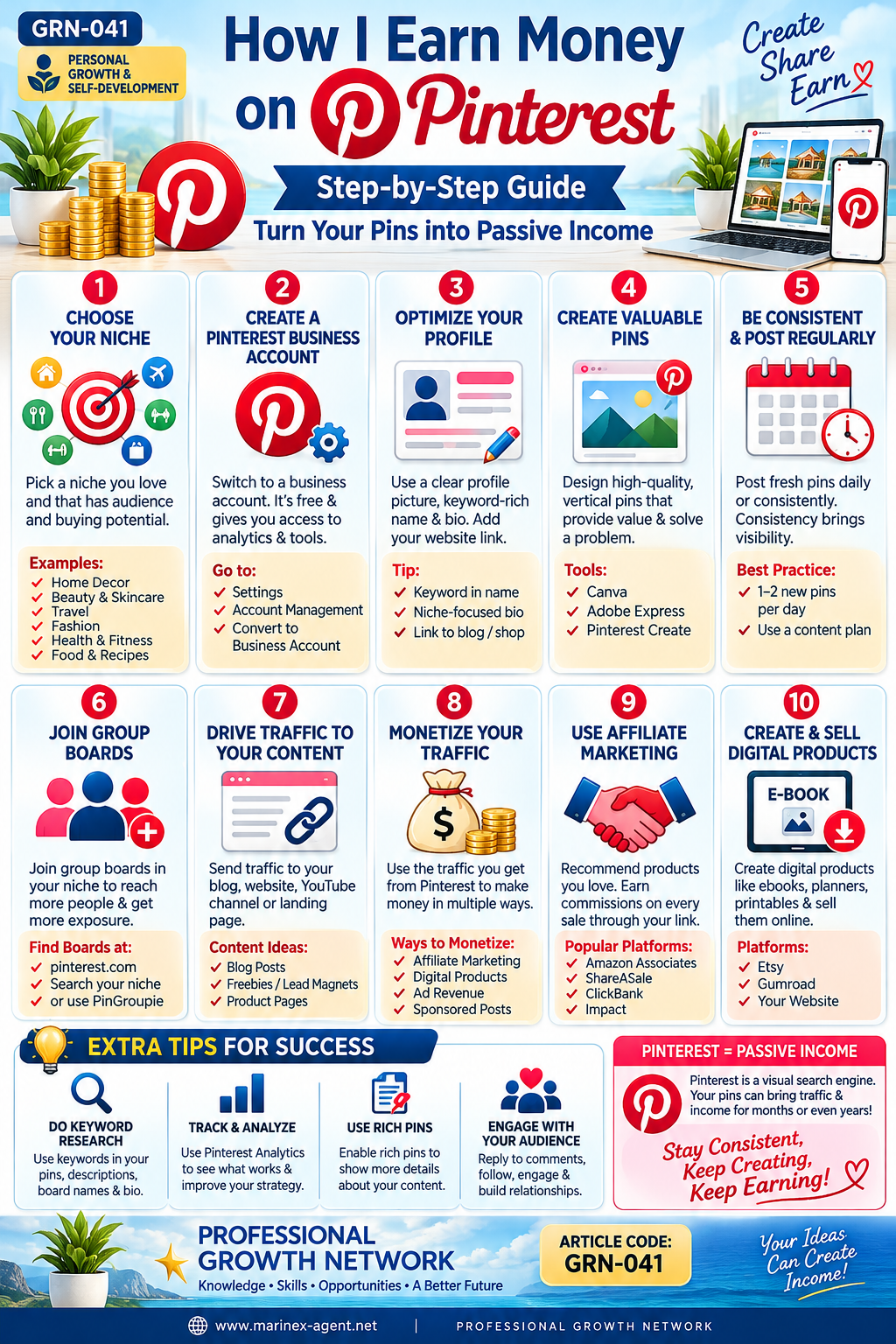
HOW TO EARN MONEY ON PINTEREST:
A STEP-BY-STEP GUIDE
Parent Category: PROFESSIONAL GROWTH NETWORK
Category: Personal Growth & Self-Development
Article Code: GRN-041
TURN YOUR PINS INTO INCOME OPPORTUNITIES
Create • Share • Promote • Grow
Introduction — Pinterest Is More Than a Social Media Platform
Millions of people use Pinterest to discover ideas, products, services, educational materials, and inspiration for their everyday lives.
However, Pinterest is more than a collection of attractive pictures. It is also a visual discovery and search platform that can help entrepreneurs, content creators, bloggers, and small business owners attract visitors to their websites and develop new income opportunities.
Unlike social media platforms where content often disappears quickly from users’ feeds, useful Pinterest Pins can continue attracting attention over extended periods.
This creates opportunities to develop long-term website traffic, promote products, introduce professional services, and generate revenue through several business models.
The basic principle is simple:
Create Valuable Content → Attract Interested Visitors → Direct Traffic → Offer Products or Services → Generate Potential Income
This guide explains ten practical steps for building a Pinterest-based promotional and monetization strategy.
Importantly, Pinterest does not automatically pay users simply for publishing Pins. Income generally comes from activities such as product sales, affiliate commissions, advertising on external websites, sponsorships, and digital product sales.
Success requires planning, consistent work, valuable content, and a suitable monetization strategy.
1. Choose Your Niche — Build Your Business Around a Clear Topic
Your first step is to select a specific subject or business area that interests you and has an identifiable audience.
A niche is a particular segment of the market with shared interests, needs, or purchasing intentions.
Examples of Popular Pinterest Niches
- Home Decor and Interior Design.
- Beauty and Skincare.
- Travel and Tourism.
- Fashion and Accessories.
- Health and Fitness.
- Food and Recipes.
- Education and Professional Skills.
- Business Development and Entrepreneurship.
- Digital Marketing and Online Promotion.
- Personal Growth and Self-Development.
For example, someone interested in home decoration could create Pins about furniture arrangements, lighting, interior colors, and affordable decorating ideas.
These Pins could direct visitors to a website containing detailed articles, product recommendations, or an online store.
How to Choose the Right Niche
Consider three important questions:
- Do I have knowledge or genuine interest in this subject?
- Are people actively searching for information about it?
- Can I eventually offer useful products, services, or recommendations?
A good niche should combine personal interest, audience demand, and realistic commercial opportunities.
Key Principle: Focus on a specific audience before attempting to reach everyone.
2. Create a Pinterest Business Account
A Pinterest Business Account provides features designed for professional content creators and businesses.
These include access to analytics, advertising tools, and business-related account features.
You can create a business account or convert an eligible personal account into a business account.
Why a Business Account Matters
A business account helps you:
- Present your brand professionally.
- Monitor the performance of your Pins.
- Understand audience engagement.
- Measure outbound clicks.
- Develop promotional campaigns.
- Connect your Pinterest activity with your website or online business.
Practical Example
A textile supplier could establish a Pinterest Business Account dedicated to:
Home Textiles • Hotel Textiles • Hospital Textiles
The account could contain separate boards for bed linen, towels, hospitality textiles, and product collections.
Each Pin could direct interested visitors to a relevant product page or professional business presentation.
Key Principle: Treat Pinterest as a professional marketing channel rather than simply a collection of images.
3. Optimize Your Pinterest Profile
Your Pinterest profile is an important part of your online business identity.
Before following your links, potential customers may want to understand who you are, what you offer, and whether your content is relevant to their interests.
Essential Profile Elements
Profile Picture: Use a clear personal photograph or recognizable business logo.
Account Name: Include your personal or business name and, where appropriate, a relevant keyword.
Biography: Explain what you do and whom you help.
Website Link: Add a link to your website, blog, online store, or professional business presentation.
Relevant Boards: Organize your content into clearly named subject categories.
Example of a Professional Profile
Account Name: Alex — Online Business Promotion
Description: Helping entrepreneurs and small businesses improve their professional web presence, digital visibility, and international business promotion.
Website: www.marinex-agent.net
This approach helps visitors understand the purpose of the account immediately.
Why Your Website Matters
A Pinterest account can introduce your content to new audiences, but your own website gives you greater control over how your business is presented.
This is particularly important for professional services, international trading, consulting, and personal branding.
Key Principle: Your Pinterest profile should lead visitors toward a clear professional destination.
4. Create Valuable Pins — Give People a Reason to Click
Pins are the central content format used for discovery on Pinterest.
Successful Pins usually communicate a clear idea, provide inspiration, answer a question, or help users solve a problem.
What Makes a Useful Pin?
An effective Pin should have:
- A clear and attractive visual design.
- A specific subject or message.
- Readable text where appropriate.
- Relevant keywords in its title and description.
- A destination link that matches the Pin’s promise.
- Genuine value for the intended audience.
Vertical graphics are often useful because they display well in Pinterest’s visual feed.
A commonly used design format is a 2:3 aspect ratio, such as 1000 × 1500 pixels.
Tools for Creating Pins
Examples include:
- Canva.
- Adobe Express.
- Pinterest’s available creation tools.
- Other graphic design and image editing applications.
Practical Example
Suppose you publish an article titled:
10 High-Income Skills That Will Still Make Money in 2030
You could create several Pins featuring different aspects of the article:
- Ten Skills for the Future.
- Why AI Literacy Matters.
- How to Learn Digital Marketing.
- Skills That Support Online Business.
- Your Professional Development Roadmap.
Each Pin would link to the corresponding article.
This allows one article to support several distinct promotional messages.
Key Principle: Create Pins that provide value before asking visitors to buy something.
5. Be Consistent — Publish Content Regularly
Consistency is one of the most important habits in long-term content marketing.
A Pinterest account with useful, regularly updated content has more opportunities to attract visitors than an inactive account.
However, publishing large quantities of repetitive or low-quality Pins is not an effective substitute for genuine value.
A Practical Publishing Schedule
For beginners, a manageable starting plan might be:
- Create one or two original Pins on days when you publish.
- Maintain a weekly content calendar.
- Reuse your best articles as inspiration for new, genuinely different Pin designs.
- Review performance regularly.
- Adjust your publishing schedule according to results.
One or two Pins per day is an optional working routine, not a guaranteed formula or an official Pinterest requirement.
Example of a Weekly Content Plan
| Day | Content Topic |
|---|---|
| Monday | Professional Growth |
| Tuesday | Digital Marketing |
| Wednesday | Business Skills |
| Thursday | Online Income Ideas |
| Friday | Personal Branding |
| Saturday | Practical Tutorials |
| Sunday | Review and Planning |
The schedule can be adapted to your audience and available time.
Key Principle: Consistent quality is more valuable than uncontrolled quantity.
6. Join Relevant Group Boards and Professional Communities
Pinterest group boards allow multiple authorized contributors to add Pins to a shared board.
Where relevant and actively maintained, they may provide an additional opportunity to share content with people interested in a particular subject.
How to Use Group Boards
- Search for boards relevant to your niche.
- Check whether they accept contributors.
- Review their content and participation rules.
- Share genuinely relevant Pins.
- Avoid repetitive promotional posting.
Group boards should be treated as an optional promotional channel rather than a guaranteed traffic source.
Beyond Group Boards
You can also promote your Pinterest content through:
- Facebook business communities.
- LinkedIn professional networks.
- Your own website.
- Relevant blogs.
- Email newsletters.
- Business associations and professional groups.
A coordinated promotional strategy can connect multiple channels to the same professional web presence.
Key Principle: Build meaningful connections rather than simply distributing advertisements.
7. Drive Pinterest Traffic to Your Own Content
One of Pinterest’s most useful business applications is directing interested visitors to external destinations.
These may include:
- Professional websites.
- Business blogs.
- Product catalogues.
- Online stores.
- Educational resources.
- Landing pages.
- Service presentations.
The Traffic Development Process
Pinterest Pin → Interested Visitor → Website or Blog → Useful Information → Business Opportunity
For example, a Pin about international textile products could direct a visitor to a supplier’s website containing product photographs, specifications, and contact information.
Similarly, a Pin about digital marketing could direct visitors to an educational article about online business promotion.
Match the Pin to the Destination
If a Pin promises a guide to business planning, its link should lead to that guide or a closely related resource.
Sending visitors to unrelated sales pages may reduce trust and damage the effectiveness of your promotional activity.
Why Website Traffic Is Valuable
Relevant visitors may:
- Read additional articles.
- Subscribe to a newsletter.
- Explore products.
- Request a quotation.
- Contact a service provider.
- Purchase a digital product.
- Return for future information.
Not every visitor becomes a customer, but useful content can support long-term business relationships.
Key Principle: Pinterest attracts attention; your website turns that attention into a professional relationship.
8. Monetize Your Traffic — Turn Attention Into Business Opportunities
Pinterest itself is not a guaranteed source of direct income.
Instead, it can help attract visitors to businesses and platforms where revenue is generated.
Main Monetization Methods
Affiliate Marketing
Recommend relevant products through permitted affiliate arrangements and earn commissions on qualifying transactions.
Digital Product Sales
Sell ebooks, templates, educational materials, planners, and other digital resources.
Advertising Revenue
A website or blog may earn advertising revenue when it meets the requirements of an advertising network.
Sponsored Content
Brands may pay eligible creators for agreed promotional content, subject to disclosure requirements and platform policies.
Professional Services
Pinterest can also help introduce consulting, design, training, marketing, and other professional services.
Example of a Revenue Model
Imagine that a business blog receives 5,000 visits from Pinterest during one month.
If 1% of those visitors purchase a $20 digital product:
5,000 × 1% = 50 purchases
50 × $20 = $1,000 in gross sales
This is a hypothetical calculation, not an earnings forecast. Actual conversion rates, traffic, costs, refunds, fees, and profitability may differ significantly.
The example illustrates how website traffic and a suitable product can potentially create revenue.
Key Principle: Traffic becomes commercially valuable when it connects with a relevant product or service.
9. Use Affiliate Marketing — Earn Commissions Through Recommendations
Affiliate marketing is a business model in which an individual promotes another company’s products or services and may earn a commission from qualifying purchases or other specified actions.
How Affiliate Marketing Works
- Join an appropriate affiliate program.
- Select products relevant to your audience.
- Create useful content about those products.
- Include properly disclosed affiliate links where permitted.
- Earn a commission when the program’s qualifying conditions are met.
Examples of Affiliate Networks and Programs
- Amazon Associates.
- ShareASale and related affiliate network services.
- ClickBank.
- Impact.
Availability, eligibility, commission rates, and promotional rules depend on the specific program and country.
Practical Example
A travel blogger could publish an article about essential travel accessories.
Pinterest Pins might introduce:
- Packing organizers.
- Travel bags.
- Portable chargers.
- Travel planning tools.
Visitors could follow a Pin to the article and explore the recommended products.
If an eligible visitor completes a qualifying purchase, the blogger may earn an affiliate commission.
Important Professional Rules
Always:
- Recommend products that are genuinely relevant.
- Disclose commercial relationships clearly.
- Follow the affiliate program’s rules.
- Follow Pinterest’s current policies.
- Avoid misleading claims and artificial engagement.
Key Principle: Sustainable affiliate marketing depends on credibility, relevance, and transparency.
10. Create and Sell Digital Products
Digital products are particularly interesting for individuals who possess useful knowledge, experience, or professional skills.
Unlike physical goods, many digital products can be delivered electronically without manufacturing or shipping each individual copy.
Examples of Digital Products
- Ebooks.
- Business planning templates.
- Printable planners.
- Educational guides.
- Digital worksheets.
- Design templates.
- Professional checklists.
- Training materials.
- Specialized reference documents.
Platforms for Selling Digital Products
Examples include:
- Etsy.
- Gumroad.
- Your own website or online store.
Each platform has its own fees, eligibility requirements, and policies.
Practical Example — Professional Knowledge
A maritime professional with extensive industry experience could create educational resources about:
- Maritime careers.
- Seafarers’ documentation.
- Professional development.
- Maritime terminology.
- International employment preparation.
Pinterest could help interested readers discover these resources and visit a website where they are explained or sold.
The same approach can be applied to hospitality, engineering, language learning, business management, and many other professional subjects.
The Value of Knowledge
Knowledge becomes commercially useful when it is organized into something that helps other people solve a problem.
Professional Experience → Useful Knowledge → Digital Resource → Online Promotion → Potential Revenue
Key Principle: You do not necessarily need a physical product to develop an online business.
11. Five Extra Tips for Pinterest Success
In addition to the ten main steps, several practical techniques can help improve the quality of your Pinterest strategy.
11.1. Conduct Keyword Research
Pinterest users often search for specific topics, products, and ideas.
Relevant keywords help describe your content and make it easier for the appropriate audience to discover.
Include natural keywords in:
- Your profile description.
- Board titles.
- Pin titles.
- Pin descriptions.
- Relevant website content.
Avoid keyword stuffing or misleading descriptions.
11.2. Track and Analyze Performance
Use Pinterest Analytics to understand how your content performs.
Important measurements may include:
- Impressions.
- Pin saves.
- Outbound clicks.
- Engagement.
- Audience interests.
These figures can help you understand which subjects attract attention and which Pins encourage visitors to explore your website.
11.3. Use Rich Pins Where Appropriate
Rich Pins can display additional information from eligible website content.
Their availability and implementation depend on Pinterest’s supported formats and technical requirements.
Where applicable, they can help provide more context about linked content.
11.4. Focus on Value
People use Pinterest to find inspiration, information, and solutions.
Your content should answer real questions, solve problems, or introduce useful opportunities.
Avoid creating Pins whose only purpose is to demand a purchase.
11.5. Engage With Your Audience
Respond professionally to relevant comments and inquiries.
Pay attention to questions that may inspire new articles, products, or services.
Meaningful communication helps build credibility and long-term professional relationships.
12. Pinterest and the Concept of Passive Income
The expression passive income is widely used in online business discussions.
However, it is important to understand what it actually means.
Pinterest can help generate traffic from previously published content, sometimes over an extended period.
For example, a useful Pin created several months earlier may continue bringing visitors to an article or product page.
Nevertheless, this does not mean that income is automatic or that no further work is required.
Successful Pinterest-based business activities may require:
- Research.
- Content creation.
- Website maintenance.
- Search optimization.
- Customer service.
- Product updates.
- Performance analysis.
- Compliance with advertising and affiliate rules.
A more accurate description is that Pinterest may help create long-term, reusable sources of online traffic.
That traffic can support income when combined with effective products, services, and business systems.
Key Principle: Build useful digital assets that can continue working for your business over time.
13. How Pinterest Can Support International Business
Pinterest is not limited to individual bloggers or lifestyle content creators.
It can also be useful for entrepreneurs and companies seeking greater visibility.
Example — Home, Hotel, and Hospital Textiles
A textile supplier could organize Pinterest boards around:
Home Textiles
- Bed linen.
- Towels.
- Curtains.
- Decorative fabrics.
Hotel Textiles
- Hotel bedding.
- Bath towels.
- Hospitality linen.
- Guest room textiles.
Hospital Textiles
- Hospital bed linen.
- Patient textiles.
- Institutional textile products.
- Healthcare facility linen.
Each Pin could connect to a professional product presentation with specifications, photographs, company details, and a business inquiry form.
Pinterest would not replace professional sales negotiations or international trade procedures.
However, it could serve as an additional channel through which potential customers discover the supplier’s products.
The Importance of Professional Presentation
International buyers often need clear information before initiating business discussions.
A professional website can help present:
- Company identity.
- Product categories.
- Technical specifications.
- Available photographs.
- Contact details.
- Commercial inquiry procedures.
This illustrates the importance of connecting online promotion with a credible professional business identity.
14. Your Full Style — From Pinterest to Professional Web Presence
At Marinex-Agent, we promote a simple principle:
FIRST PROMOTE YOURSELF — THEN PROMOTE THE PRODUCTS AND SERVICES YOU REPRESENT.
Before expecting customers to trust your business proposals, you should make it easy for them to understand who you are and how to contact you.
Our professional promotion concept is based on three connected elements:
Premium Business Card → Mini-Web Presence → Personal Online Promotion Agent
Premium Business Card
A concise and professional presentation of your identity, business activities, and contact information.
Mini-Web Presence
A dedicated online presentation featuring your professional profile, business services, products, photographs, and commercial proposals.
Personal Online Promotion Agent
An additional promotional service designed to help improve your professional online visibility.
How Pinterest Fits Into This System
Pinterest Pin → Mini-Web Presence → Professional Business Presentation → Direct Customer Contact
For example, a small business owner can create Pins about products or services and direct visitors to a Mini-Web Presence.
The visitor can then review the business presentation and decide whether to make contact.
This connects visual promotion with a more complete professional identity.
15. A Practical 30-Day Pinterest Development Plan
For beginners, a structured first month can provide a useful starting point.
Week 1 — Preparation
- Select your niche.
- Identify your target audience.
- Create or optimize your Pinterest Business Account.
- Prepare your profile.
- Connect your website or professional business presentation.
- Research relevant keywords.
Week 2 — Content Development
- Identify five to ten useful content topics.
- Prepare articles, product pages, or landing pages.
- Create original Pin designs.
- Organize your Pinterest boards.
- Establish a realistic publishing schedule.
Week 3 — Promotion
- Publish Pins consistently.
- Connect Pins to relevant destination pages.
- Test different headlines and visual designs.
- Share suitable content through other professional channels.
- Review initial engagement.
Week 4 — Analysis and Improvement
- Examine Pinterest Analytics.
- Identify which Pins attract outbound clicks.
- Improve weak descriptions or destination pages.
- Develop additional content around promising subjects.
- Prepare your next monthly content plan.
Thirty days may be enough to establish a basic workflow, but it is not a reliable period for predicting traffic or income.
Key Principle: Use the first month to build a repeatable system, not to chase unrealistic earnings promises.
16. Common Mistakes to Avoid
Beginners sometimes expect Pinterest to generate immediate income.
Other common mistakes include:
- Publishing Pins without a clear target audience.
- Using attractive images without useful content.
- Linking Pins to unrelated websites.
- Promoting products without understanding customer needs.
- Ignoring analytics.
- Creating repetitive or misleading content.
- Failing to disclose affiliate relationships.
- Depending entirely on one digital platform.
- Expecting guaranteed passive income.
- Neglecting their own professional website or business identity.
A sustainable approach combines useful content, ethical promotion, a clear business model, and continuous learning.
17. The Role of PROFESSIONAL GROWTH NETWORK
PROFESSIONAL GROWTH NETWORK encourages individuals to develop practical knowledge, improve professional skills, and explore new opportunities in the digital economy.
Pinterest provides an example of how ordinary people can use digital tools to share knowledge, introduce products, and connect with international audiences.
Our broader objective is to help individuals and small businesses understand that professional growth begins with their own knowledge, skills, credibility, and online identity.
The combination of:
Knowledge + Digital Skills + Professional Web Presence + Consistent Promotion
can help create new opportunities for personal and business development.
Through educational articles, practical guides, and professional promotion services, we aim to make digital business knowledge more accessible.
Conclusion — Create, Share, Promote, and Grow
Pinterest can be a valuable tool for building online visibility, attracting relevant website visitors, and supporting different business models.
The ten steps described in this guide provide a practical framework:
- Choose your niche.
- Create a Pinterest Business Account.
- Optimize your profile.
- Create valuable Pins.
- Publish consistently.
- Participate in relevant communities.
- Drive traffic to useful content.
- Develop suitable monetization methods.
- Explore affiliate marketing.
- Create and sell digital products.
The most important lesson is that online income begins with creating something valuable for other people.
Pinterest can help others discover that value.
However, long-term success depends on professional credibility, consistent effort, audience trust, and the quality of your products or services.
STAY CONSISTENT. KEEP CREATING. KEEP LEARNING.
Your Ideas Can Create Opportunities — and Those Opportunities May Become Income.
Further Reading and Useful Resources
- Pinterest Business: https://business.pinterest.com — Business tools, advertising information, and educational resources.
- Pinterest Help Center: https://help.pinterest.com — Account settings, business features, and platform guidance.
- Pinterest Analytics: Available through eligible Pinterest Business Accounts.
- Canva: https://www.canva.com — Graphic design tools for creating Pins.
- Adobe Express: https://www.adobe.com/express — Content creation and design tools.
- Marinex-Agent: https://www.marinex-agent.net — Professional online promotion and business presentation.
PROFESSIONAL GROWTH NETWORK
Knowledge • Skills • Opportunities • A Better Future
Our Mission: GLOBAL BUSINESS VISIBILITY FOR EVERYONE
Online Promotion Agent: www.marinex-agent.net
Article Code: GRN-041