
OUR REF NO: MML-004
Post-Traumatic Stress Disorder (PTSD)
What You Need to Know About Post-Traumatic Stress Disorder
Post-traumatic stress disorder (PTSD) is a chronic mental health condition that may develop after a traumatic event. About 8% of men and 20% of women who have experienced traumatic events develop PTSD. If left unaddressed, it can lead to the breakdown of relationships, work, health, or even a person’s life. PTSD can be overcome or successfully managed.
How and in whom PTSD may develop
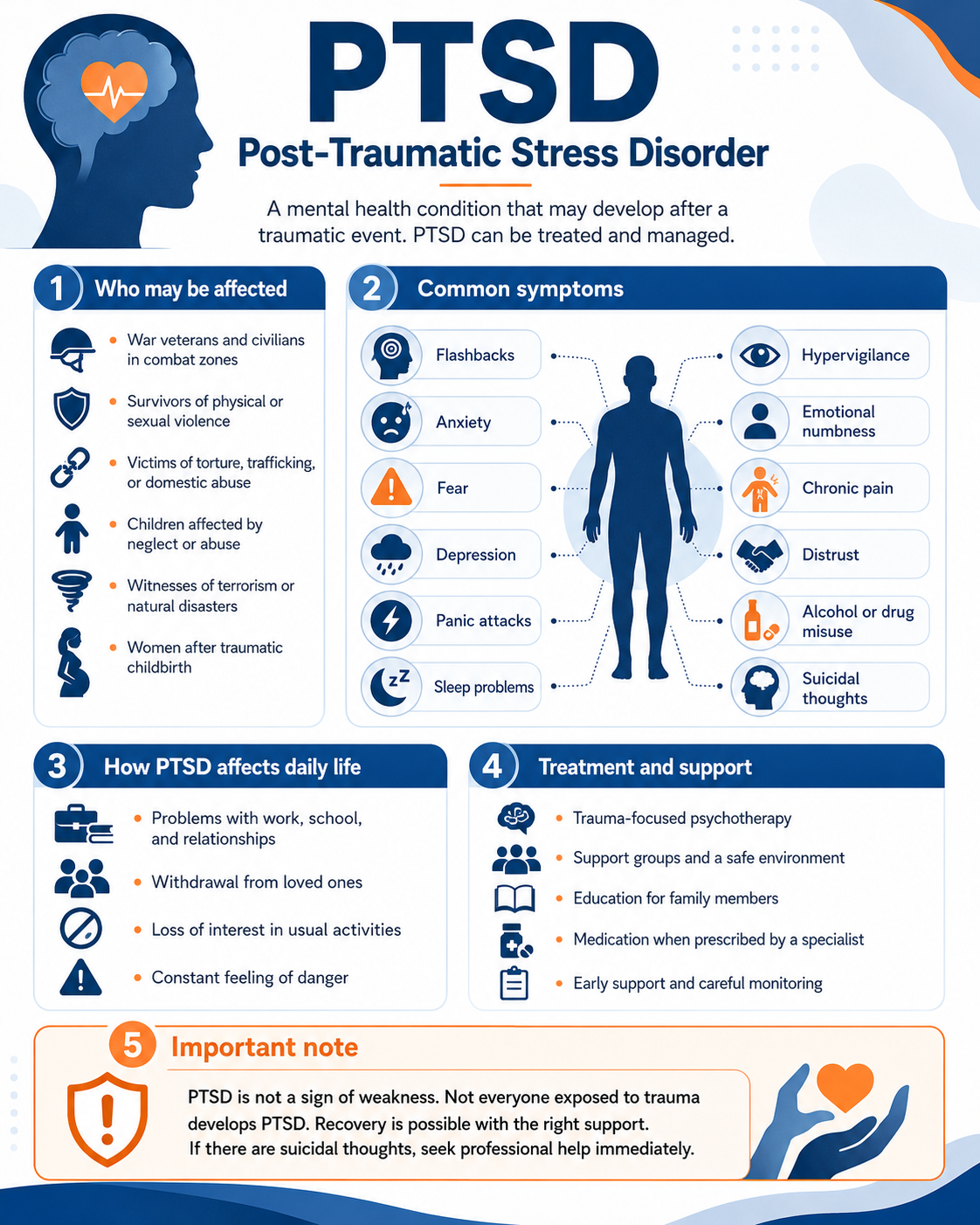
PTSD may develop in people who have experienced an extraordinary situation that threatened their life or dignity:
- war veterans;
- civilians living in combat zones;
- victims of sexual and/or physical violence;
- prisoners and victims of torture;
- victims of human trafficking and sexual slavery;
- victims or witnesses of ongoing domestic violence;
- victims of bullying, including school bullying;
- children who experience neglect (children whose needs are ignored, who may not even be properly fed, or who are neglected by their parents), physical abuse, or sexual abuse;
- witnesses of terrorist attacks;
- people who have been in areas affected by natural disasters;
- women who have experienced traumatic childbirth and mistreatment by medical personnel.
Research shows that individual vulnerability or resilience is a key factor in the development of PTSD. The disorder is currently viewed as the result of external stress factors triggering an already existing susceptibility to psychological trauma.
Studies of twins have found that approximately 40% of susceptibility to PTSD may be attributable to heredity. People with certain characteristics related to the production and perception of neurotransmitters and some hormones may be particularly susceptible to developing PTSD and to using alcohol as a coping mechanism.
For this reason, it is wrong and cruel to say, “People used to go to war, come home, start families and work, while now they do not want to live.” Likewise, one should not turn away from a person with PTSD or compare oneself, for example, with fellow soldiers who returned to civilian life relatively easily. Everyone has a different sensitivity to stressful factors.
Not everyone who experiences the situations listed above develops PTSD. Knowing that a person has been involved in combat is not sufficient to make a diagnosis.
How PTSD manifests itself
Persistent thoughts about the traumatic event. They may occur involuntarily, appear in dreams, or return as flashbacks — vivid re-experiences of an old memory — when a particular trigger reminds the person of the trauma.
Living in a state of constant alert. Such a person may react instantly, become irritable or anxious, and constantly worry about personal safety. Anxiety may manifest as sleep disturbances, difficulty concentrating, or physical symptoms such as constipation, indigestion, muscle tension, or rapid heartbeat.
Avoidance of reminders of the trauma — an unwillingness to talk about the event or to be around people who remind the person of it. Emotional numbness, withdrawal from loved ones, and loss of interest in activities that were once enjoyable may also occur. The latter strongly resembles symptoms of depressive disorder.
Panic attacks: intense fear, shallow breathing, dizziness, nausea, rapid heartbeat, and chest pain.
Chronic pain, headaches, diarrhea, a feeling of tightness or burning behind the breastbone, muscle spasms, and lower back pain.
Distrust: loss of trust in other people and the belief that the world is dangerous.
Difficulties in everyday life: problems at work or finding employment, at school, or in relationships.
Alcohol, cigarette, and drug misuse.
Relationship problems and emotional distancing from one’s partner.
Suicidal thoughts. If such thoughts occur, tell someone close to you and seek psychological support.
How PTSD is treated
There are several treatment protocols, and none of them is exhaustive or universally applicable. This means that the approach and medication should be selected individually for each person, while still taking established protocols and the individual’s life circumstances into account.
A person diagnosed with PTSD should be reassured that they are not “going crazy” and that the condition can improve. A qualified professional — a psychotherapist, psychiatrist, social worker, or another specialist trained to work with traumatized people — should provide information about PTSD and how to cope with it, preferably in written form.
A professionally facilitated support group should be found. PTSD sometimes improves over time without medication, but one should not simply wait for it to disappear. PTSD should be carefully monitored, with attention paid to any signs of deterioration.
A safe environment should be created. Triggers of traumatic memories should be reduced or eliminated. This is why fireworks should not be used in a country where war is ongoing. There are adults and children among us who remember grenade launchers and Topol missile systems all too well.
Work should also be carried out with family members and loved ones. They need to understand what is happening, what causes it, how panic attacks and flashbacks may be prevented, and what to do when they occur.
Work should be conducted with patients, while society should also be educated about the appropriate use of language. Stigmatization, hate speech, and the exclusion of people from society must not be tolerated.
PTSD treatment includes psychotherapy and/or medication.
Psychotherapy is needed to address the underlying cause and to process, integrate, and reduce the impact of traumatic memories.
The same measures may also be used to help prevent the development of PTSD in people who are at risk. Other approaches exist as well, although they are not necessarily required.
Usually, 8–10 therapy sessions may be needed to address PTSD. Therapy should follow an established protocol and be conducted by a specialist trained to work with traumatized clients. At the same time, it is important to make sure that the client does not have dissociative disorders or psychosis and does not pose a danger to others.
Medication therapy approved by treatment protocols includes paroxetine, venlafaxine, or sertraline. These are antidepressants, and these active substances are registered in Ukraine.
These are prescription medications, and their effectiveness without psychotherapy is approximately 60%. Fewer than one-third of patients recover completely. However, antidepressants can help normalize a person’s well-being and daily routine so that they have enough strength to undergo psychotherapy.
Medication treatment of PTSD is not recommended for children and adolescents under the age of 18.
If sleep disturbances occur, additional medications may be prescribed.
Benzodiazepines should not be used.
Treatment protocols recommend prescribing risperidone in cases of psychosis and avoiding other antipsychotic medications unless clinically indicated.
If PTSD is accompanied by depression, the depression should be treated as a priority.
If a patient uses drugs or alcohol, they should still receive treatment for PTSD.
People with complex PTSD require longer-term therapy.
Does medical cannabis help with PTSD?
Substance misuse involving substances that temporarily help a person relax or forget is common among people with PTSD. This is sometimes handled incorrectly: the person may be accused of alcoholism, others may try to treat only the substance use, or they may turn away from and abandon the affected person at the most critical moment. It is important to understand that people with PTSD may feel as though they are living in a personal hell that constantly remains with them.
The use of cannabis-based medicines and cannabis derivatives for PTSD has become widespread in some parts of the world. Medical cannabis preparations are intended for medical use. Cannabidiol (CBD), one of the active substances commonly associated with medical cannabis, may have anxiolytic properties, meaning that it may help reduce anxiety. It does not produce the same intoxicating effects as tetrahydrocannabinol (THC) and may also have relaxing and pain-relieving properties.
People often confuse recreational and medical cannabis. Unlike medical cannabis, recreational cannabis is generally used for its intoxicating or pleasurable effects. It may contain significant amounts of tetrahydrocannabinol (THC). This substance has pronounced psychoactive effects and is the main intoxicating component of cannabis.
Research in humans and, to a greater extent, in animals has examined whether cannabinoids may influence the extinction or processing of traumatic memories. However, recreational cannabis is not recommended as a treatment for PTSD. Cannabis or other calming approaches should not replace psychotherapy and evidence-based medical treatment.
Note: In the original Ukrainian text, “фенфлафаксин” appears to be a typo. I translated it as the medically recognized drug venlafaxine.