
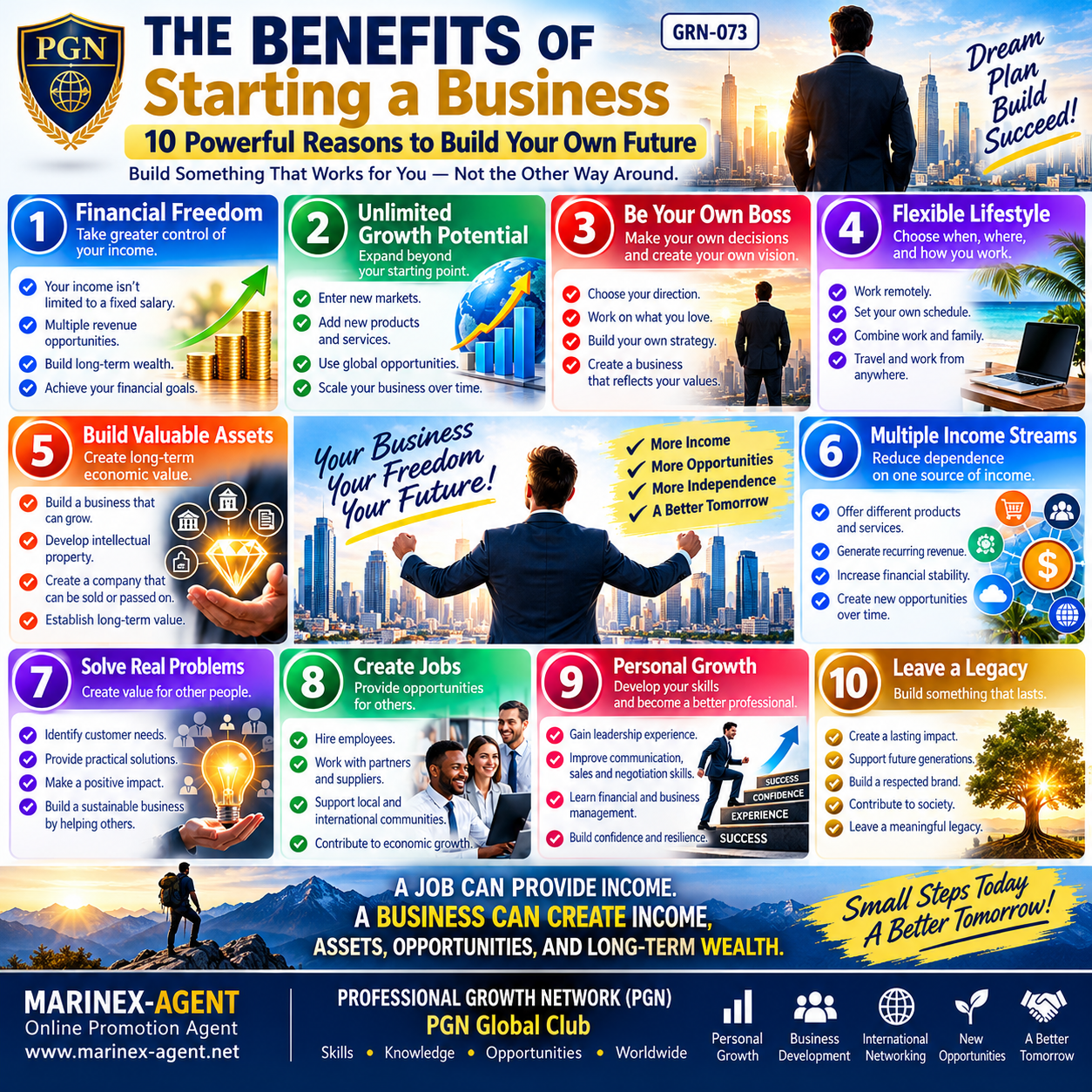
The Benefits of Starting a Business:
10 Powerful Reasons to Build Your Own Future
Parent Category: PROFESSIONAL GROWTH NETWORK (PGN)**
Category: Personal Growth & Self-Development
Article Code: GRN-073
Introduction: Build Something That Works for You
Starting a business is one of the most significant decisions a person can make in their professional life.
For some people, entrepreneurship represents a path toward financial independence. For others, it offers personal freedom, creative expression, professional development, or the opportunity to build something meaningful for future generations.
The traditional employment model generally involves exchanging time, knowledge, and professional skills for an agreed salary.
Entrepreneurship introduces another possibility: building a system that creates value for customers and may eventually generate income beyond the direct working hours of its founder.
However, business ownership is not simply about earning money.
It involves identifying opportunities, accepting responsibility, managing risks, solving problems, developing relationships, and continuously improving products or services.
A successful business may become much more than a source of income. It can develop into a valuable asset, a platform for professional growth, and a contribution to society.
The central entrepreneurial principle is simple:
Build something that works for you — not the other way around.
This article explores ten important benefits of starting a business and explains how entrepreneurship can contribute to long-term personal and professional development.
1. Financial Freedom — Take Greater Control of Your Income
One of the most attractive benefits of entrepreneurship is the possibility of greater financial independence.
In traditional employment, income is usually determined by salary agreements, working hours, bonuses, and organizational policies.
A business owner can develop several ways to generate revenue by providing valuable products or services to customers.
How Entrepreneurship Creates Financial Opportunities
A business may generate income through:
- Product sales.
- Professional services.
- Consulting and advisory activities.
- Online commerce.
- Digital products.
- Licensing and royalties.
- Subscription services.
- Business partnerships.
Unlike a fixed salary, business revenue is not necessarily tied to one employer or a predetermined compensation structure.
However, business income is not guaranteed. Revenue must cover expenses, taxes, investments, and other financial obligations before it becomes profit.
Building Financial Independence
Financial freedom generally develops gradually.
A practical approach includes:
Step 1: Identify a market need.
Step 2: Develop a product or service that meets that need.
Step 3: Acquire paying customers.
Step 4: Control operating expenses.
Step 5: Reinvest part of the profits into business development.
Step 6: Build financial reserves and sustainable systems.
Financial Independence Requires Discipline
Successful entrepreneurship does not eliminate financial responsibility.
In fact, business owners must often exercise greater financial discipline than salaried employees.
They must understand cash flow, operating margins, customer acquisition costs, taxation, and long-term financial planning.
Key lesson: Entrepreneurship offers the opportunity to build greater financial independence, but sustainable profitability requires planning, discipline, and consistent customer value.
2. Unlimited Growth Potential — Expand Beyond Your Starting Point
A business can grow beyond its original size, geographic location, and customer base.
An individual may begin with a small local service and gradually develop a larger organization operating across different markets.
Modern digital technologies make this possibility more accessible than ever before.
Different Forms of Business Growth
Business expansion may include:
- Increasing the number of customers.
- Entering new geographic markets.
- Introducing additional products.
- Developing new services.
- Building international partnerships.
- Hiring employees.
- Establishing distribution networks.
- Creating online sales channels.
The Role of the Internet
The Internet allows even relatively small businesses to reach potential customers beyond their immediate geographic location.
For example, an independent consultant can begin serving local customers and later establish professional relationships with international clients.
Similarly, a small manufacturer can use digital marketing and international partnerships to reach distributors in other countries.
Scaling a Business
Scalability refers to a business’s ability to increase its output or revenue without a proportional increase in every operating cost.
Digital products, software, standardized services, and licensing models may offer particular opportunities for scaling.
However, no business can expand without limits. Market demand, competition, available capital, operational capacity, and management capabilities impose practical constraints.
Sustainable Growth
Growth should not be measured exclusively by revenue.
A growing company must also maintain:
- Product and service quality.
- Customer satisfaction.
- Financial stability.
- Reliable operations.
- Ethical business practices.
- Effective management.
Key lesson: Starting small does not necessarily mean remaining small. A well-managed business can develop into a larger and more valuable enterprise.
3. Be Your Own Boss — Make Your Own Decisions
Entrepreneurship provides an opportunity to exercise greater control over professional decisions.
Instead of following the strategy established by an employer, business owners can develop their own vision and determine how to implement it.
Areas of Entrepreneurial Independence
A business owner may decide:
- Which products or services to offer.
- Which customers and markets to serve.
- How to organize daily operations.
- Which technologies to adopt.
- Which partners to cooperate with.
- How to position the business.
- When and how to expand.
Independence Comes with Responsibility
Being your own boss does not mean being free from obligations.
Entrepreneurs remain accountable to customers, employees, suppliers, business partners, financial institutions, and regulatory authorities.
A poor decision can directly affect the financial stability of the company.
Therefore, entrepreneurial independence requires:
- Critical thinking.
- Effective planning.
- Risk assessment.
- Financial responsibility.
- Communication skills.
- Ethical judgment.
Developing a Personal Business Vision
A clear vision helps entrepreneurs maintain direction.
For example:
Business Vision: Build an international network of professional services that helps individuals and small businesses establish a credible online presence.
Business Mission: Provide practical and affordable digital promotion solutions.
Business Strategy: Combine personal web presentations, online marketing, professional networking, and international cooperation.
Key lesson: Entrepreneurship allows you to make important professional decisions while accepting responsibility for their consequences.
4. Flexible Lifestyle — Design Your Own Working Environment
Many people begin businesses because they want greater flexibility in organizing their professional and personal lives.
Entrepreneurship may provide opportunities to choose where, when, and how certain activities are performed.
Potential Lifestyle Benefits
Depending on the business model, entrepreneurs may be able to:
- Work remotely.
- Organize flexible schedules.
- Reduce unnecessary commuting.
- Choose suitable working environments.
- Combine professional and family responsibilities.
- Travel while managing online operations.
- Delegate routine tasks.
The Importance of Business Models
Not all businesses offer the same degree of flexibility.
For example, an online consultant may have considerable control over working hours.
By contrast, the owner of a restaurant, manufacturing facility, or physical retail business may face demanding schedules and location-specific responsibilities.
Building a More Flexible Business
Flexibility can improve when entrepreneurs establish reliable operational systems.
These may include:
Digital Communication: Email, messaging platforms, and video conferencing.
Cloud-Based Documentation: Remote access to business files and records.
Automation: Routine processes that can operate with limited manual involvement.
Delegation: Assigning responsibilities to qualified employees or contractors.
Standardized Procedures: Clear instructions that reduce dependence on the founder.
Work-Life Balance
New businesses frequently demand substantial time and effort, particularly during their early development.
Flexible working arrangements are therefore a potential long-term benefit, not an automatic feature of entrepreneurship.
Key lesson: A well-designed business can provide greater control over your lifestyle, especially when supported by effective systems and delegation.
5. Build Valuable Assets — Create Long-Term Economic Value
One of the most important differences between earning a salary and building a successful business is the possibility of creating an asset.
A profitable and well-managed business may possess economic value beyond the personal labor of its founder.
What Makes a Business Valuable?
Business value may be associated with:
- Established customer relationships.
- Recognizable trademarks.
- Proprietary technology.
- Intellectual property.
- Equipment and infrastructure.
- Distribution networks.
- Recurring revenue.
- Reliable operating systems.
- Skilled employees.
- Long-term commercial agreements.
Tangible and Intangible Assets
Tangible Assets are physical resources such as equipment, machinery, buildings, and inventory.
Intangible Assets include trademarks, software, intellectual property, customer relationships, and certain contractual rights.
Both categories may contribute to the economic value of a business.
A Business That Can Operate Independently
A company becomes potentially more valuable when it can operate effectively without requiring the founder to personally perform every task.
This generally involves:
- Documented operating procedures.
- Reliable financial reporting.
- Established customer relationships.
- Delegated management responsibilities.
- Consistent quality standards.
- Predictable revenue sources.
Long-Term Opportunities
Depending on its financial performance and market conditions, an established business may eventually be:
- Expanded.
- Franchised.
- Transferred to family members.
- Merged with another company.
- Sold to investors or another entrepreneur.
Key lesson: Building a business means creating an organization that may develop lasting economic value beyond your personal working hours.
6. Multiple Income Streams — Reduce Dependence on One Revenue Source
A business does not always need to depend on a single product or service.
As an enterprise develops, it may introduce complementary revenue streams.
This can improve financial resilience when those income sources are commercially viable and sufficiently diversified.
Examples of Multiple Revenue Streams
A digital services business might generate revenue from:
- Website development.
- Website maintenance.
- Personal web presentations.
- Domain registration assistance.
- Digital marketing.
- Graphic design.
- Online consulting.
- Educational products.
- Subscription-based services.
- Referral or agency commissions.
Why Diversification Matters
If one product experiences reduced demand, other services may continue generating revenue.
However, diversification also introduces additional operational complexity.
Launching too many services simultaneously can weaken customer service, increase expenses, and distract management from the company’s most profitable activities.
A Practical Development Strategy
Stage 1 — Core Service
Establish one reliable product or service.
Stage 2 — Customer Base
Build a reputation and attract repeat customers.
Stage 3 — Complementary Services
Introduce related offerings that solve additional customer problems.
Stage 4 — Recurring Revenue
Explore suitable subscription, maintenance, or long-term service agreements.
Stage 5 — Strategic Expansion
Evaluate new business lines according to demand, profitability, and operational resources.
Example: Personal Online Promotion Services
A customer may initially require a personal web presentation.
Later, the same customer might need:
- A personal domain.
- Professional email.
- Business promotion.
- Social media graphics.
- Website updates.
- International networking assistance.
This creates opportunities to develop a coordinated portfolio of services.
Key lesson: Multiple revenue streams can strengthen a business, but each should contribute genuine customer value and sustainable profitability.
7. Solve Real Problems — Create Value for Other People
Successful entrepreneurship begins with identifying problems that people or organizations are willing to pay to solve.
A business becomes economically relevant when it delivers products or services that customers genuinely need.
Common Customer Problems
People and organizations may need help with:
- Saving time.
- Reducing expenses.
- Improving efficiency.
- Finding qualified professionals.
- Increasing sales.
- Reaching new markets.
- Managing information.
- Developing digital skills.
- Improving communication.
- Establishing professional credibility.
The Problem-Solution Business Model
A simple entrepreneurial formula is:
Customer Problem → Practical Solution → Customer Value → Commercial Opportunity.
Example: Professional Internet Presence
Problem: An independent professional has valuable experience but lacks a credible online presentation.
Solution: Create a professional web page describing qualifications, services, experience, and contact information.
Customer Value: Potential clients can more easily evaluate the professional’s background and activities.
Business Opportunity: A digital promotion agent can offer web presentation, domain assistance, and related marketing services.
Understanding the Customer
Before launching a new business, entrepreneurs should investigate:
- Who experiences the problem?
- How serious is it?
- How is it currently being solved?
- What would customers consider an improvement?
- Are customers willing and able to pay?
- Can the solution be delivered profitably?
Customer Feedback
Customer feedback provides essential information for improving products and services.
A successful entrepreneur should continuously listen, evaluate, and adapt.
Key lesson: The most sustainable businesses focus on solving real problems rather than simply trying to sell products.
8. Create Jobs — Contribute to Economic Development
As businesses grow, they may create employment and professional opportunities for other people.
Entrepreneurship therefore has significance beyond the financial interests of individual business owners.
Direct Employment
A growing company may hire:
- Administrative personnel.
- Sales representatives.
- Technical specialists.
- Marketing professionals.
- Customer service employees.
- Accountants.
- Project managers.
- Operational staff.
Indirect Economic Opportunities
Businesses may also generate work for independent contractors, suppliers, logistics companies, consultants, and professional service providers.
The Role of Small Businesses
Small and medium-sized enterprises play an important role in many national economies.
They support employment, innovation, competition, and the development of local communities.
International Cooperation
Modern businesses can create opportunities across national borders.
For example, a company based in one country may cooperate with:
- Software developers in another country.
- Graphic designers working remotely.
- International sales representatives.
- Overseas suppliers.
- Independent consultants.
- Regional marketing partners.
Responsible Employment
Creating jobs also involves responsibilities.
Employers should consider:
- Fair compensation.
- Safe working conditions.
- Applicable labor legislation.
- Professional development.
- Clear contractual arrangements.
- Equal opportunity.
- Respectful management practices.
Key lesson: A successful business can contribute to the prosperity of employees, partners, suppliers, and the wider community.
9. Personal Growth — Become a More Capable Professional
Entrepreneurship can become an intensive form of practical education.
Business owners regularly encounter situations that require them to learn new skills, make difficult decisions, and adapt to changing circumstances.
Essential Entrepreneurial Skills
Leadership
Developing a vision, motivating people, and accepting responsibility.
Communication
Presenting ideas clearly and building effective professional relationships.
Negotiation
Finding commercially acceptable agreements with customers, suppliers, and partners.
Financial Literacy
Understanding budgets, costs, cash flow, profitability, and financial risks.
Marketing
Identifying customer needs and communicating the value of products or services.
Sales
Building trust, understanding customer requirements, and reaching agreements.
Time Management
Organizing priorities and allocating attention to important activities.
Problem-Solving
Analyzing challenges and developing practical solutions.
Digital Literacy
Using modern technologies to improve communication, productivity, and commercial operations.
Networking
Establishing and maintaining valuable professional relationships.
Learning Through Experience
Formal education can provide important theoretical foundations.
Entrepreneurship complements this knowledge through direct experience.
Every customer interaction, business negotiation, operational challenge, and strategic decision provides an opportunity to learn.
The Importance of Resilience
Not every entrepreneurial initiative succeeds.
Unexpected costs, changes in demand, competition, and operational difficulties may require entrepreneurs to revise their plans.
Learning from setbacks is valuable, but financial and personal risks should be managed carefully.
Key lesson: Even when a business does not achieve all its original goals, the professional skills developed through entrepreneurship can remain valuable.
10. Leave a Legacy — Build Something That Lasts
For many entrepreneurs, the ultimate purpose of building a business extends beyond personal financial success.
They want to create something useful, meaningful, and potentially lasting.
Different Forms of Entrepreneurial Legacy
A legacy may include:
- A successful family enterprise.
- A respected professional organization.
- A useful product or technology.
- New employment opportunities.
- Improved community services.
- Educational programs.
- Charitable initiatives.
- Long-term international partnerships.
- A professional network that continues developing.
Building an Organization That Can Continue
For a business to survive beyond its founder’s direct involvement, it generally needs:
- A clear mission.
- Sustainable financial operations.
- Reliable governance.
- Qualified management.
- Documented procedures.
- Effective succession planning.
- Strong relationships with customers and partners.
Financial Success and Social Contribution
A commercially successful business may support social and humanitarian initiatives through funding, technology, employment, services, and partnerships.
Some organizations integrate public benefit directly into their operating models.
Others allocate part of their profits or resources to community development.
Measuring Long-Term Impact
Financial performance is important, but it is not the only measure of entrepreneurial achievement.
Business owners may also consider:
- How many customers were helped?
- How many meaningful jobs were created?
- What problems were solved?
- Which professional opportunities were developed?
- What useful knowledge was shared?
- What positive contributions will remain in the future?
Key lesson: The most meaningful entrepreneurial legacy combines economic sustainability with lasting value for other people.
11. Employment and Entrepreneurship: Understanding the Difference
Entrepreneurship is not automatically better than employment.
Both can provide meaningful professional opportunities, and each has advantages and limitations.
| Employment | Entrepreneurship |
|---|---|
| Usually offers more predictable compensation | Income may fluctuate significantly |
| Responsibilities are defined by the employer | The owner manages broader responsibilities |
| Working arrangements depend on the position | Greater flexibility may develop over time |
| Business risks are primarily borne by the employer | Financial and operational risks fall on the owner |
| Career growth follows available opportunities | Growth depends on business performance |
| Benefits may include paid leave and employer contributions | Benefits generally require independent planning |
| Usually requires less personal business capital | May require financial investment |
A Combined Career Strategy
Many people begin entrepreneurial activities while maintaining regular employment.
This approach may allow them to test a business idea without immediately abandoning an established income source.
For example, an individual may gradually develop:
- Freelance consulting.
- Online educational services.
- Graphic design.
- Digital product sales.
- Professional web presentations.
- Business referral services.
Before expanding, it is important to consider employment agreements, conflicts of interest, taxation, and applicable regulations.
Key lesson: Entrepreneurship should be approached as a deliberate professional choice based on personal goals, financial resources, market opportunities, and risk tolerance.
12. Starting Small: A Practical Path into Entrepreneurship
A person does not necessarily need a large office, an extensive staff, or substantial initial investment to test a business idea.
Many service-based businesses can begin with relatively modest resources.
Step 1 — Identify Your Knowledge and Skills
Consider what you already know and what problems you can solve.
Examples include:
- Professional consulting.
- Technical services.
- Translation.
- Teaching.
- Digital marketing.
- Graphic design.
- Website management.
- Business networking.
Step 2 — Identify a Target Market
Determine who might benefit from your services.
Avoid trying to serve everyone immediately.
A clearly defined customer group often makes marketing more effective.
Step 3 — Validate Demand
Discuss your proposed service with potential customers.
Find out what they actually need, what alternatives they use, and whether they would pay for your solution.
Step 4 — Calculate Basic Economics
Estimate:
- Initial investment.
- Monthly operating expenses.
- Pricing.
- Expected customer demand.
- Direct service costs.
- Taxes and transaction fees.
- Required cash reserves.
Step 5 — Establish a Professional Identity
Choose an appropriate business name and develop a credible professional presentation.
Step 6 — Create Your Online Presence
A professional website or web presentation can explain:
- Who you are.
- What you offer.
- Your professional experience.
- Your target customers.
- Your services.
- Your contact information.
Step 7 — Find Your First Customers
Use appropriate professional networks, referrals, direct outreach, and digital marketing.
Step 8 — Improve Your Services
Collect feedback and refine your offer.
Step 9 — Build Reliable Procedures
Establish consistent processes for communication, project delivery, invoicing, and recordkeeping.
Step 10 — Expand Gradually
Increase investment only when supported by evidence of demand, operational capacity, and financial sustainability.
Key lesson: Small, well-planned steps can create the foundation for a larger business.
13. PROFESSIONAL GROWTH NETWORK (PGN): From Personal Skills to Business Opportunities
The mission of the PROFESSIONAL GROWTH NETWORK (PGN) is closely connected with the principles of entrepreneurship.
Many individuals possess valuable knowledge, professional experience, and business ideas but lack the resources or understanding required to promote themselves effectively.
A capable engineer may have no professional website.
An experienced consultant may have limited international contacts.
A small entrepreneur may offer useful services but struggle to communicate them to potential customers.
In each case, the person may benefit from a stronger professional identity and better digital visibility.
The PGN Development Concept
Our approach connects several important elements:
Personal Development
Improve knowledge, skills, and professional competence.
Professional Identity
Define your qualifications, experience, services, and business objectives.
Personal Web Presentation
Establish a credible professional presence on the Internet.
Personal Domain Name
Create an independent and recognizable online address.
Online Promotion
Make your professional information accessible to potential customers and partners.
International Networking
Develop relationships with professionals and organizations in different countries.
Business Development
Transform professional contacts and market opportunities into mutually beneficial cooperation.
The PGN Entrepreneurial Development Formula
Knowledge → Skills → Professional Identity → Web Presentation → Online Promotion → International Networking → Business Opportunities → Sustainable Growth.
This process does not guarantee commercial success.
However, it provides a practical framework for developing professional visibility and exploring new opportunities.
14. Your Personal Online Promotion Agent: Promote Yourself First
One of the central principles of the Marinex-Agent concept is that individuals should first establish their own professional identity before concentrating exclusively on the promotion of somebody else’s products or services.
This distinction is particularly important for independent business intermediaries, consultants, freelancers, and small entrepreneurs.
The Traditional Approach
An individual may attempt to sell products or introduce business opportunities without possessing a professional website, a recognizable online identity, or easily verifiable background information.
Potential customers may therefore find it difficult to evaluate the person’s credibility.
The Personal Promotion Approach
A more structured model begins with the individual.
Step 1: Establish your professional identity.
Step 2: Create a personal web presentation.
Step 3: Register a suitable personal domain.
Step 4: Present your experience, knowledge, services, and business interests.
Step 5: Promote your professional presence.
Step 6: Develop contacts with potential customers and business partners.
Step 7: Introduce commercial offers that correspond to your professional activities.
A Practical Example
An independent business representative could establish a professional web presentation containing:
- Professional background.
- Areas of commercial interest.
- Products and services represented.
- Relevant industry experience.
- Business cooperation objectives.
- Contact information.
This presentation becomes a digital professional introduction that can be shared with new contacts.
It does not replace independent due diligence, but it may help potential partners understand who they are communicating with.
The Marinex-Agent Principle
First, promote yourself. Then promote your business, products, services, and professional opportunities.
A personal online presence can become an important foundation for international networking and business development.
15. The Entrepreneurial Mindset: Small Steps Today, a Better Tomorrow
Entrepreneurship begins long before a company becomes profitable.
It begins when a person recognizes an opportunity and decides to explore it constructively.
Think Long-Term
Consider not only immediate income but also the value you want to create over several years.
Start with Available Resources
Use your current knowledge, experience, contacts, and digital tools.
Develop Your Skills Continuously
Business conditions, technologies, and customer expectations change.
Continuous learning supports adaptability.
Focus on Real Customer Needs
Products and services become commercially valuable when they solve problems.
Build Professional Relationships
Trust and cooperation are essential components of sustainable business development.
Manage Risks Carefully
Avoid committing resources that you cannot afford to lose.
Test assumptions before making large investments.
Measure Progress
Track customer satisfaction, expenses, revenue, profitability, and other relevant indicators.
Improve Consistently
Small operational improvements can produce meaningful results over time.
Entrepreneurship is not simply about taking risks. It is about identifying opportunities, evaluating risks intelligently, and building something valuable through disciplined action.
Conclusion: Build Income, Assets, Opportunities, and Long-Term Value
Starting a business can provide important opportunities for financial independence, professional development, personal fulfillment, and social contribution.
The ten principal benefits explored in this article are:
- Financial Freedom — Greater potential control over your income.
- Unlimited Growth Potential — Opportunities to expand beyond your starting point.
- Be Your Own Boss — Independence in professional decision-making.
- Flexible Lifestyle — Potentially greater control over working arrangements.
- Build Valuable Assets — Create long-term economic value.
- Multiple Income Streams — Develop additional revenue opportunities.
- Solve Real Problems — Deliver meaningful value to customers.
- Create Jobs — Contribute to employment and economic activity.
- Personal Growth — Develop essential professional and leadership skills.
- Leave a Legacy — Build something that can benefit others in the future.
Entrepreneurship offers possibilities, but it also requires responsibility, patience, financial discipline, and a willingness to learn.
Not every business will succeed, and not every person needs to become an entrepreneur.
Nevertheless, for individuals who recognize a genuine market opportunity and are prepared to develop their capabilities, starting a business can become an important path toward professional independence and long-term achievement.
Within the PROFESSIONAL GROWTH NETWORK, we encourage people to develop their knowledge, strengthen their professional identity, establish useful international contacts, and explore business opportunities responsibly.
Small Steps Today — A Better Tomorrow.
A JOB CAN PROVIDE INCOME. A BUSINESS CAN CREATE INCOME, ASSETS, OPPORTUNITIES, AND LONG-TERM WEALTH.
Dream. Plan. Build. Improve. Succeed.
PROFESSIONAL GROWTH NETWORK (PGN)
PGN Global Club
Online Promotion Agent: https://www.marinex-agent.net/
Article Code: GRN-073