
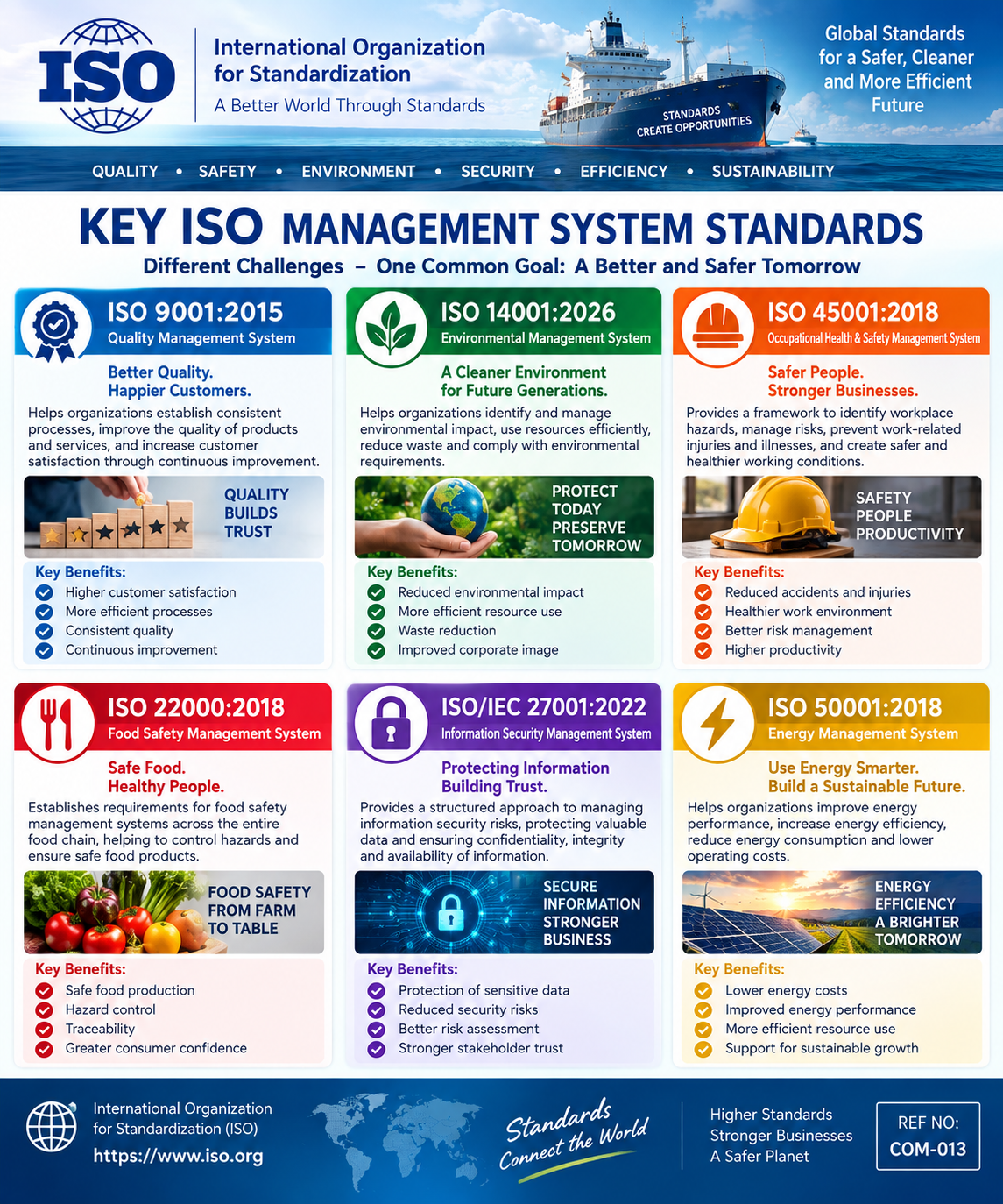
REF NO: COM-013
Types of ISO Standards — Quality, Safety, Efficiency and Sustainability
International ISO standards provide organizations with structured management frameworks that help improve quality, safety, environmental performance, information security and operational efficiency.
Different ISO standards address different areas of business activity. Many organizations implement several management systems simultaneously, depending on their operations, industry and customer requirements.
ISO 9001 — Quality Management System
ISO 9001:2015 is one of the world’s best-known standards for quality management systems.
It helps organizations establish consistent processes, improve the quality of products and services, monitor performance and continuously improve customer satisfaction.
For customers and business partners, ISO 9001 certification can provide additional confidence that a company operates according to an established quality management framework.
Key focus:
Customer satisfaction • Process approach • Continual improvement • Consistent quality
ISO 14001 — Environmental Management System
ISO 14001:2026 provides an internationally recognized framework for environmental management.
It helps organizations identify and manage their environmental impact, use resources more efficiently, reduce waste, address applicable environmental requirements and continually improve environmental performance.
Key focus:
Environmental protection • Resource efficiency • Waste reduction • Environmental compliance
ISO 45001 — Occupational Health & Safety Management System
ISO 45001:2018 focuses on occupational health and safety.
The standard provides a framework for organizations to identify workplace hazards, manage occupational risks, prevent work-related injuries and illnesses, and create safer working conditions.
Key focus:
Risk management • Injury prevention • Safe working conditions • Employee health and safety
ISO 22000 — Food Safety Management System
ISO 22000:2018 establishes requirements for food safety management systems and can be applied by organizations throughout the food chain.
Its purpose is to help organizations systematically manage food safety hazards and provide safe food products while strengthening confidence among customers and other participants in the supply chain.
Key focus:
Food safety • Hazard control • Traceability • Consumer confidence
ISO/IEC 27001 — Information Security Management System
ISO/IEC 27001:2022 is the international management system standard for information security, cybersecurity and privacy protection.
It provides a structured approach to managing information-security risks and protecting valuable information assets. This is particularly important for organizations working with confidential business information, customer data and digital systems.
Key focus:
Information security • Risk assessment • Data protection • Confidentiality
ISO 50001 — Energy Management System
ISO 50001:2018 provides a framework for organizations to establish and continually improve an energy management system.
The standard helps businesses monitor energy performance, improve energy efficiency and identify opportunities to reduce energy consumption and related operating costs.
Key focus:
Energy efficiency • Energy performance • Energy saving • Sustainable use of resources
Why Do ISO Standards Matter?
ISO management system standards provide internationally recognized frameworks that can help organizations operate more systematically and consistently.
Depending on the particular standard, implementation can support:
- improved operational efficiency and quality;
- compliance with applicable requirements;
- better management of business risks;
- stronger customer and partner confidence;
- continual improvement;
- environmental and energy performance;
- workplace safety;
- protection of information and data.
For companies operating internationally, ISO certification can also be an important indicator of structured management practices when establishing relationships with customers, suppliers and business partners.
Conclusion
ISO standards are not simply certificates displayed on a company’s website or office wall. Their real value comes from the management systems and processes implemented behind the certification.
ISO 9001 addresses quality, ISO 14001 environmental management, ISO 45001 occupational health and safety, ISO 22000 food safety, ISO/IEC 27001 information security, and ISO 50001 energy management. Together, these standards demonstrate how different areas of an organization can be managed through internationally recognized frameworks.
Official Source:
International Organization for Standardization (ISO)