
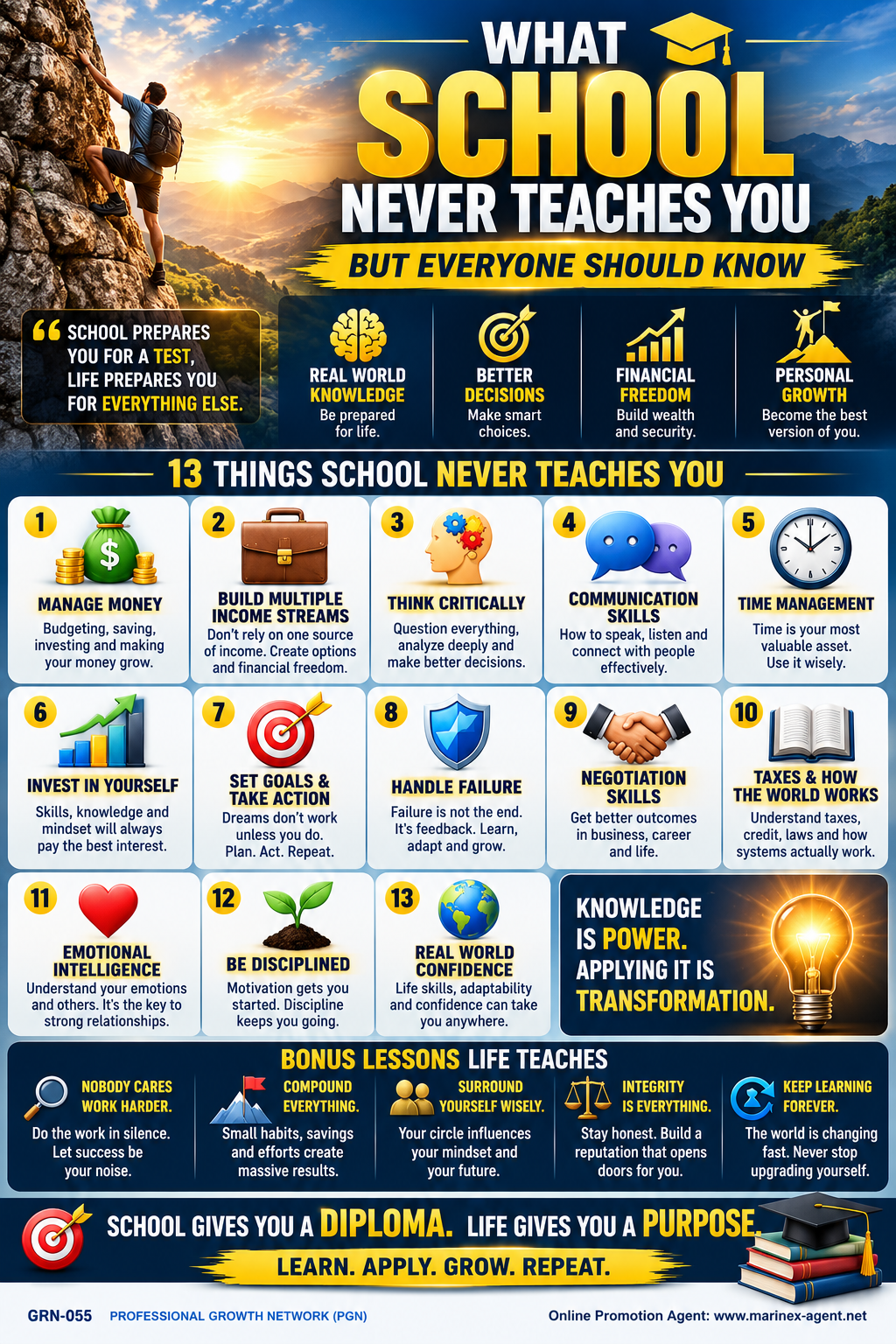
WHAT SCHOOL NEVER TEACHES YOU — BUT EVERYONE SHOULD KNOW
Parent Category: PROFESSIONAL GROWTH NETWORK
Category: Personal Growth & Self-Development
Article Code: GRN-055
13 Essential Life Skills for Personal Growth, Financial Independence & Professional Success
Education plays an important role in developing knowledge, intellectual abilities, and professional qualifications.
However, many essential life skills are not always taught systematically in traditional schools.
Financial management, communication, critical thinking, negotiation, emotional intelligence, and personal discipline are among the practical skills people often develop through experience.
School prepares you for tests. Life prepares you for everything else.
This article explores 13 important life skills that can help individuals make better decisions, improve their financial well-being, build successful relationships, and achieve personal and professional growth.
1. Manage Money — Financial Literacy
Learn how to earn, save, manage, and invest money responsibly.
Financial literacy is one of the most important skills for achieving long-term financial stability.
Understanding personal finances helps people avoid unnecessary debt, plan expenses, and prepare for future opportunities.
Essential Financial Skills:
- Prepare a monthly personal or family budget.
- Monitor income and expenses.
- Build an emergency savings fund.
- Understand interest rates and borrowing costs.
- Learn the fundamentals of saving and investing.
- Avoid unnecessary financial risks.
Key Principle: Financial success depends not only on how much you earn, but also on how effectively you manage your money.
2. Build Multiple Income Streams
Do not depend entirely on one source of income.
Relying on a single salary or business activity can create financial vulnerability.
Developing additional income opportunities may improve financial stability and provide greater flexibility.
Possible Income Sources:
- Employment income.
- Small business activities.
- Freelancing and consulting.
- Online services.
- Investments.
- Intellectual property and royalties.
- Rental income.
For example, a professional can combine regular employment with part-time consulting or online business activities.
Key Principle: Diversification of income sources can help reduce dependence on a single employer or business.
3. Think Critically
Question assumptions, evaluate information, and make informed decisions.
Critical thinking means examining facts and arguments before reaching conclusions.
It is especially important in business, finance, education, and everyday decision-making.
Develop Critical Thinking by:
- Asking relevant questions.
- Comparing information from different sources.
- Distinguishing facts from opinions.
- Identifying possible risks.
- Evaluating alternative solutions.
- Avoiding decisions based only on emotions.
Key Principle: Do not believe everything you hear or read. Verify important information before taking action.
4. Develop Communication Skills
Learn how to speak, listen, negotiate, and build relationships effectively.
Communication is essential for personal relationships, professional development, and successful business cooperation.
Effective communication requires more than speaking confidently. It also involves listening carefully and understanding other people’s perspectives.
Important Communication Skills:
- Active listening.
- Clear and respectful speaking.
- Professional correspondence.
- Public speaking.
- Constructive feedback.
- Conflict resolution.
- Cross-cultural communication.
Key Principle: Successful communication begins with understanding others, not simply expressing your own opinions.
5. Master Time Management
Time is one of your most valuable resources. Use it wisely.
Everyone has the same 24 hours each day, but people use their time differently.
Good time management can improve productivity, reduce stress, and create more opportunities for learning and personal development.
Practical Recommendations:
- Establish daily priorities.
- Set realistic deadlines.
- Create a weekly schedule.
- Reduce unnecessary distractions.
- Divide large projects into smaller tasks.
- Reserve time for rest and personal development.
Key Principle: Being busy does not always mean being productive. Focus on activities that produce meaningful results.
6. Invest in Yourself
Your knowledge, skills, health, and experience are valuable long-term assets.
Investing in personal development can create opportunities that last throughout life.
Unlike many material possessions, useful knowledge and professional skills can continue providing benefits for many years.
Areas for Personal Investment:
- Professional education.
- Foreign languages.
- Computer skills and digital literacy.
- Business and financial knowledge.
- Physical and mental well-being.
- Leadership and management.
- Communication and networking.
Key Principle: Continuous learning improves your ability to adapt to changing professional and economic conditions.
7. Set Goals and Take Action
Dreams become achievements through planning, discipline, and consistent action.
Having ambitions is important, but progress requires practical steps.
Successful people generally translate their objectives into specific activities and measurable results.
A Simple Goal-Setting Strategy:
- Define a clear objective.
- Establish a realistic deadline.
- Break the objective into smaller tasks.
- Identify the necessary resources.
- Begin taking action.
- Monitor progress.
- Adjust the plan when necessary.
Key Principle: Plan. Act. Review. Improve. Repeat.
8. Learn How to Handle Failure
Failure is not necessarily the end. It can become valuable feedback.
Mistakes, unexpected difficulties, and unsuccessful attempts are common experiences in education, business, and professional life.
The important issue is how people respond to these challenges.
Develop Resilience by:
- Accepting responsibility for mistakes.
- Analyzing what went wrong.
- Identifying lessons learned.
- Improving your strategy.
- Seeking professional advice when necessary.
- Maintaining realistic expectations.
Key Principle: Learn from mistakes, adapt your approach, and continue developing your abilities.
9. Develop Negotiation Skills
Negotiation is an essential skill in business, employment, and everyday life.
People negotiate regularly, whether discussing salaries, prices, contracts, business partnerships, or personal responsibilities.
Effective negotiation requires preparation, patience, and an understanding of the interests of all participants.
Important Negotiation Principles:
- Understand your objectives.
- Study the interests of the other party.
- Prepare facts and supporting information.
- Listen carefully.
- Identify mutually beneficial solutions.
- Avoid unnecessary confrontation.
- Confirm agreements in writing when appropriate.
Key Principle: Successful negotiations aim to create fair and sustainable agreements.
10. Understand Taxes and How the World Works
Basic knowledge of financial, legal, and economic systems is essential for responsible decision-making.
People regularly interact with banks, tax authorities, insurance providers, employers, and government institutions.
Understanding how these systems operate can help individuals protect their interests and avoid costly mistakes.
Important Areas of Knowledge:
- Personal and business taxation.
- Banking and payment systems.
- Credit and borrowing.
- Insurance.
- Employment rights and obligations.
- Basic contract principles.
- Consumer protection.
- International trade procedures.
Tax and legal requirements vary between countries, so important decisions should be based on applicable local rules and qualified professional advice.
Key Principle: Understanding the systems around you helps you make informed financial and professional decisions.
11. Develop Emotional Intelligence
Understand your emotions and recognize the feelings and perspectives of other people.
Emotional intelligence helps individuals manage relationships, respond to stressful situations, and communicate effectively.
It is particularly important for managers, entrepreneurs, teachers, and professionals working with diverse teams.
Core Emotional Intelligence Skills:
- Self-awareness.
- Emotional self-regulation.
- Empathy.
- Active listening.
- Conflict management.
- Respectful communication.
- Constructive responses to criticism.
Key Principle: Emotional intelligence supports strong personal relationships and effective teamwork.
12. Build Personal Discipline
Motivation helps you begin. Discipline helps you continue.
Motivation can change depending on circumstances, emotions, and external influences.
Discipline helps people maintain useful habits even when enthusiasm decreases.
Practical Ways to Develop Discipline:
- Establish a daily routine.
- Set achievable targets.
- Complete important tasks consistently.
- Limit unnecessary distractions.
- Monitor personal progress.
- Build healthy habits.
- Maintain a balance between work and rest.
Key Principle: Small actions repeated consistently can produce substantial long-term improvements.
13. Build Real-World Confidence
Confidence develops through knowledge, preparation, experience, and practical action.
Real-world confidence means trusting your ability to learn, solve problems, communicate, and adapt to unfamiliar situations.
It does not mean believing that you know everything.
Ways to Develop Confidence:
- Improve professional knowledge.
- Practice communication skills.
- Accept reasonable challenges.
- Learn from experienced people.
- Recognize your achievements.
- Develop practical problem-solving abilities.
- Continue learning throughout life.
Key Principle: Genuine confidence grows when knowledge and preparation are supported by real experience.
14. Bonus Lessons Life Teaches
Beyond these 13 essential skills, several additional principles can support long-term personal and professional growth.
14.1. Work Smarter, Not Just Harder
Effort is important, but effective planning, useful tools, and clear priorities can make that effort more productive.
14.2. Understand the Power of Compounding
Small improvements, regular savings, and consistent efforts can accumulate over time.
Compounding applies not only to finance but also to knowledge, professional experience, and personal habits.
14.3. Choose Your Environment Wisely
The people around you can influence your attitudes, decisions, and opportunities.
Develop relationships with individuals who encourage learning, integrity, cooperation, and professional development.
14.4. Maintain Integrity
Honesty, reliability, and respect are essential foundations for long-term relationships.
A good reputation can become one of the most valuable professional assets.
14.5. Never Stop Learning
Technology, business practices, and labor markets continue evolving.
Lifelong learning helps people remain adaptable and prepared for new opportunities.
15. The Role of Professional Growth Network (PGN)
The Professional Growth Network (PGN) is based on the principle that knowledge, professional connections, practical experience, and continuous personal development can create new opportunities.
Our international community aims to encourage:
- Knowledge sharing.
- Professional education.
- Personal development.
- Digital literacy.
- Business entrepreneurship.
- International networking.
- Practical business cooperation.
Through Marinex-Agent and the Personal Online Promotion Agent concept, we also encourage entrepreneurs and professionals to develop their own credible online presence.
Our Main Business Principle:
First, Promote Yourself. Then, Promote Your Products or Services.
Professional growth begins with developing personal knowledge, skills, credibility, and useful business relationships.
Knowledge • Connections • Opportunities • Growth
Conclusion
Traditional education provides an important foundation for intellectual and professional development.
However, practical life skills must also be developed through experience, independent learning, and continuous improvement.
Financial literacy, communication, critical thinking, discipline, negotiation, and emotional intelligence are valuable skills that can support long-term success.
Knowledge Is Power. Applying It Creates Transformation.
School Gives You a Diploma. Life Gives You a Purpose.
LEARN • APPLY • GROW • REPEAT
PROFESSIONAL GROWTH NETWORK (PGN)
Online Promotion Agent: www.marinex-agent.net
Article Code: GRN-055