
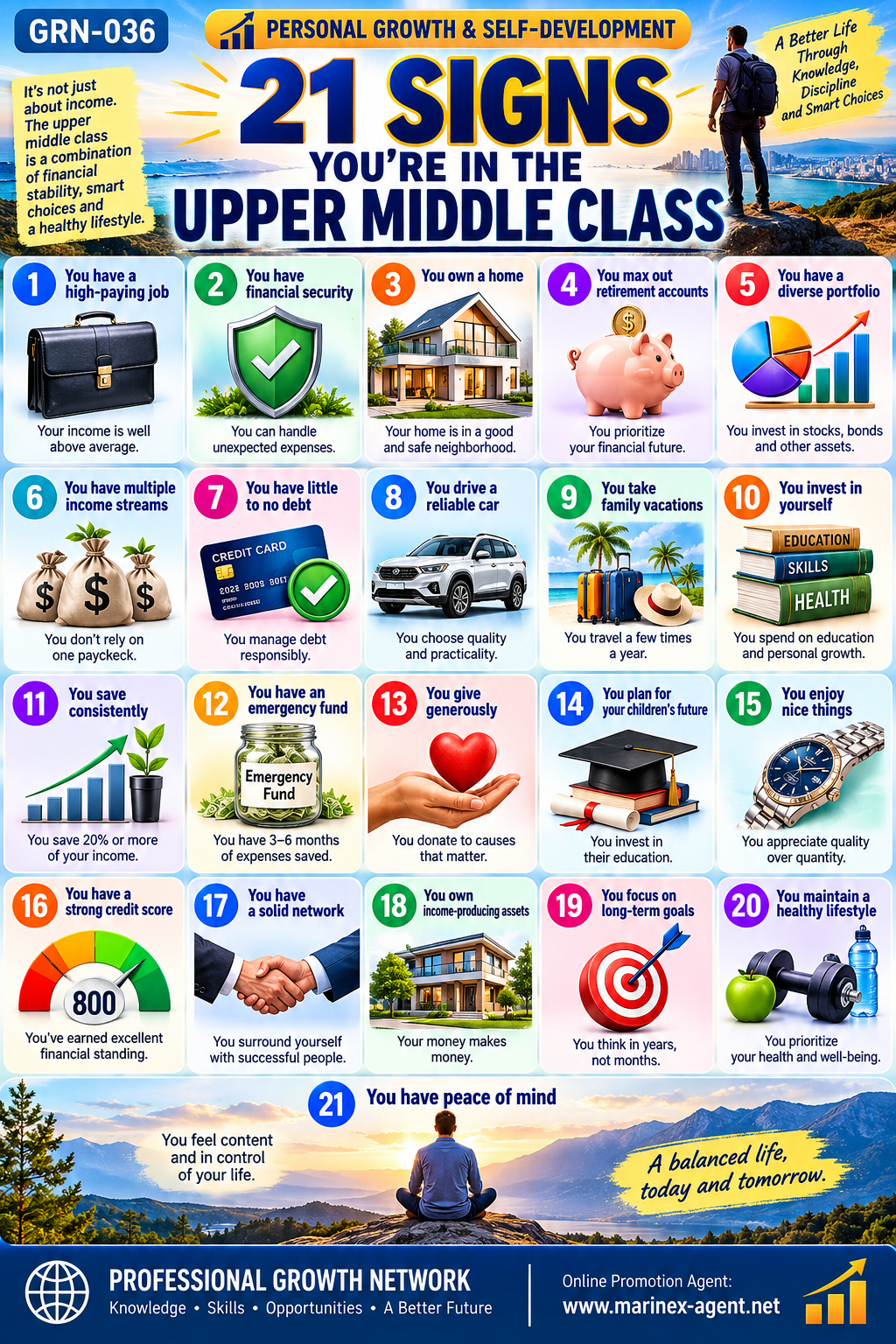
21 SIGNS YOU’RE IN THE UPPER MIDDLE CLASS
Category: Personal Growth & Self-Development
GRN-036
PROFESSIONAL GROWTH NETWORK
Introduction
What does it really mean to belong to the upper middle class?
Many people associate the upper middle class with high salaries, expensive houses, luxury cars, and prestigious lifestyles.
However, financial success is not determined by income alone.
A person may earn a substantial salary and still experience financial difficulties because of excessive debt, poor spending habits, or a lack of long-term planning.
Conversely, someone with a more modest income may enjoy considerable financial security through disciplined saving, responsible investments, and careful management of personal resources.
The upper middle class is not simply about earning more money. It is about building financial stability, making intelligent decisions, and creating a balanced, fulfilling life.
This article explores 21 commonly associated characteristics of an upper-middle-class lifestyle, including financial security, professional development, family priorities, health, and peace of mind.
These characteristics are useful indicators of financial well-being, not universal requirements or an official socioeconomic classification. Definitions of the upper middle class vary significantly between countries, regions, and economic circumstances.
1. You Have a High-Paying Job
A well-paid profession is often one of the foundations of upper-middle-class financial stability.
People in this group frequently possess specialized knowledge, professional qualifications, managerial experience, or valuable technical skills.
Their earnings may be significantly higher than the average income in their local labour market.
Practical Recommendations
- Develop professional skills that are in demand.
- Invest in education and continuous training.
- Improve communication and leadership abilities.
- Seek opportunities for career advancement.
- Evaluate your income in relation to local living costs.
Key Principle: Your professional knowledge and skills are among your most valuable income-producing assets.
2. You Have Financial Security
Financial security means being able to meet your regular financial obligations and manage unexpected expenses without immediately facing a crisis.
This may include maintaining adequate savings, appropriate insurance coverage, and a realistic household budget.
Practical Recommendations
- Monitor monthly income and expenses.
- Avoid unnecessary financial commitments.
- Maintain accessible savings.
- Review insurance needs.
- Prepare for possible interruptions in income.
Key Principle: Financial security is more important than simply appearing wealthy.
3. You Own a Home
Homeownership is commonly associated with financial stability and long-term wealth accumulation.
A home may provide residential security, personal independence, and the opportunity to build equity over time.
However, owning property also involves expenses such as maintenance, insurance, taxes, and possible mortgage payments.
Practical Recommendations
- Choose a home that matches your financial capacity.
- Consider the safety and quality of the neighbourhood.
- Evaluate transportation, healthcare, and local infrastructure.
- Avoid purchasing property solely to demonstrate social status.
- Maintain sufficient savings for repairs and emergencies.
Key Principle: A home should support your quality of life rather than become an excessive financial burden.
4. You Maximize Your Retirement Savings
Long-term retirement planning is an important part of responsible financial management.
People who consistently save for retirement are better prepared to maintain their standard of living when their regular employment income ends.
Practical Recommendations
- Begin retirement planning as early as possible.
- Contribute regularly to appropriate retirement accounts.
- Understand the tax benefits available in your country.
- Review investment risks and administrative fees.
- Adjust your savings strategy as your circumstances change.
Key Principle: Financial independence in later life requires planning long before retirement begins.
5. You Have a Diversified Investment Portfolio
Financially established individuals often avoid keeping all their investments in a single asset.
Diversification means spreading investments across different categories to reduce dependence on one source of returns.
A portfolio may include stocks, bonds, cash equivalents, real estate, or other suitable assets.
Practical Recommendations
- Understand the risks of each investment.
- Avoid concentrating all your money in one company or sector.
- Consider your investment time horizon.
- Review fees and taxation.
- Seek qualified financial advice when necessary.
Diversification can help manage investment risk, but it does not eliminate the possibility of losses.
Key Principle: Successful investing requires patience, discipline, and risk management.
6. You Have Multiple Income Streams
Depending entirely on one salary can create financial vulnerability.
Additional sources of income may provide greater flexibility and improve long-term financial resilience.
Examples of Additional Income
- Part-time professional consulting.
- Freelance services.
- Online business activities.
- Rental income.
- Investment income.
- Royalties from intellectual property.
- Small business partnerships.
Not every income source is passive, and additional business activities may involve significant work, expenses, and financial risks.
Key Principle: Multiple sustainable income sources can reduce dependence on a single employer.
7. You Have Little or No Unnecessary Debt
Responsible debt management is another characteristic of financial stability.
Not all debt is inherently harmful. For example, an affordable mortgage or carefully evaluated business loan may support long-term objectives.
Problems arise when debt becomes expensive, excessive, or difficult to repay.
Practical Recommendations
- Pay credit card balances on time.
- Avoid high-interest consumer borrowing.
- Compare loan conditions carefully.
- Monitor your total monthly debt payments.
- Distinguish productive borrowing from unnecessary consumption.
Key Principle: Financial freedom increases when debt remains manageable.
8. You Drive a Reliable Car
A reliable vehicle can improve mobility, save time, and support professional and family responsibilities.
However, a financially sensible vehicle does not necessarily have to be expensive or luxurious.
Many financially successful individuals choose practicality, reliability, safety, and reasonable maintenance costs over prestige.
Practical Recommendations
- Consider total ownership costs.
- Evaluate fuel efficiency and maintenance requirements.
- Prioritize safety and reliability.
- Avoid excessive vehicle financing.
- Replace a vehicle when there is a practical reason to do so.
Key Principle: Intelligent spending is more valuable than expensive appearances.
9. You Take Family Vacations
The ability to travel and spend quality time with family is often associated with a comfortable standard of living.
Vacations can provide opportunities for relaxation, cultural experiences, personal development, and stronger family relationships.
Practical Recommendations
- Include holidays in your annual financial plan.
- Choose destinations that fit your budget.
- Prioritize meaningful experiences.
- Avoid financing vacations through expensive debt.
- Maintain a healthy balance between work and personal life.
Key Principle: Financial success should create opportunities to enjoy life, not only accumulate money.
10. You Invest in Yourself
Personal development is one of the most valuable long-term investments.
Education, professional training, health, communication skills, and digital literacy can improve both earning potential and quality of life.
Important Areas of Self-Investment
- Professional education.
- Foreign languages.
- Computer skills.
- Digital technologies.
- Business communication.
- Physical fitness.
- Personal health.
- Leadership and management.
Key Principle: Your ability to learn and adapt is essential for long-term professional success.
11. You Save Consistently
Regular saving demonstrates financial discipline.
Some personal finance approaches recommend saving approximately 20% of income, but the appropriate percentage depends on living expenses, household responsibilities, income stability, and financial goals.
Practical Recommendations
- Establish a realistic monthly savings target.
- Automate transfers when possible.
- Separate savings from daily spending money.
- Increase contributions when income grows.
- Review your progress regularly.
Even relatively small contributions can become meaningful over time.
Key Principle: Consistency is often more important than the initial amount saved.
12. You Have an Emergency Fund
An emergency fund provides financial protection against unexpected events.
These may include medical expenses, urgent home repairs, vehicle breakdowns, or temporary unemployment.
A frequently used planning guideline is to maintain approximately three to six months of essential living expenses in accessible savings.
The appropriate amount may be higher for households with irregular income or greater financial responsibilities.
Practical Recommendations
- Calculate essential monthly expenses.
- Establish a target emergency reserve.
- Keep the money readily accessible.
- Avoid using the fund for ordinary purchases.
- Replenish savings after an emergency.
Key Principle: Emergency savings provide financial flexibility during uncertain periods.
13. You Give Generously
Generosity is not measured exclusively by the amount of money donated.
Supporting charitable organizations, helping vulnerable people, mentoring others, and contributing time or professional knowledge are also valuable forms of giving.
Examples of Meaningful Contributions
- Supporting healthcare initiatives.
- Assisting educational projects.
- Participating in humanitarian activities.
- Helping local communities.
- Mentoring young professionals.
- Sharing useful knowledge and experience.
Charitable giving should remain compatible with personal financial responsibilities.
Key Principle: Meaningful success includes making a positive contribution to the lives of others.
14. You Plan for Your Children’s Future
Families often consider education and long-term opportunities for their children an important financial priority.
Planning may include saving for education, developing practical skills, and teaching responsible financial behaviour.
Practical Recommendations
- Establish realistic educational savings goals.
- Encourage language learning and digital literacy.
- Teach children basic money management.
- Support professional interests and talents.
- Discuss career opportunities and personal responsibility.
Key Principle: Investing in the next generation can create benefits that extend far beyond financial wealth.
15. You Enjoy Nice Things
A comfortable lifestyle may include high-quality clothing, furniture, technology, travel, and other personal purchases.
However, quality should not be confused with unnecessary luxury.
Financially responsible consumers often focus on durability, usefulness, and long-term value.
Practical Recommendations
- Buy products that meet genuine needs.
- Compare quality and total costs.
- Avoid impulsive purchases.
- Prioritize durability over brand prestige.
- Enjoy purchases without compromising financial security.
Key Principle: True comfort comes from thoughtful choices, not excessive consumption.
16. You Have a Strong Credit Score
In countries that use consumer credit scoring, a strong credit history can improve access to financial services and potentially more favourable borrowing conditions.
Credit scores may reflect payment history, outstanding debt, credit utilization, and other factors.
For example, in certain United States credit-scoring systems, a score around 800 is generally considered excellent.
However, scoring systems differ internationally, and some countries use other methods of evaluating creditworthiness.
Practical Recommendations
- Pay financial obligations on time.
- Avoid excessive borrowing.
- Review credit reports where available.
- Correct inaccurate financial information.
- Maintain responsible credit habits.
Key Principle: A good financial reputation can create additional opportunities.
17. You Have a Solid Professional Network
Professional relationships are valuable resources for career development, entrepreneurship, and international business.
A strong network may include colleagues, business partners, mentors, suppliers, clients, and professionals from different industries.
Practical Recommendations
- Build relationships based on trust.
- Maintain regular professional communication.
- Participate in business communities.
- Share useful information.
- Support mutually beneficial cooperation.
- Develop international professional contacts.
Key Principle: Strong professional relationships can create opportunities that money alone cannot provide.
18. You Own Income-Producing Assets
Income-producing assets are resources that may generate financial returns.
Examples include rental properties, business ownership interests, dividend-paying investments, and certain forms of intellectual property.
Practical Recommendations
- Understand how an asset generates income.
- Calculate operating expenses and taxes.
- Evaluate financial risks.
- Avoid assuming that income is guaranteed.
- Consider long-term maintenance and management responsibilities.
Owning assets does not automatically mean receiving reliable profits.
Their performance depends on market conditions, management quality, and associated costs.
Key Principle: Productive assets can contribute to long-term financial independence.
19. You Focus on Long-Term Goals
Financial stability often results from decisions made consistently over many years.
People who plan for the future are more likely to evaluate opportunities carefully and avoid decisions driven entirely by short-term emotions.
Examples of Long-Term Goals
- Developing professional qualifications.
- Building retirement savings.
- Purchasing a suitable home.
- Establishing a sustainable business.
- Supporting family education.
- Improving health and well-being.
- Achieving greater financial independence.
Practical Recommendations
- Define measurable objectives.
- Establish realistic timelines.
- Review progress periodically.
- Adjust plans when circumstances change.
- Maintain discipline without becoming inflexible.
Key Principle: Long-term thinking transforms individual decisions into lasting progress.
20. You Maintain a Healthy Lifestyle
Financial well-being and physical health are closely connected to overall quality of life.
A comfortable income becomes less meaningful when health and personal relationships are neglected.
Important Lifestyle Priorities
- Regular physical activity.
- Balanced nutrition.
- Adequate sleep.
- Preventive healthcare.
- Stress management.
- Meaningful social relationships.
- Reasonable work-life balance.
Healthy habits can support physical and mental well-being, although they do not eliminate the possibility of illness.
Key Principle: Health is one of the most valuable foundations of a successful life.
21. You Have Peace of Mind
The final characteristic is perhaps the most important.
Peace of mind means feeling reasonably secure, satisfied, and in control of your personal circumstances.
It does not require unlimited wealth or the complete absence of difficulties.
Instead, it often develops through a combination of financial stability, meaningful relationships, realistic goals, good health practices, and personal satisfaction.
Signs of Greater Peace of Mind
- You understand your financial situation.
- You can manage ordinary living expenses.
- You have plans for future responsibilities.
- You maintain supportive relationships.
- You make decisions according to your values.
- You can enjoy life without constantly comparing yourself with others.
Key Principle: The ultimate purpose of financial progress is not simply to become wealthier, but to create a more secure, meaningful, and balanced life.
22. How to Build an Upper-Middle-Class Lifestyle
The 21 characteristics described above do not represent a checklist that every person must complete.
Some people prefer renting rather than owning a home. Others do not need a car, do not have children, or choose lifestyles that place less emphasis on material possessions.
Financial well-being should therefore be evaluated according to personal circumstances rather than a rigid social model.
Nevertheless, several practical principles can help people improve their long-term position.
Step 1 — Develop Valuable Professional Skills
Focus on knowledge and abilities that improve your career prospects and earning potential.
Step 2 — Control Your Expenses
Create a realistic budget and distinguish essential needs from unnecessary spending.
Step 3 — Build Financial Reserves
Establish emergency savings before taking excessive financial risks.
Step 4 — Manage Debt Responsibly
Reduce expensive borrowing and maintain affordable financial commitments.
Step 5 — Invest for the Long Term
Study investment fundamentals and develop a strategy appropriate to your goals and risk tolerance.
Step 6 — Create Additional Income Opportunities
Explore professional services, entrepreneurship, digital business, and other sustainable sources of income.
Step 7 — Continue Learning
Improve your professional knowledge, computer skills, communication abilities, and understanding of modern technologies.
Step 8 — Build Strong Relationships
Develop reliable personal and professional networks based on mutual respect and cooperation.
Step 9 — Protect Your Health
Make physical activity, nutrition, rest, and preventive care part of your long-term priorities.
Step 10 — Define Your Own Meaning of Success
Set goals that reflect your values, responsibilities, and desired quality of life.
23. The Role of PROFESSIONAL GROWTH NETWORK
The PROFESSIONAL GROWTH NETWORK (PGN) is based on the principle that knowledge, practical skills, professional visibility, and international cooperation can create new opportunities for personal and business development.
Through educational articles and professional networking initiatives, PGN encourages individuals to:
- Expand their knowledge.
- Develop practical professional skills.
- Improve digital literacy.
- Explore additional income opportunities.
- Strengthen their professional identity.
- Build international business relationships.
- Promote their own products, services, and projects.
One of our central principles is:
First Promote Yourself — Then Promote the Products and Services You Represent.
A professional online presentation can help entrepreneurs and specialists introduce themselves to potential customers, employers, and business partners.
Through Marinex-Agent — Your Personal Online Promotion Agent, we aim to support this process by helping people establish and develop their professional presence on the Internet.
Conclusion
The upper middle class is often associated with high earnings, homeownership, investments, and financial security.
However, a genuinely successful lifestyle involves much more than material possessions.
It includes responsible financial management, continuous education, professional relationships, family well-being, personal health, and the ability to plan confidently for the future.
The 21 characteristics presented in this article should be viewed as practical indicators of financial stability and personal development, rather than mandatory conditions for belonging to a particular social class.
A person does not need to demonstrate all 21 characteristics to achieve financial security or live a successful and fulfilling life.
Real prosperity is the ability to manage your resources wisely, develop your potential, support the people who matter to you, and enjoy greater peace of mind.
The path toward a better life begins with everyday decisions:
Learn More → Earn Wisely → Save Consistently → Invest Responsibly → Live Better
PROFESSIONAL GROWTH NETWORK
Knowledge • Skills • Opportunities • A Better Future
Online Promotion Agent: https://www.marinex-agent.net