
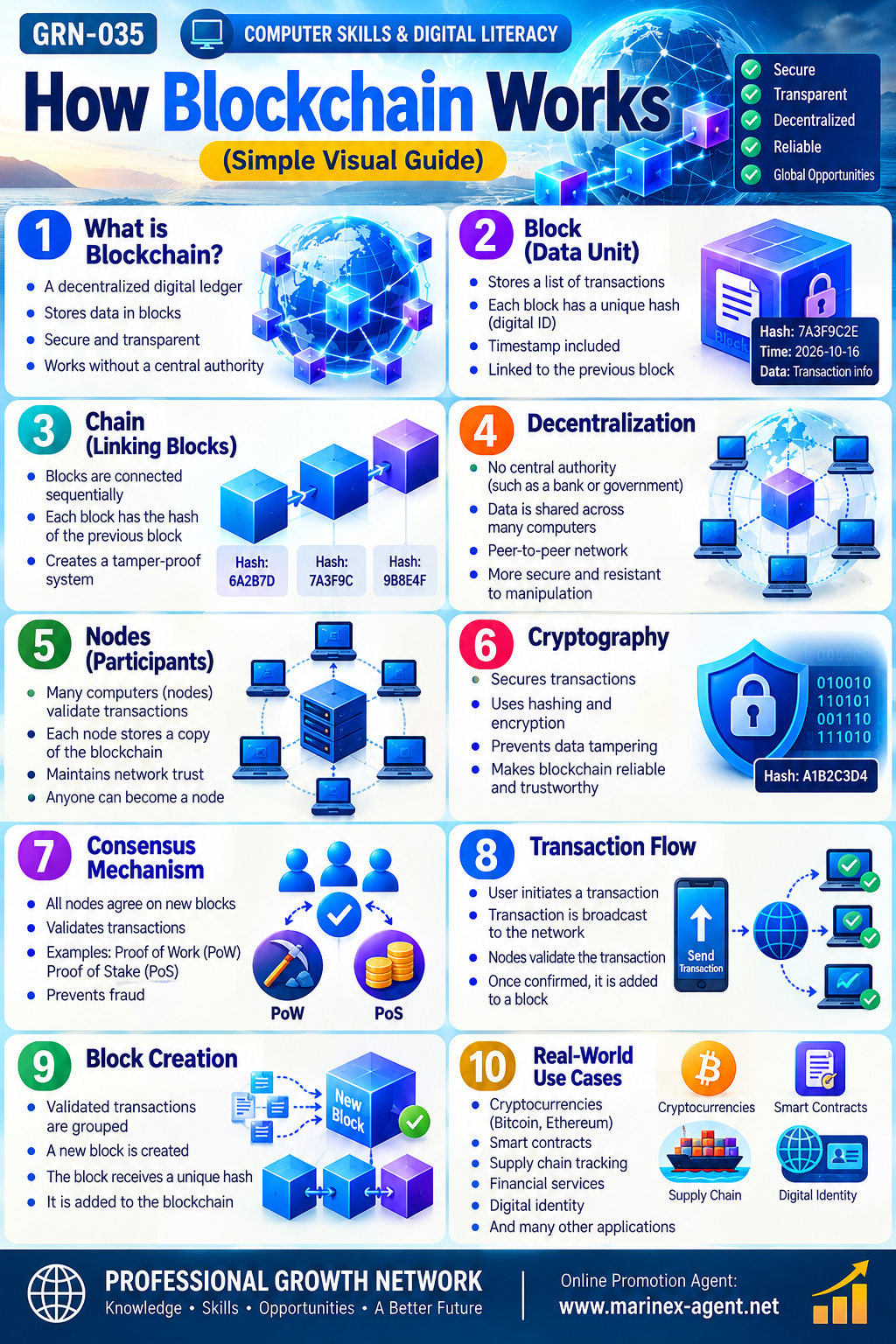
HOW BLOCKCHAIN WORKS:
A SIMPLE VISUAL GUIDE
Category: Computer Skills & Digital Literacy
ARTICLE CODE: GRN-035
PROFESSIONAL GROWTH NETWORK
Introduction
Blockchain is one of the most important technologies associated with the development of digital currencies, decentralized networks, and modern digital business systems.
Although blockchain is often discussed in connection with Bitcoin and other cryptocurrencies, its potential applications extend far beyond digital money.
Blockchain technology can also support digital contracts, supply chain management, financial services, digital identity systems, and secure recordkeeping.
Understanding the basic principles of blockchain is becoming increasingly valuable for entrepreneurs, business professionals, students, and anyone interested in developing their computer skills and digital literacy.
This article explains how blockchain works in 10 simple steps, following the structure of our GRN-035 infographic.
1. What Is Blockchain?
Blockchain is a distributed digital ledger that records transactions and other information across a network of computers.
Unlike a traditional database controlled by a single organization, many blockchain systems allow multiple independent participants to maintain and verify a shared record.
Main Characteristics
- Distributed Ledger: Information is maintained across multiple computers.
- Blocks: Transactions are organized into groups called blocks.
- Security: Cryptographic methods help protect the integrity of records.
- Transparency: Authorized participants can inspect and verify recorded information.
- Decentralization: Many blockchain networks operate without a single central authority.
Not every blockchain is fully decentralized or publicly accessible. Some are operated by a limited group of authorized organizations.
Simple Example
Imagine a digital accounting book shared among hundreds of independent computers.
When a new transaction is accepted, the network updates its records according to agreed rules.
This makes unauthorized alterations more difficult to conceal.
2. Block — The Basic Data Unit
A block is a digital container that holds a collection of transactions or other records.
Each block contains information that helps the network identify it and connect it to the blockchain.
Typical Block Information
- Transaction data.
- A timestamp or other time-related information.
- A cryptographic hash identifying the block.
- A reference to the previous block.
- Additional information required by the network’s protocol.
What Is a Hash?
A hash is a digital fingerprint produced by a mathematical function.
For example, a block might have an illustrative hash such as:
7A3F9C2E
Actual blockchain hashes are usually much longer.
If the information used to calculate a hash changes, the resulting hash will normally change as well.
This helps the network detect unauthorized modifications.
3. Chain — Linking Blocks Together
The word blockchain combines two concepts:
Block + Chain = Blockchain
Blocks are connected sequentially through cryptographic references.
Each new block normally includes a reference to the hash of the preceding block.
How the Chain Works
- Transactions are collected and validated.
- A new block is prepared.
- The block references the previous block.
- The network accepts the block according to its consensus rules.
- The new block becomes part of the blockchain.
Why Is This Important?
If someone changes information inside an earlier block, its hash will change.
That change can break the cryptographic links connecting subsequent blocks.
Consequently, altering historical records without detection becomes increasingly difficult, particularly in well-established decentralized networks.
Blockchain records are therefore commonly described as tamper-evident and tamper-resistant, rather than absolutely impossible to change.
4. Decentralization — No Single Central Authority
Decentralization is one of the most widely discussed characteristics of blockchain technology.
In a traditional centralized system, one organization may control the database and determine how information is updated.
In a decentralized blockchain network, these responsibilities can be distributed among many independent participants.
Main Features
- No single participant necessarily controls the entire network.
- Multiple computers maintain or verify records.
- Participants communicate through network protocols.
- Updates follow predefined rules.
- The network can continue operating despite some individual computer failures.
Practical Example
A conventional bank maintains its own transaction records.
A decentralized cryptocurrency network, by contrast, allows independent computers to verify transactions according to shared rules.
However, decentralization does not automatically guarantee complete security, privacy, or freedom from manipulation.
The actual level of decentralization depends on the network’s design and governance.
5. Nodes — Participants in the Blockchain Network
A node is a computer or software system that participates in a blockchain network.
Nodes help the network communicate, distribute information, and maintain its records.
Different types of nodes perform different functions.
Main Functions of Nodes
- Receive and transmit transactions.
- Verify transactions against network rules.
- Store blockchain records.
- Check newly proposed blocks.
- Help maintain consistency across the network.
Full Nodes and Lightweight Nodes
Full Nodes maintain and independently validate the blockchain information required by their protocol.
Lightweight Nodes generally store less information and depend on other nodes for some verification tasks.
Not every node stores a complete copy of the blockchain, and not every node participates directly in block production.
Why Are Nodes Important?
A distributed network of independently operated nodes can reduce dependence on a single computer or organization.
This contributes to the resilience and reliability of many blockchain systems.
6. Cryptography — Protecting Blockchain Information
Cryptography is an essential part of blockchain technology.
It uses mathematical techniques to protect information, verify transactions, and detect unauthorized changes.
Main Cryptographic Tools
1. Cryptographic Hashing
Hash functions generate digital fingerprints that help identify changes in recorded information.
2. Digital Signatures
Digital signatures allow participants to prove that transactions were authorized using the appropriate private keys.
3. Public and Private Keys
A public key can be shared or used in the process of identifying a participant.
A private key must remain confidential because it can authorize transactions involving associated digital assets.
Important Security Principle
Blockchain security does not depend on encryption alone.
Many public blockchains store transaction information that is visible to anyone.
Their security relies on a combination of cryptographic hashing, digital signatures, network rules, consensus mechanisms, and other safeguards.
Protecting private keys is particularly important because losing or exposing them can result in permanent loss of control over digital assets.
7. Consensus Mechanism — How the Network Reaches Agreement
A blockchain network needs rules for determining which transactions and blocks are valid.
These rules form part of its consensus mechanism.
Consensus helps participants agree on the accepted state of the blockchain without relying exclusively on a central administrator.
Proof of Work (PoW)
Proof of Work requires participating miners to perform computational work to propose valid blocks.
Bitcoin is a well-known example of a blockchain using Proof of Work.
Its security model relies partly on the computational resources required to alter the accepted transaction history.
Proof of Stake (PoS)
Proof of Stake selects or organizes validators according to protocol rules involving cryptocurrency that participants commit as a stake.
Ethereum is a well-known example of a blockchain using Proof of Stake.
Validators help propose and confirm blocks, and dishonest behavior can result in financial penalties under the network’s rules.
Why Consensus Matters
Consensus mechanisms help networks:
- Validate transactions.
- Agree on the accepted transaction history.
- Resolve competing block proposals.
- Reduce certain forms of fraud.
- Maintain consistent records across participants.
Different blockchain systems use different consensus methods, each with advantages, limitations, and security requirements.
8. Transaction Flow — From Sender to Blockchain
A blockchain transaction normally passes through several stages before becoming part of the accepted ledger.
Step 1 — Transaction Initiation
A user creates a transaction.
For example, a person may initiate a cryptocurrency transfer to another digital wallet.
Step 2 — Digital Authorization
The transaction is typically authorized using a cryptographic digital signature.
Step 3 — Network Broadcasting
The transaction is transmitted to participating nodes.
Step 4 — Transaction Validation
Nodes check whether the transaction follows the network’s rules.
Depending on the blockchain, these checks may include digital signatures, available funds, transaction formatting, and other conditions.
Step 5 — Block Inclusion
A miner, validator, or other authorized block producer includes the transaction in a proposed block.
Step 6 — Confirmation
Once the block is accepted by the network, the transaction receives its initial confirmation.
Some networks require additional blocks or other finality conditions before a transaction is considered sufficiently settled.
Practical Example
Sender → Digital Signature → Blockchain Network → Validation → Block Inclusion → Confirmation
This process allows participants to transfer digital assets according to shared technical rules.
9. Block Creation — Adding New Information
Block creation is the process of grouping validated transactions and adding them to the blockchain.
How a New Block Is Created
- The network receives transactions.
- Transactions are checked against protocol rules.
- Eligible transactions are selected for a proposed block.
- The block includes the necessary cryptographic references.
- The consensus mechanism determines whether the block is accepted.
- The accepted block is added to the blockchain’s history.
What Happens Next?
Once accepted, the new block becomes part of the shared record.
Participating nodes update their local blockchain information according to the protocol.
Future blocks build upon the accepted chain.
This structure helps maintain a chronological and verifiable history of transactions.
Can a Block Be Deleted?
In many blockchain systems, historical records are intentionally difficult to modify or remove.
However, blockchain reorganizations, governance decisions, software changes, or other exceptional circumstances can affect the accepted history.
The practical strength of record permanence depends on the particular blockchain network.
10. Real-World Applications of Blockchain
Blockchain technology has applications beyond cryptocurrency trading.
Its usefulness depends on whether a shared, verifiable record provides advantages over a conventional database.
A. Cryptocurrencies
Blockchain supports digital currencies such as Bitcoin and Ethereum’s native cryptocurrency, Ether.
These systems allow participants to transfer digital assets according to network rules.
B. Smart Contracts
Smart contracts are computer programs deployed on compatible blockchain networks.
They can automatically perform predefined actions when specified conditions are met.
For example, a smart contract may release a digital payment when required conditions have been verified.
C. Supply Chain Tracking
Blockchain can help organizations maintain shared records concerning the movement and origin of goods.
Potential applications include:
- Food supply chains.
- Manufacturing.
- International logistics.
- Product traceability.
- Verification of selected supply chain events.
Blockchain does not automatically guarantee that information entered into the system is accurate. Reliable data collection and verification remain essential.
D. Financial Services
Blockchain systems may support:
- Digital asset transfers.
- Payment settlement.
- Tokenized financial instruments.
- Shared financial records.
- Automated financial processes.
Their practical use depends on applicable regulations, technical infrastructure, and operational requirements.
E. Digital Identity
Blockchain-based identity systems are being explored as ways to manage verifiable credentials and digital identity information.
Such systems may help users prove selected facts without repeatedly sharing unnecessary personal information.
Privacy protection remains a major design consideration.
F. Other Potential Applications
Additional areas of exploration include:
- Healthcare record verification.
- Educational credentials.
- Intellectual property records.
- Business documentation.
- Digital certificates.
- Public registries.
11. Advantages and Limitations of Blockchain
Understanding blockchain also means recognizing what the technology can and cannot do.
Potential Advantages
Transparency: Shared records can make selected transactions easier to verify.
Traceability: Recorded events can be linked to their transaction history.
Tamper Resistance: Cryptographic linking and consensus mechanisms make unauthorized historical changes more difficult.
Resilience: Distributed systems can reduce dependence on individual infrastructure components.
Automation: Smart contracts can execute predefined processes.
Important Limitations
Scalability: Some blockchains process transactions more slowly than centralized databases.
Transaction Costs: Fees may increase during periods of high network demand.
Energy Consumption: Certain consensus mechanisms, particularly Proof of Work, can require substantial electricity.
Security Risks: Smart contract errors, stolen private keys, scams, and compromised applications can still cause losses.
Regulation: Legal requirements differ between jurisdictions.
Data Accuracy: Blockchain can preserve incorrect information just as effectively as correct information.
Privacy: Public blockchain records may expose transaction details that users did not intend to disclose.
For these reasons, blockchain should be selected only when its technical characteristics offer a meaningful benefit for a particular application.
12. Why Blockchain Knowledge Matters for Digital Literacy
Blockchain is an important subject within modern computer education because it brings together several fundamental technologies.
Studying blockchain helps develop an understanding of:
- Computer networks.
- Distributed databases.
- Digital signatures.
- Cryptographic hashing.
- Information security.
- Digital identity.
- Automated transactions.
- Online financial systems.
- Decentralized applications.
For entrepreneurs and professionals, this knowledge can also help distinguish realistic business opportunities from exaggerated promotional claims.
Recommended Learning Approach
Step 1: Understand how ordinary databases and digital transactions work.
Step 2: Learn the difference between centralized and decentralized networks.
Step 3: Study blocks, hashes, nodes, and digital signatures.
Step 4: Understand Proof of Work and Proof of Stake.
Step 5: Explore real blockchain applications without investing money.
Step 6: Learn the basic security principles of digital wallets and private keys.
Step 7: Evaluate whether blockchain provides a genuine advantage for a specific business process.
The objective should be to develop practical digital knowledge rather than to speculate on cryptocurrency prices.
Conclusion
Blockchain is a technology for maintaining shared digital records through cryptography, distributed networking, and agreed validation rules.
Its basic structure is relatively straightforward:
Transactions → Validation → Block Creation → Consensus → Blockchain
By linking blocks together and distributing records across participating computers, blockchain systems can make transaction histories easier to verify and more resistant to unauthorized modification.
The technology has become particularly well known through cryptocurrencies, but its potential applications extend to financial services, digital contracts, supply chain management, identity systems, and other business processes.
However, blockchain is not a universal solution. Its benefits must always be evaluated alongside its costs, technical limitations, security risks, and legal requirements.
For the PROFESSIONAL GROWTH NETWORK, the purpose of studying blockchain is to strengthen computer skills, improve digital literacy, and help people understand the technologies shaping modern business and international cooperation.
Knowledge creates understanding. Understanding creates opportunities.
Further Reading
- National Institute of Standards and Technology (NIST): https://www.nist.gov/information-technology/blockchain
- NIST Blockchain Technology Overview: https://doi.org/10.6028/NIST.IR.8202
- IBM — What Is Blockchain?: https://www.ibm.com/think/topics/blockchain
- IBM — Smart Contracts: https://www.ibm.com/topics/smart-contracts
PROFESSIONAL GROWTH NETWORK
Knowledge • Skills • Opportunities • A Better Future
Online Promotion Agent: https://www.marinex-agent.net