
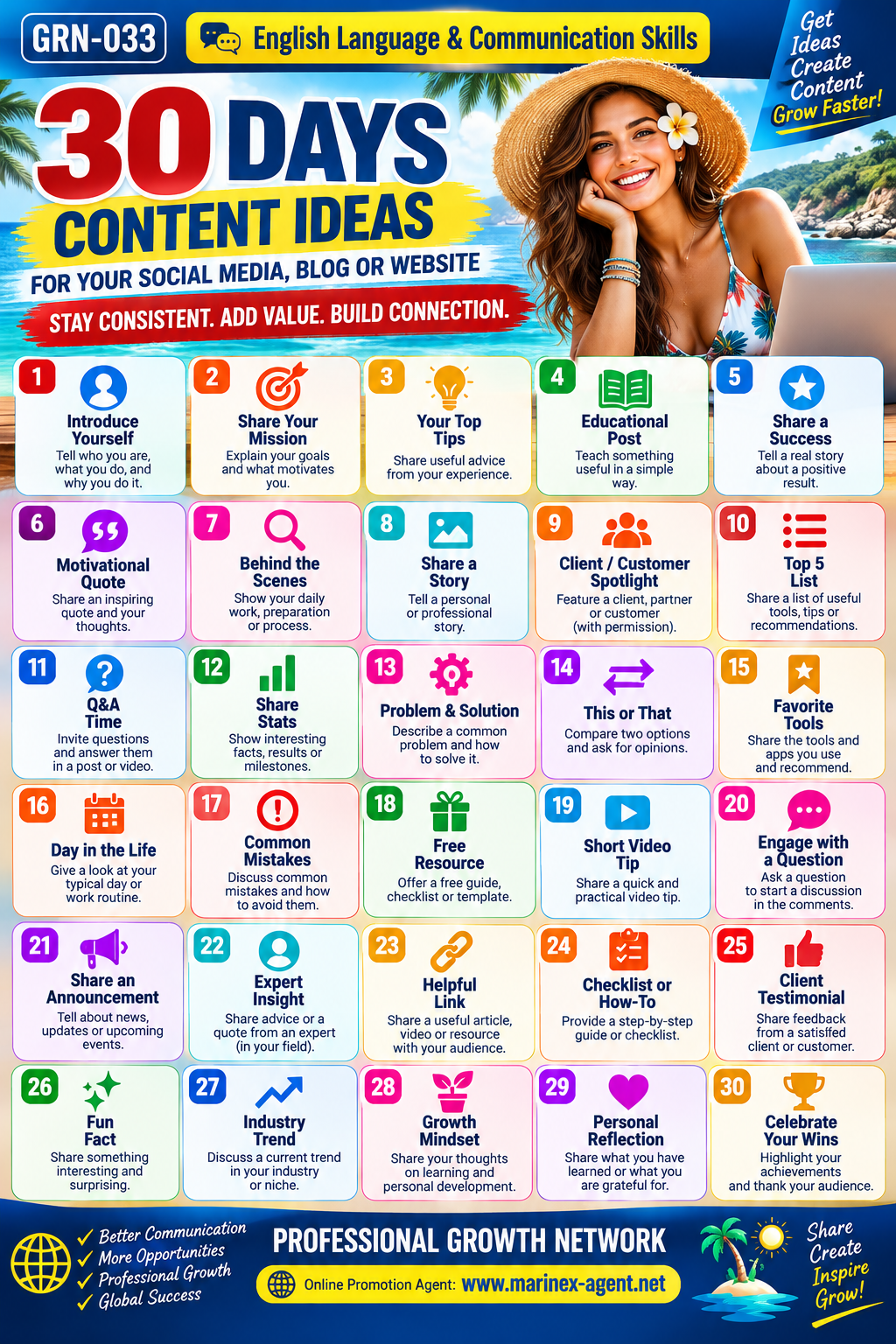
30 DAYS CONTENT IDEAS FOR SOCIAL MEDIA, BLOGS AND WEBSITES
Category: English Language & Communication Skills
Parent Category: PROFESSIONAL GROWTH NETWORK
Article Code: GRN-033
STAY CONSISTENT • ADD VALUE • BUILD CONNECTION!
Introduction
In today’s digital world, professional communication is essential for personal development, business promotion, and international networking.
Millions of individuals, entrepreneurs, consultants, freelancers, and small business owners use social media, blogs, and websites to introduce themselves, share knowledge, promote services, and communicate with potential customers.
However, one of the most common challenges is deciding what to publish regularly.
The GRN-033 infographic — 30 Days Content Ideas provides a practical monthly content plan with 30 different topics for creating engaging and informative publications.
These ideas can be adapted for Facebook, Instagram, LinkedIn, Pinterest, Threads, personal blogs, and professional websites.
The objective is not simply to publish more content, but to develop better communication, demonstrate professional knowledge, and build lasting relationships with an international audience.
1. Introduce Yourself
Your first publication should help people understand who you are.
Introduce your name, profession, experience, interests, and the services or knowledge you can offer.
Example
“Hello! My name is Alex. I work in international business development and online promotion. I enjoy connecting professionals, sharing useful knowledge, and exploring new business opportunities.”
Communication Tip
Keep your introduction friendly, professional, and easy to understand.
2. Share Your Mission
Explain why you do what you do and what motivates your professional activities.
A clear mission helps your audience understand your values and long-term objectives.
Example
“My mission is to help individuals develop their professional skills, establish an online presence, and connect with international business opportunities.”
Communication Tip
Focus on the value you want to create for others.
3. Share Your Top Tips
Provide useful recommendations based on your experience.
Practical advice helps establish professional credibility and encourages readers to follow your publications.
Example
“Three tips for improving your professional online presence: create a clear profile, describe your services accurately, and make your contact information easy to find.”
Communication Tip
Choose advice that readers can apply immediately.
4. Publish an Educational Post
Teach your audience something useful.
Educational publications may explain professional terminology, computer skills, business procedures, or practical communication techniques.
Example
“Did you know that Windows + E opens File Explorer? Learning simple keyboard shortcuts can make everyday computer work more efficient.”
Communication Tip
Explain one subject clearly rather than overwhelming readers with unnecessary details.
5. Share a Success
Describe a real achievement, completed project, or positive professional result.
Success stories can demonstrate experience and inspire others.
Example
“We have successfully launched a new educational section dedicated to computer literacy and professional communication.”
Communication Tip
Share genuine achievements without exaggerating results.
6. Share a Motivational Quote
An inspiring quotation can encourage reflection and discussion.
Choose a message related to professional growth, education, discipline, or personal development.
Example
“Every new skill you learn creates another opportunity for your future.”
Communication Tip
When using a quotation attributed to another person, verify its source.
7. Show Behind the Scenes
Introduce your audience to the work involved in preparing your products, services, or publications.
People often appreciate seeing the effort behind professional results.
Example
“Today we are preparing a new educational infographic for our Professional Growth Network blog.”
Communication Tip
Show authentic work processes while protecting confidential information.
8. Share a Story
Stories help readers connect with real experiences.
Describe a professional challenge, an important lesson, or a meaningful event.
Example
“When I first started working with international clients, I learned that clear communication and reliability were just as important as commercial knowledge.”
Communication Tip
Use a simple structure: situation, challenge, action, and lesson.
9. Client or Customer Spotlight
Introduce a client, customer, or business partner and explain their professional activities.
This can support networking and help other people discover useful services.
Example
“Today we are pleased to introduce one of our professional partners working in international business consulting.”
Communication Tip
Obtain permission before publishing personal information, photographs, or business details.
10. Create a Top 5 List
Lists are easy to read and useful for presenting practical information.
Choose five recommendations, tools, lessons, or resources relevant to your audience.
Example
“Top 5 Skills for International Business: English communication, computer literacy, negotiation, professional networking, and time management.”
Communication Tip
Keep each item short and explain why it matters.
11. Organize a Q&A Session
Invite your audience to ask questions about your professional field.
Questions and answers can help identify subjects for future publications.
Example
“Do you have questions about creating a professional online business presentation? Leave your questions in the comments.”
Communication Tip
Answer questions accurately and acknowledge when additional research is necessary.
12. Share Statistics
Relevant statistics can make educational content more informative.
Use verified figures from reliable organizations, research publications, or official reports.
Example
“Here are three important statistics about digital skills and employment, based on a recent industry report.”
Communication Tip
Always identify the source and date of the statistics.
13. Present a Problem and Solution
Identify a common problem experienced by your audience and explain a practical way to address it.
This approach is especially effective in professional service marketing.
Example
“Problem: Potential customers cannot find reliable information about your services online. Solution: Create a professional web presentation with clear service descriptions and contact details.”
Communication Tip
Describe realistic solutions rather than promising guaranteed commercial success.
14. This or That
Invite readers to compare two alternatives.
Comparison posts can encourage discussion and help people understand different approaches.
Example
“Which do you prefer for professional communication: Email or WhatsApp? Share your opinion and explain why.”
Communication Tip
Select comparisons that are relevant to your audience.
15. Share Your Favorite Tools
Introduce applications, websites, or professional tools that help you work more efficiently.
Explain what each tool does and why you find it useful.
Example
“My favorite digital tools include ChatGPT for drafting and research assistance, Excel for organizing information, and WordPress for publishing articles.”
Communication Tip
Distinguish personal preferences from objective product recommendations.
16. A Day in Your Life
Describe a typical working day or professional routine.
This type of content helps your audience understand your responsibilities and working methods.
Example
“My working day begins with reviewing business correspondence, preparing project updates, and organizing new publications for our professional network.”
Communication Tip
Focus on activities that provide useful insights into your profession.
17. Discuss Common Mistakes
Explain mistakes frequently made by beginners or professionals in your industry.
Offer practical advice on how to avoid them.
Example
“Three common mistakes in international business correspondence: unclear subject lines, incomplete commercial information, and failure to confirm the next steps.”
Communication Tip
Be constructive. The purpose is education, not criticism.
18. Offer a Free Resource
Share a useful guide, checklist, template, or educational material.
Free resources can demonstrate expertise and help readers solve practical problems.
Example
“Download our free checklist for preparing a professional business introduction.”
Communication Tip
Clearly describe what the resource contains and whether registration is required.
19. Share a Short Video Tip
Create a short educational video explaining one useful skill.
Video content can be effective for demonstrations, tutorials, and professional presentations.
Example
“Today’s 30-second tip: How to open Windows Settings using the keyboard shortcut Win + I.”
Communication Tip
Use clear speech, readable captions, and a focused message.
20. Engage With a Question
Ask your audience a question that encourages meaningful discussion.
Questions can help you learn more about the interests and needs of your readers.
Example
“Which professional skill would you most like to improve this year: English, computer literacy, business communication, or personal development?”
Communication Tip
Respond respectfully to different opinions.
21. Share an Announcement
Inform your audience about new services, upcoming events, educational materials, or project developments.
Example
“We are pleased to announce a new educational series dedicated to English language and international business communication.”
Communication Tip
Include the essential details: what, when, where, and how to participate.
22. Share an Expert Insight
Present advice or observations from a qualified professional.
Expert perspectives can help readers better understand complex subjects.
Example
“An experienced maritime professional explains why clear communication is essential for safe and efficient shipboard operations.”
Communication Tip
Identify the expert and distinguish professional opinion from established facts.
23. Share a Helpful Link
Recommend a useful website, article, educational resource, or professional organization.
Explain why the resource may benefit your audience.
Example
“Explore our Professional Growth Network blog for educational materials on digital literacy, communication, and personal development.”
Communication Tip
Check that the link works and leads to relevant information.
24. Publish a Checklist or How-To Guide
Step-by-step instructions are particularly useful for teaching practical skills.
Choose a process that readers can complete independently.
Example
“How to Prepare Your First Professional Online Profile: Step 1 — Introduce yourself. Step 2 — Describe your experience. Step 3 — List your services. Step 4 — Provide contact information.”
Communication Tip
Use numbered steps and avoid unnecessary technical terminology.
25. Share a Client Testimonial
Publish genuine feedback from a satisfied customer.
Testimonials can help potential customers understand the experience of working with you.
Example
“Our client appreciated the clear communication and professional presentation of the completed project.”
Communication Tip
Obtain permission, preserve the original meaning, and never invent testimonials.
26. Share a Fun Fact
Interesting facts can make educational content more engaging.
Choose something surprising but relevant to your audience.
Example
“Fun Fact: The first widely recognized computer mouse prototype was demonstrated in the 1960s, long before modern graphical computer interfaces became common.”
Communication Tip
Verify factual statements before publication.
27. Discuss an Industry Trend
Introduce a current development in your professional field.
Explain how it may influence businesses, employees, or customers.
Example
“Artificial intelligence is changing how businesses prepare content, communicate with customers, and organize administrative work.”
Communication Tip
Separate established developments from predictions and personal opinions.
28. Share a Growth Mindset Message
Encourage your audience to continue learning and developing professional skills.
Personal growth content can support motivation and lifelong education.
Example
“You do not need to master every skill immediately. Learn something useful today, practice tomorrow, and continue improving.”
Communication Tip
Promote realistic, consistent progress rather than instant success.
29. Publish a Personal Reflection
Share something you have learned through professional or personal experience.
Reflections can make communication more authentic and meaningful.
Example
“One important lesson from my professional experience is that long-term relationships depend on trust, patience, and consistent communication.”
Communication Tip
Focus on lessons that may benefit your audience.
30. Celebrate Your Wins
Finish the month by reviewing achievements, thanking supporters, and identifying future objectives.
Recognizing progress helps maintain motivation and strengthens relationships.
Example
“During the past month, we published new educational materials, developed professional connections, and explored opportunities for future cooperation. Thank you for being part of our network!”
Communication Tip
Celebrate progress honestly and acknowledge the contributions of others.
31. How to Use the 30-Day Content Plan
The GRN-033 infographic provides a flexible structure for preparing a monthly publication calendar.
You do not need to publish every idea on every platform.
Instead, adapt each topic to your audience, available time, and professional objectives.
Step 1 — Define Your Audience
Identify who you want to reach.
Your audience may include students, entrepreneurs, professionals, potential customers, or international business partners.
Step 2 — Choose Suitable Platforms
Different platforms support different types of communication.
Facebook can be useful for community discussions, LinkedIn for professional networking, Instagram for visual storytelling, Pinterest for discovering visual resources, and blogs for detailed educational articles.
Step 3 — Prepare Content in Advance
Develop a publication calendar and prepare drafts, images, and links before posting.
This helps maintain consistency and reduces last-minute work.
Step 4 — Adapt the English Language
Use clear and natural English suitable for your audience.
Avoid unnecessary jargon and overly complicated sentences.
Step 5 — Encourage Communication
Invite questions, comments, and constructive discussion.
Professional networking depends on meaningful interaction, not simply the number of publications.
Step 6 — Review Your Results
Evaluate which publications generate useful conversations, inquiries, or other meaningful responses.
Use these observations to improve your future content strategy.
32. Practical English Communication Skills
A regular content calendar can also serve as a practical English-learning exercise.
By preparing different types of publications, individuals can improve vocabulary, grammar, written communication, and confidence.
Introducing Yourself
Useful expressions include:
- “My name is…”
- “I specialize in…”
- “I have experience in…”
- “My professional interests include…”
Sharing Knowledge
Useful expressions include:
- “Here are three practical tips…”
- “Let me explain…”
- “One important point to remember is…”
- “This approach may help you…”
Inviting Discussion
Useful expressions include:
- “What is your opinion?”
- “Have you experienced something similar?”
- “Which option would you prefer?”
- “Please share your thoughts in the comments.”
Building Professional Relationships
Useful expressions include:
- “Thank you for your interest.”
- “I appreciate your feedback.”
- “I would be pleased to discuss this opportunity.”
- “I look forward to hearing from you.”
Practicing these expressions can help develop communication skills for social media, business correspondence, and international networking.
33. From Content Creation to Professional Online Promotion
Publishing useful content is one of the ways individuals can establish a recognizable professional identity.
A professional online presence helps potential customers and business partners learn about your qualifications, experience, interests, and services.
The PROFESSIONAL GROWTH NETWORK encourages individuals to combine knowledge development with practical communication and networking skills.
Through the concept of a Personal Online Promotion Agent, MARINEX AGENT promotes an approach based on a simple principle:
First promote yourself and your professional abilities. Then promote the products and services you represent.
A personal web presentation can serve as a digital business card, while regular educational publications can demonstrate your knowledge and professional interests.
However, visibility alone does not guarantee commercial success. Sustainable business relationships depend on competence, trust, reliable services, and genuine customer demand.
Conclusion
The GRN-033 — 30 Days Content Ideas infographic offers a practical monthly plan for individuals who want to improve their English communication, create educational content, and develop their professional online presence.
The 30 topics cover personal introductions, professional missions, educational publications, customer stories, useful resources, expert insights, industry developments, and personal achievements.
The most important principle is not simply to publish something every day.
It is to communicate consistently, share useful knowledge, and develop meaningful relationships with your audience.
For entrepreneurs, consultants, professionals, and individuals interested in international opportunities, these activities can support professional development and stronger digital communication skills.
STAY CONSISTENT • ADD VALUE • BUILD CONNECTION!
SHARE • CREATE • INSPIRE • GROW!
PROFESSIONAL GROWTH NETWORK
Online Promotion Agent: www.marinex-agent.net