
MARKETING PLAN: FROM STRATEGY
TO BUSINESS GROWTH
Parent Category: PROFESSIONAL GROWTH NETWORK
Category: Personal Growth & Self-Development
Article Code: GRN-039
STRATEGY • TARGET • GROWTH • SUCCESS
Introduction
Every successful business needs customers.
However, attracting customers, developing professional relationships, and increasing sales rarely happen automatically.
Even a company offering excellent products or services may struggle to grow if potential customers do not know that the company exists.
This is why a well-organized Marketing Plan is one of the most important tools for business development.
A marketing plan helps entrepreneurs understand their market, identify potential customers, establish business objectives, select effective promotional channels, and evaluate the results of their activities.
It transforms general business ambitions into a structured system of practical actions.
A GOOD PLAN TODAY, BIG RESULTS TOMORROW.
For small businesses, independent professionals, consultants, service providers, and international trading companies, a marketing plan does not necessarily require a large advertising budget.
It requires clear objectives, an understanding of customers, consistent communication, and the ability to evaluate results.
This article explains the five essential stages of a successful marketing plan, together with practical recommendations for developing and promoting a business in the modern digital economy.
1. Market Research — Understand Your Business Environment
Market research is the foundation of every effective marketing plan.
Before promoting a product or service, entrepreneurs should understand the market in which they intend to operate.
This includes studying customer needs, competitors, prices, purchasing behaviour, and potential opportunities.
A. Understand Your Market
Begin by identifying the market for your products or services.
Important questions include:
- What products or services are in demand?
- Who are the potential customers?
- In which countries or regions are they located?
- What prices are customers willing to pay?
- What problems are customers trying to solve?
- What factors influence purchasing decisions?
For international business, market research should also consider language, cultural differences, logistics, legal requirements, and payment conditions.
B. Analyze Your Competitors
Competitor analysis helps identify how other businesses attract customers and position their products.
Study their:
- Websites and online presentations.
- Product and service descriptions.
- Pricing structures.
- Advertising channels.
- Customer reviews.
- Professional reputation.
- Competitive advantages.
The purpose is not simply to imitate competitors.
It is to understand what customers already receive and identify opportunities to offer something better or different.
C. Identify Customer Needs
Successful marketing begins with understanding the customer.
A business should identify the practical problems its customers experience and determine how its products or services can help solve them.
For example, a small manufacturer may produce high-quality products at competitive prices but lack access to international customers.
Its primary need may not be additional production capacity.
It may need professional international promotion and reliable business contacts.
D. Find Market Gaps and Opportunities
A market gap exists when customer demand is not adequately satisfied by existing products or services.
Possible opportunities include:
- Underserved customer groups.
- Specialized professional services.
- Products unavailable in particular regions.
- Better customer support.
- More convenient online purchasing.
- Improved delivery conditions.
- Professional digital promotion for small businesses.
Key Principle: Know the market before investing significant resources in promotion.
2. Target Audience — Identify Your Ideal Customers
Not every person is a potential customer for every business.
Trying to promote products or services to everyone can waste time, money, and effort.
A successful marketing plan identifies the specific groups most likely to benefit from the business offering.
A. Define Your Ideal Customer
An ideal customer is a person or organization whose needs closely match the products or services being offered.
For a business-to-business company, useful characteristics may include:
- Industry.
- Country or region.
- Company size.
- Purchasing requirements.
- Budget.
- Decision-making authority.
- Business development objectives.
For consumer products, relevant characteristics may include interests, purchasing habits, lifestyle, and customer needs.
B. Segment Your Audience
Market segmentation means dividing potential customers into smaller groups with similar characteristics.
Common segmentation methods include:
Geographic Segmentation: Customers grouped by country, city, or region.
Demographic Segmentation: Customers grouped by characteristics such as age or income, where relevant and appropriate.
Behavioural Segmentation: Customers grouped by purchasing habits, interests, and product usage.
Business Segmentation: Organizations grouped by industry, size, procurement needs, or commercial activity.
Segmentation allows businesses to prepare more relevant marketing messages.
C. Understand Customer Problems
Customers generally purchase products or services because they expect to receive a benefit or solve a problem.
For example:
A maritime professional may need assistance presenting qualifications to international employers.
A manufacturer may need new overseas distributors.
A consultant may need a professional website to demonstrate expertise.
A small trading company may need additional customers and reliable suppliers.
Each customer group requires a different marketing approach.
D. Build Customer Personas
A customer persona is a simplified profile representing a typical customer.
For example:
Customer Persona — Small International Trader
- Operates a small import-export business.
- Has limited marketing resources.
- Needs international customers.
- Uses email, WhatsApp, and professional networks.
- Requires a credible online business presentation.
- Wants practical promotion at an affordable cost.
A clear customer persona helps develop suitable promotional messages and service packages.
Key Principle: Deliver the right message to the right people.
3. Marketing Strategy — Build a Clear Business Direction
A marketing strategy explains how a business intends to attract customers, communicate its value, and achieve its objectives.
It connects market research with practical promotional activities.
A. Set Clear Marketing Goals
Business goals should be specific and measurable.
A useful approach is the SMART framework:
- Specific: Clearly define the objective.
- Measurable: Establish how progress will be evaluated.
- Achievable: Consider available resources.
- Relevant: Connect the objective to business priorities.
- Time-Bound: Establish a realistic deadline.
Practical Example
Instead of saying:
“We want more customers.”
A company might establish the following objective:
“Generate 30 qualified business inquiries from potential international customers within the next three months.”
This objective can be monitored and evaluated.
B. Choose the Right Marketing Mix
The traditional marketing mix includes four important elements:
Product: What are you offering?
Price: What will customers pay?
Place: Where and how will customers obtain the product or service?
Promotion: How will potential customers learn about the offering?
For service businesses, additional considerations may include people, processes, and customer experience.
C. Position Your Brand
Brand positioning describes how a business wants customers to perceive it.
A strong position should communicate:
- Professional competence.
- Reliability.
- Product or service quality.
- Customer benefits.
- Competitive advantages.
- A recognizable business identity.
For example, a small business may position itself as a reliable supplier of competitively priced products with professional international customer support.
D. Create a Unique Value Proposition
A Unique Value Proposition (UVP) explains why customers should consider choosing your business.
It should answer three questions:
- What do you offer?
- What problem do you solve?
- Why is your offering valuable or different?
Practical Example
Marinex-Agent — Your Personal Online Promotion Agent
A professional online promotion service designed to help entrepreneurs, specialists, and companies establish their digital business presence and increase their visibility to potential international customers and partners.
The value proposition should be realistic, understandable, and supported by the services actually provided.
Key Principle: A clear strategy creates a stronger and more recognizable business.
4. Marketing Tactics and Channels — Put Your Strategy Into Action
Marketing strategy defines the direction.
Marketing tactics determine the practical activities used to reach customers.
Modern businesses can use several promotional channels, depending on their target audience and available resources.
A. Social Media Marketing
Social media platforms allow businesses to communicate with customers, publish information, and build professional communities.
Common platforms include:
- Facebook.
- Instagram.
- LinkedIn.
- Pinterest.
- Threads.
- YouTube.
- TikTok.
Different platforms serve different audiences and communication purposes.
For example, LinkedIn may be particularly relevant for professional business contacts, while Instagram and Pinterest can support visual product promotion.
The appropriate choice depends on customer behaviour and business objectives.
B. Content Marketing
Content marketing involves creating and distributing useful information that attracts and educates potential customers.
Examples include:
- Educational articles.
- Company profiles.
- Product descriptions.
- Professional infographics.
- Industry news.
- Practical guides.
- Case studies.
- Business presentations.
Useful content can help demonstrate expertise and support long-term customer relationships.
For the PROFESSIONAL GROWTH NETWORK, educational articles and infographics are an important part of our content development approach.
C. Email Marketing
Email remains an important communication tool in international business.
It can be used for:
- Introducing a company.
- Presenting products and services.
- Sending commercial proposals.
- Maintaining customer relationships.
- Sharing professional updates.
- Following up on business inquiries.
Effective business emails should be concise, relevant, and personalized.
Commercial email campaigns should also comply with applicable privacy and anti-spam requirements.
D. Paid Advertising
Paid advertising can help businesses reach selected audiences through search engines, social networks, and other online platforms.
Examples include:
- Search advertising.
- Social media advertisements.
- Display advertising.
- Sponsored content.
- Retargeting campaigns.
Paid advertising requires careful budget control and performance monitoring.
Spending more money does not automatically produce better results.
E. Influencer and Partnership Marketing
Businesses may cooperate with industry specialists, professional communities, or other organizations to reach relevant audiences.
Possible arrangements include:
- Referral partnerships.
- Joint promotional campaigns.
- Professional endorsements.
- Affiliate programs.
- Business network cooperation.
Any commercial relationship should be transparent and comply with applicable advertising requirements.
F. Search Engine Optimization (SEO)
SEO helps make website content easier for search engines to discover, understand, and potentially display in relevant search results.
Important SEO practices include:
- Clear article titles.
- Useful original content.
- Logical heading structures.
- Relevant keywords.
- Descriptive page addresses.
- Internal links.
- Mobile-friendly website design.
- Accurate business information.
Search indexing and ranking are not guaranteed, and results may develop gradually.
G. Your Own Professional Website
A professional website is one of the most important elements of modern business presentation.
It provides a central online location where potential customers can find information about:
- Your company.
- Your professional background.
- Products and services.
- Business opportunities.
- Contact details.
- Relevant experience and references.
Social media accounts can support business promotion, but they should not necessarily replace a professional website.
Key Principle: Use multiple appropriate channels to increase your reach while maintaining a consistent professional identity.
5. Monitor and Evaluate — Measure Your Marketing Results
A marketing plan should not remain unchanged after implementation.
Markets change, customer preferences evolve, and promotional channels produce different results.
Regular evaluation helps businesses understand which activities are effective and which require improvement.
A. Track Marketing Performance
Important performance indicators may include:
- Website visitors.
- Customer inquiries.
- Qualified leads.
- Email responses.
- Conversion rates.
- Customer acquisition costs.
- Sales revenue.
- Repeat customers.
- Customer retention.
- Advertising expenses.
Not every business needs to monitor every indicator.
The most useful measurements are those directly connected to its objectives.
B. Analyze Results
Compare actual performance with the goals established in the marketing plan.
For example:
A company launches a three-month promotional campaign.
During that period, it receives:
- 2,000 website visits.
- 100 inquiries.
- 20 qualified leads.
- 5 new customers.
These figures provide a starting point for evaluating marketing performance.
However, the company must also consider the quality of the customers, the cost of promotion, and the profitability of resulting sales.
C. Measure Return on Investment (ROI)
Marketing ROI helps evaluate the financial effectiveness of promotional spending.
A simplified formula is:
Marketing ROI = (Return Attributable to Marketing − Marketing Cost) ÷ Marketing Cost × 100%
For example:
If a campaign costs $500 and produces $1,500 in attributable contribution before marketing costs, the simplified ROI is:
($1,500 − $500) ÷ $500 × 100% = 200%
This is an illustrative calculation. Accurate ROI measurement should account for relevant product or service costs and the difficulty of attributing results to a particular campaign.
D. Optimize Your Strategy
If a promotional channel performs poorly, the business should investigate why.
Possible reasons include:
- Incorrect audience targeting.
- Unclear promotional messages.
- Inadequate product presentation.
- Weak customer trust.
- Unsuitable pricing.
- Ineffective website design.
- Insufficient follow-up communication.
Improvements should be based on evidence rather than assumptions.
E. Improve Continuously
Marketing is an ongoing process.
Businesses should periodically review:
- Customer needs.
- Competitor activity.
- Promotional content.
- Marketing expenses.
- Sales performance.
- Website information.
- Business development opportunities.
Key Principle: Measure today to improve tomorrow.
6. The Marketing Plan Roadmap
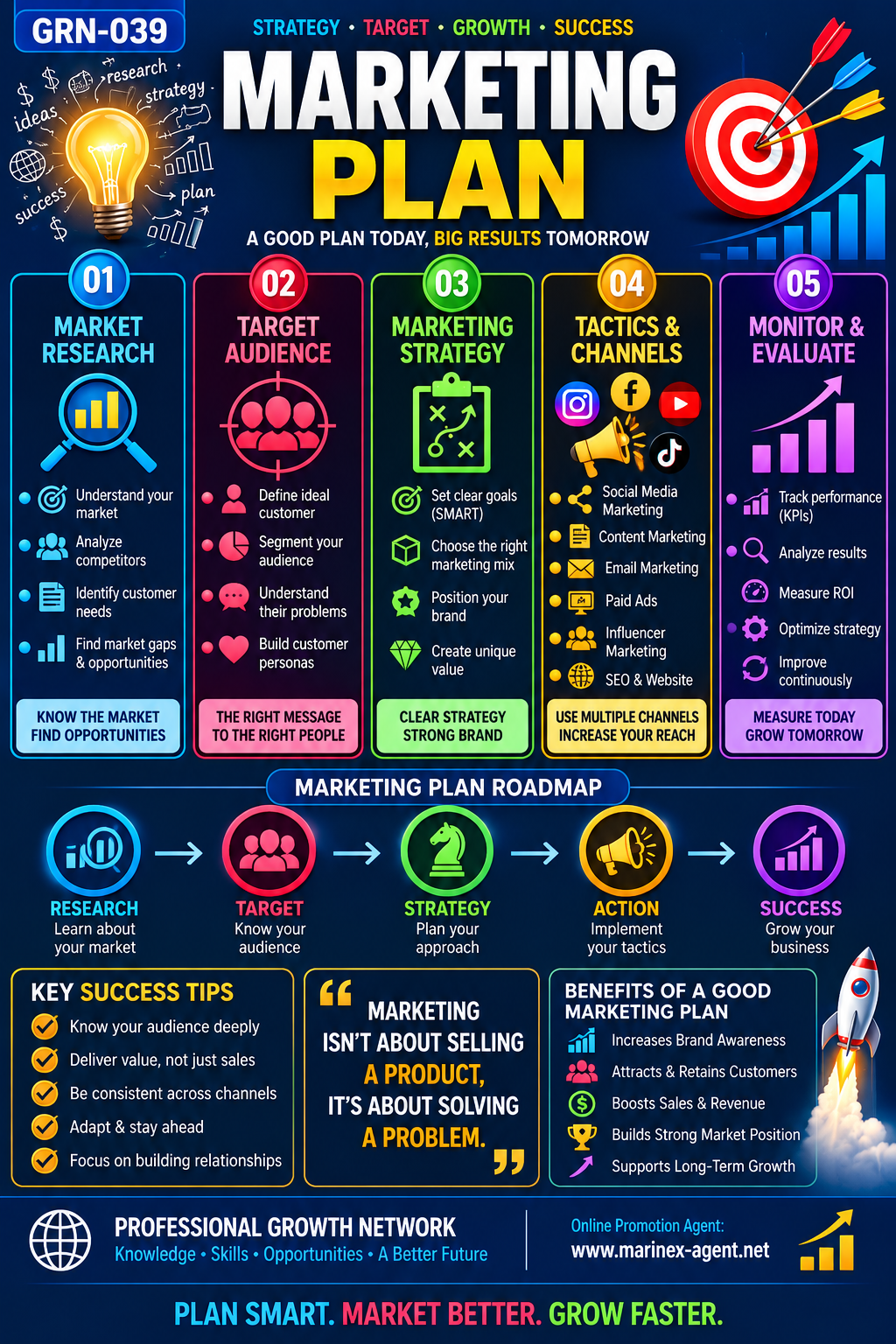
Our GRN-039 infographic presents a simple five-stage roadmap:
RESEARCH → TARGET → STRATEGY → ACTION → SUCCESS
Stage 1 — Research
Learn about the market, competitors, and customer needs.
Stage 2 — Target
Identify the customers most likely to benefit from your offering.
Stage 3 — Strategy
Establish clear objectives and decide how your business will create value.
Stage 4 — Action
Implement promotional activities through appropriate communication channels.
Stage 5 — Success
Evaluate results, improve performance, and pursue sustainable business growth.
Success is not automatic at the end of the process.
The roadmap should be repeated as new information becomes available.
Marketing is a continuous cycle of learning, planning, action, and improvement.
7. Five Key Success Tips
The infographic highlights five practical principles that apply to businesses of different sizes.
1. Know Your Audience Deeply
Understand customers’ needs, purchasing decisions, and professional expectations.
2. Deliver Value, Not Just Sales
Focus on solving genuine customer problems rather than promoting products without a clear benefit.
3. Be Consistent Across Channels
Use recognizable branding, accurate information, and consistent contact details.
4. Adapt and Stay Ahead
Monitor changes in technology, customer preferences, and competitive conditions.
5. Focus on Building Relationships
Long-term customer relationships can be more valuable than isolated transactions.
Marketing is not only about attracting customers. It is also about giving them reasons to return.
8. Marketing Is About Solving Problems
One of the central messages of our infographic is:
MARKETING ISN’T ABOUT SELLING A PRODUCT. IT’S ABOUT SOLVING A PROBLEM.
This principle explains why customer understanding is so important.
People rarely purchase products or services simply because a company wants to sell them.
They purchase because they expect some form of value.
Practical Examples
A Maritime Professional
The problem: Limited visibility to international employers.
A possible solution: A professional online profile presenting qualifications, experience, and contact information.
A Small Manufacturer
The problem: Insufficient access to overseas customers.
A possible solution: International product promotion, digital catalogues, and business networking.
An Independent Consultant
The problem: Potential clients cannot easily verify professional experience.
A possible solution: A professional website presenting services, qualifications, and relevant work.
A Small Trading Company
The problem: Difficulty establishing credibility with unfamiliar buyers.
A possible solution: A consistent professional business presentation with verifiable company information and reliable communication channels.
Key Principle: Identify the customer’s problem first. Then explain how your business can help solve it.
9. Benefits of a Good Marketing Plan
A well-developed marketing plan can provide several important business advantages.
A. Increased Brand Awareness
Consistent promotion helps potential customers become familiar with a company’s name, products, and services.
B. Customer Attraction and Retention
Relevant marketing can generate new inquiries while supporting relationships with existing customers.
C. Improved Sales Opportunities
A clearer understanding of customer needs can improve the quality of sales conversations and commercial proposals.
D. Stronger Market Position
Professional communication and consistent service delivery can help a business differentiate itself from competitors.
E. Long-Term Business Growth
A structured approach makes it easier to identify opportunities, allocate resources, and improve results over time.
These benefits are potential outcomes rather than guaranteed results.
Their realization depends on the quality of the offering, market conditions, execution, and customer satisfaction.
10. Practical Marketing Plan for a Small Business
A small business does not need a complicated marketing department to begin promoting itself professionally.
A simple plan can provide a useful starting point.
Step 1 — Prepare Your Professional Identity
Establish a consistent company name, business description, logo where appropriate, and professional contact information.
Step 2 — Create Your Online Business Presentation
Develop a website or professional mini-web page explaining who you are, what you offer, and how customers can contact you.
Step 3 — Define Your Main Products or Services
Describe the offering clearly and explain its practical benefits.
Step 4 — Identify Your Target Customers
Determine which customer groups, industries, or countries are most relevant.
Step 5 — Select Promotional Channels
Choose a manageable combination of website content, social media, professional networking, and direct business correspondence.
Step 6 — Prepare Promotional Materials
Create professional business cards, commercial presentations, brochures, product catalogues, or infographics.
Step 7 — Begin Consistent Promotion
Publish useful information, communicate with relevant contacts, and respond promptly to genuine inquiries.
Step 8 — Record Business Contacts
Maintain an organized list of customers, inquiries, partners, and follow-up activities, respecting applicable privacy requirements.
Step 9 — Evaluate Results
Identify which promotional activities generate meaningful inquiries and profitable business.
Step 10 — Improve and Expand
Strengthen successful channels and gradually explore new markets.
Key Principle: Start with a simple, affordable system that can develop alongside your business.
11. Your Full Style — A Professional Marketing Foundation
For the Marinex-Agent project, we propose a unified approach to professional business presentation called Your Full Style.
The concept combines three important elements:
Premium Business Card → Mini-Web Presence → Personal Online Promotion Agent
A. Premium Business Card
A professional presentation of an entrepreneur, specialist, or company.
It should provide accurate information and convenient contact details.
B. Mini-Web Presence
A dedicated online presentation that explains professional activities, products, services, and business interests.
This presentation can be updated as the business develops.
C. Personal Online Promotion Agent
An additional professional promotion channel intended to improve business visibility and support the introduction of services, products, and projects.
Through Marinex-Agent, the objective is to help clients develop a consistent and credible Internet presence.
Consistent Contact Information
Professional promotional materials should preferably include:
- Mobile / WhatsApp.
- Email.
- Mini-Web Presence.
- Marinex-Agent — Your Personal Online Promotion Agent.
This format can be used across business cards, commercial offers, flyers, catalogues, and other promotional materials.
12. Every Sale Is a New Business Contact
Even a small commercial transaction can become the beginning of a long-term customer relationship.
When a customer purchases a product or service, the seller has an opportunity to introduce the business professionally.
For example, the customer may receive a business card or small flyer containing the company’s complete contact information and website.
This creates an opportunity for future communication.
A customer who initially purchases one inexpensive product may later require additional products, services, or professional assistance.
However, long-term relationships depend on more than contact information.
They require:
- Reliable products and services.
- Honest communication.
- Reasonable prices.
- Professional customer support.
- Consistent fulfilment of commitments.
- Respect for customer preferences.
Key Principle: Every sale is an opportunity to establish trust and develop a lasting business relationship.
13. International Marketing Opportunities — China, Africa, and Global Markets
Digital communication allows small businesses to explore opportunities beyond their local markets.
Manufacturers, suppliers, consultants, and service providers can potentially reach customers in other countries without maintaining physical offices in every market.
For example, a manufacturer in China may seek additional customers in Africa or Europe.
An African entrepreneur may be interested in representing international suppliers.
A European professional may offer consulting services to customers worldwide.
A coordinated marketing approach can help connect these participants.
Potential Areas of Cooperation
- International product promotion.
- Business representation.
- Supplier and customer introductions.
- Professional web presentations.
- Digital catalogues.
- Online marketing support.
- Business networking.
- Small business development.
International activities also require appropriate attention to trade regulations, customs procedures, taxation, logistics, payment security, and partner verification.
Key Principle: Digital marketing can expand access to international markets, but successful trade still requires reliable business operations.
14. The Role of PROFESSIONAL GROWTH NETWORK
The PROFESSIONAL GROWTH NETWORK (PGN) promotes knowledge, professional development, business visibility, and international cooperation.
Our objective is to help individuals and small businesses improve their professional presentation, develop practical skills, and explore additional income opportunities.
A marketing plan is an essential part of this process.
Through educational articles, infographics, business networking, and the services of Marinex-Agent, we encourage entrepreneurs to develop their own professional identity before attempting to promote other companies’ products or services.
Our central principle is:
FIRST PROMOTE YOURSELF — THEN PROMOTE THE PRODUCTS AND SERVICES YOU REPRESENT.
This approach can help potential customers understand who they are dealing with and make it easier to establish professional communication.
For small businesses, a credible online presentation combined with a clear marketing strategy can provide a practical foundation for long-term development.
Conclusion
A successful marketing plan begins with understanding the market and identifying the needs of potential customers.
It then develops through clear business objectives, appropriate promotional channels, practical implementation, and continuous performance evaluation.
The five essential stages are:
MARKET RESEARCH → TARGET AUDIENCE → MARKETING STRATEGY → TACTICS & CHANNELS → MONITOR & EVALUATE
These stages form a practical framework that can be adapted to different industries, countries, and business models.
For small businesses, marketing does not have to begin with large advertising expenditures.
It can begin with a professional business presentation, a clear description of products and services, accurate contact information, and consistent communication with potential customers.
The most important principle is to create genuine value.
Marketing is not simply about selling more products. It is about understanding customers, solving problems, building trust, and developing sustainable business relationships.
For the PROFESSIONAL GROWTH NETWORK, effective marketing is closely connected with personal development, professional visibility, and international business cooperation.
Our message is simple:
PLAN SMART. MARKET BETTER. GROW FASTER.
Further Reading
- U.S. Small Business Administration — Marketing and Sales: https://www.sba.gov/business-guide/manage-your-business/marketing-sales
- HubSpot Academy — Marketing Education: https://academy.hubspot.com/
- Google Skillshop — Digital Marketing Training: https://skillshop.withgoogle.com/
- American Marketing Association: https://www.ama.org/
PROFESSIONAL GROWTH NETWORK
Knowledge • Skills • Opportunities • A Better Future
Online Promotion Agent: https://www.marinex-agent.net