
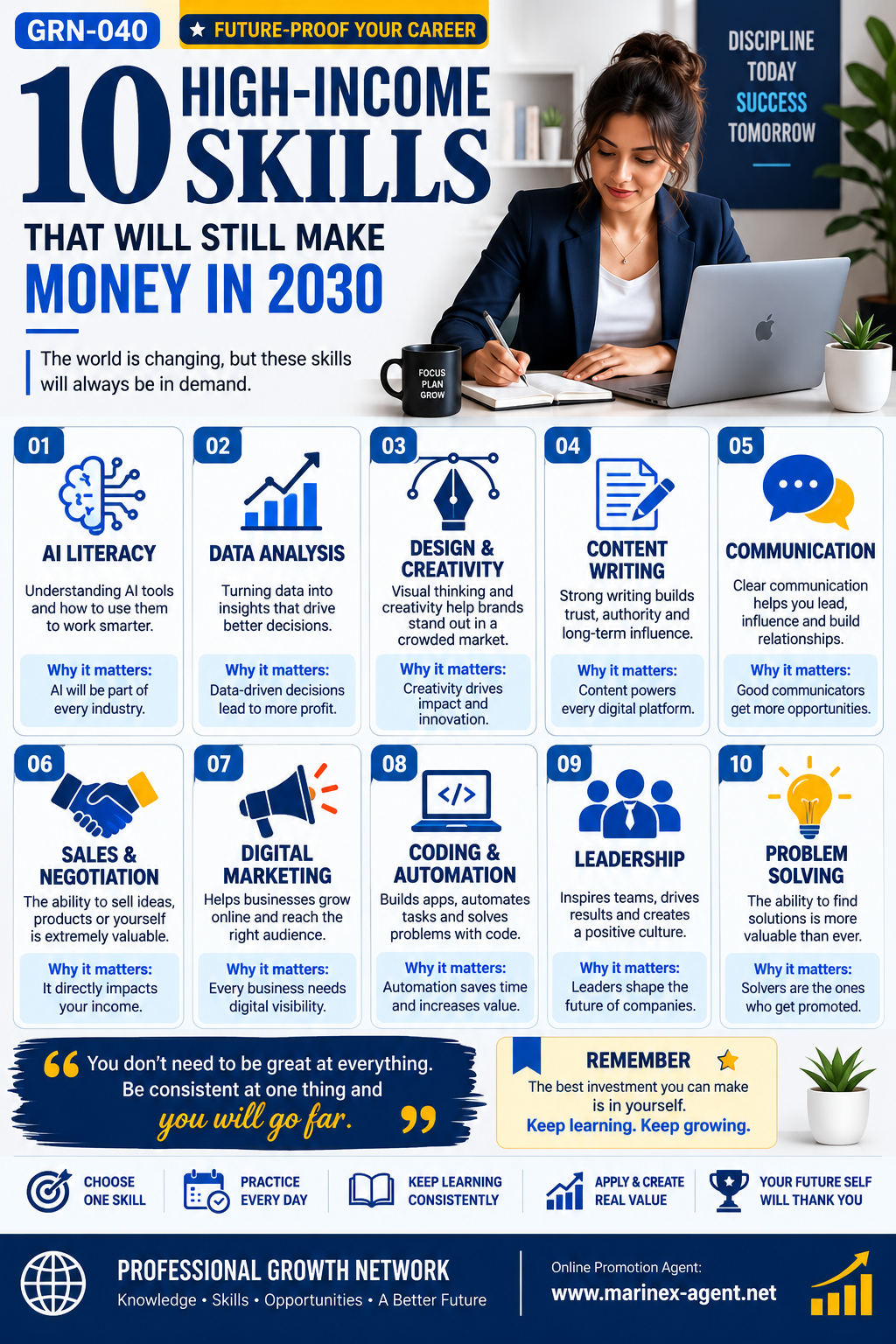
10 HIGH-INCOME SKILLS THAT WILL STILL
MAKE MONEY IN 2030
Parent Category: PROFESSIONAL GROWTH NETWORK
Category: Personal Growth & Self-Development
Article Code: GRN-040
FUTURE-PROOF YOUR CAREER
DISCIPLINE TODAY — SUCCESS TOMORROW
Introduction
The world of work is changing rapidly.
Artificial intelligence, digital technologies, automation, international competition, and new business models are transforming the way people work, communicate, and earn money.
Some traditional tasks are becoming automated, while new professional opportunities are emerging.
In this environment, one of the most important questions for every professional, entrepreneur, student, and small business owner is:
Which skills should I develop today to remain competitive and create income opportunities in 2030?
Although nobody can predict the future labour market with complete certainty, several professional skills are likely to remain valuable because they help individuals and businesses solve problems, improve productivity, communicate effectively, and create economic value.
Our GRN-040 infographic highlights ten such skills:
- AI Literacy.
- Data Analysis.
- Design & Creativity.
- Content Writing.
- Communication.
- Sales & Negotiation.
- Digital Marketing.
- Coding & Automation.
- Leadership.
- Problem Solving.
These skills can support employment, freelancing, entrepreneurship, consulting, and international business cooperation.
However, learning a skill does not automatically guarantee a high income. Actual earnings depend on experience, market demand, location, competition, and the ability to deliver measurable value.
The best investment you can make is in yourself. Keep learning. Keep growing.
1. AI Literacy — Understanding and Using Artificial Intelligence
Artificial intelligence is becoming an important tool in many professional activities.
AI literacy means understanding what artificial intelligence can do, how to use AI-powered tools effectively, and how to recognize their limitations.
Professionals do not necessarily need to become AI programmers to benefit from artificial intelligence.
They can use AI to improve research, writing, planning, data processing, customer communication, and everyday productivity.
What You Should Learn
- Basic principles of artificial intelligence.
- Generative AI and language models.
- Effective prompt writing.
- AI-assisted research and information organization.
- AI tools for business productivity.
- Verification of AI-generated information.
- Data privacy and responsible AI use.
- AI integration into professional workflows.
Potential Income Opportunities
AI literacy can support several professional activities:
- AI-assisted business consulting.
- Content development.
- Digital marketing services.
- Administrative support.
- Customer service automation.
- Research assistance.
- Workflow optimization.
- Small business productivity consulting.
Practical Example
A small business owner spends several hours preparing product descriptions, customer letters, and promotional materials.
By learning to use AI responsibly, the owner may reduce preparation time and improve consistency.
However, all important information must still be checked for accuracy.
Why It Matters
AI is likely to become part of many industries, making the ability to use it effectively an increasingly valuable professional skill.
Key Principle: Learn to work with AI rather than assuming it can replace professional judgment.
2. Data Analysis — Turning Information Into Better Decisions
Modern businesses generate large quantities of information.
Sales records, website statistics, customer inquiries, financial reports, inventory data, and market research all contain information that can support better decisions.
Data analysis is the process of collecting, organizing, interpreting, and presenting this information.
What You Should Learn
- Microsoft Excel and Google Sheets.
- Data cleaning and organization.
- Tables, charts, and dashboards.
- Basic statistics.
- Business performance indicators.
- SQL fundamentals.
- Power BI or similar visualization tools.
- Data interpretation and reporting.
Potential Income Opportunities
Data analysis skills can support work as a:
- Business data analyst.
- Reporting specialist.
- Marketing analyst.
- Sales performance analyst.
- Operations analyst.
- Freelance spreadsheet consultant.
- Dashboard developer.
Practical Example
A company receives 500 customer inquiries during one month.
A data analyst can help determine:
- Which countries generate the most inquiries.
- Which products attract the greatest interest.
- Which promotional channels perform best.
- How many inquiries become actual sales.
- Which activities produce the highest return.
This information helps management allocate resources more effectively.
Why It Matters
Data-driven decisions can improve efficiency, reduce unnecessary costs, and support business profitability.
Key Principle: Information becomes valuable when it helps people make better decisions.
3. Design & Creativity — Making Ideas Visible
Creative thinking and visual communication remain important in business.
Companies need professional presentations, websites, product catalogues, advertising materials, packaging, and recognizable brand identities.
Design is not simply about making something attractive.
Effective design helps communicate information, solve problems, and improve customer experience.
What You Should Learn
- Principles of graphic design.
- Typography and colour combinations.
- Visual hierarchy.
- Brand identity.
- Canva and other design tools.
- Adobe or comparable professional software.
- User interface fundamentals.
- Presentation design.
- AI-assisted creative workflows.
Potential Income Opportunities
Creative skills can support:
- Graphic design services.
- Business presentation design.
- Social media content production.
- Infographic creation.
- Website design.
- Branding services.
- Digital advertising materials.
- Product catalogue development.
Practical Example
A manufacturer has excellent products but presents them through poorly organized photographs and incomplete descriptions.
A professional designer can create a digital catalogue with clear product images, technical specifications, and consistent branding.
This may improve the manufacturer’s ability to communicate with international customers.
Why It Matters
Creativity helps brands stand out, communicate value, and develop new solutions in competitive markets.
Key Principle: Good design combines visual quality with practical communication.
4. Content Writing — Building Trust Through Words
Written communication remains essential in the digital economy.
Websites, business proposals, advertisements, newsletters, educational articles, and product descriptions all depend on effective writing.
AI can assist with drafting, but professional writing still requires judgment, accuracy, audience understanding, and editorial responsibility.
What You Should Learn
- Clear professional writing.
- Business correspondence.
- Copywriting fundamentals.
- Search-oriented content writing.
- Storytelling.
- Article structure.
- Product and service descriptions.
- Editing and proofreading.
- Fact-checking.
- Responsible AI-assisted writing.
Potential Income Opportunities
Content writing skills can support:
- Website content development.
- Blog article writing.
- Commercial proposal preparation.
- Email marketing.
- Product description writing.
- Technical writing.
- Editing services.
- Professional profile development.
Practical Example
An independent consultant has extensive professional experience but no clear explanation of the services offered.
A content writer can help prepare a professional biography, service descriptions, and an introductory business presentation.
The result is a clearer and more credible message for potential customers.
Why It Matters
Strong writing helps businesses explain their value, build trust, and maintain long-term relationships.
Key Principle: Write to inform, explain, and solve problems—not merely to fill a page.
5. Communication — Building Professional Relationships
Communication is one of the most transferable skills in the global economy.
It influences teamwork, customer relationships, leadership, sales, negotiations, and international cooperation.
Professionals who communicate clearly can often explain complex ideas more effectively and reduce misunderstandings.
What You Should Learn
- Business communication.
- Active listening.
- Professional email writing.
- Public speaking.
- Presentation skills.
- Cross-cultural communication.
- Conflict resolution.
- Constructive feedback.
- Online meeting etiquette.
- Foreign language development.
Potential Income Opportunities
Strong communication skills support careers in:
- Business development.
- Customer relationship management.
- Consulting.
- Sales.
- Project coordination.
- Training.
- Public relations.
- International business representation.
Communication is usually a skill that strengthens another profession rather than a separate income source by itself.
Practical Example
Two suppliers offer similar products at comparable prices.
One provides incomplete information and responds inconsistently.
The other communicates clearly, answers questions promptly, and provides professional documentation.
The second supplier may have a stronger opportunity to establish a reliable business relationship.
Why It Matters
Good communicators can build confidence, develop relationships, and create additional professional opportunities.
Key Principle: Professional communication begins with understanding the other person.
6. Sales & Negotiation — Converting Value Into Revenue
Every business needs customers.
Even a high-quality product or service may fail commercially if potential buyers do not understand its value.
Sales and negotiation skills help professionals identify customer needs, present appropriate solutions, and reach mutually acceptable agreements.
What You Should Learn
- Customer needs assessment.
- Product presentation.
- Value-based selling.
- Business prospecting.
- Commercial proposal preparation.
- Negotiation techniques.
- Pricing fundamentals.
- Objection handling.
- Contract basics.
- Customer relationship management.
Potential Income Opportunities
Sales and negotiation skills can support:
- Business development services.
- Sales representation.
- Commercial agency work.
- Account management.
- International trade.
- Independent consulting.
- Commission-based commercial activities.
- Entrepreneurship.
Commission arrangements and commercial representation should always be supported by clear agreements and compliance with applicable laws.
Practical Example
A manufacturer wants to enter a foreign market but lacks local customer relationships.
An experienced business representative may help identify potential buyers, introduce the manufacturer, coordinate communication, and support negotiations.
The representative’s compensation can be agreed according to the actual services provided and the terms of the contract.
Why It Matters
Sales and negotiation directly influence a company’s ability to generate revenue and develop commercial relationships.
Key Principle: Effective selling means understanding customer needs and offering genuine value.
7. Digital Marketing — Helping Businesses Reach the Right Audience
Digital marketing allows companies to introduce their products and services to customers through online channels.
It includes websites, search engines, social media, email campaigns, online advertising, and content marketing.
Digital marketing is especially relevant to small businesses that want to reach customers beyond their immediate geographical area.
What You Should Learn
- Marketing strategy.
- Market research.
- Customer segmentation.
- Social media marketing.
- Search engine optimization (SEO).
- Content marketing.
- Email marketing.
- Paid advertising fundamentals.
- Website analytics.
- Conversion measurement.
- Brand positioning.
Potential Income Opportunities
Digital marketing skills can support:
- Social media management.
- Website promotion.
- SEO consulting.
- Content marketing services.
- Advertising campaign management.
- Email marketing support.
- Digital business consulting.
- Online promotion agency services.
Practical Example
A small company produces quality household textiles but has limited international visibility.
A digital marketing specialist can help prepare a professional website, product catalogue, company profile, and suitable online promotional campaign.
This may help the manufacturer reach potential importers, distributors, and commercial partners.
Why It Matters
Businesses need digital visibility to communicate with potential customers and compete in increasingly connected markets.
Key Principle: Digital marketing should attract relevant customers, not simply generate large numbers of website visitors.
8. Coding & Automation — Building Practical Digital Solutions
Software development and automation help businesses improve efficiency and create new services.
Coding allows professionals to develop websites, applications, databases, and other digital systems.
Automation reduces repetitive manual work through software and integrated workflows.
Although AI-assisted coding tools are becoming more capable, understanding programming fundamentals remains valuable for building, evaluating, and maintaining reliable systems.
What You Should Learn
- Basic programming logic.
- Python fundamentals.
- JavaScript and web technologies.
- HTML and CSS.
- SQL databases.
- Application programming interfaces (APIs).
- Workflow automation.
- Software testing.
- Cybersecurity fundamentals.
- AI-assisted software development.
Potential Income Opportunities
Coding and automation skills can support:
- Website development.
- Software development.
- Database management.
- Business process automation.
- Workflow integration.
- Technical consulting.
- Application maintenance.
- Custom digital solutions for small businesses.
Practical Example
A maritime recruitment agency receives numerous application forms from seafarers.
Instead of manually searching through every document, the agency can develop a structured database that records professional rank, qualifications, experience, and contact information.
Appropriate automation may help organize records and improve administrative efficiency while protecting personal data.
Why It Matters
Automation can save time, reduce repetitive work, and improve the consistency of business operations.
Key Principle: Learn to use technology to solve real operational problems.
9. Leadership — Helping People Achieve Common Goals
Leadership is the ability to guide, motivate, organize, and support people in achieving shared objectives.
It is important not only for company directors and senior managers but also for project coordinators, entrepreneurs, consultants, and team members.
Effective leadership requires responsibility, communication, planning, and the ability to make decisions under uncertainty.
What You Should Learn
- Team management.
- Strategic planning.
- Decision-making.
- Delegation.
- Conflict resolution.
- Emotional intelligence.
- Project management.
- Performance evaluation.
- Coaching and mentoring.
- Ethical leadership.
Potential Income Opportunities
Leadership skills can support advancement into:
- Management positions.
- Project management.
- Business consulting.
- Team supervision.
- Operations management.
- Entrepreneurship.
- Professional training.
- International project coordination.
Practical Example
A small international business project involves a supplier in China, a representative in Africa, and an online promotion service in Europe.
An effective project leader helps establish responsibilities, coordinate communication, monitor progress, and resolve operational difficulties.
Without clear leadership, even promising projects may suffer from confusion and delays.
Why It Matters
Leadership helps organizations coordinate people, achieve objectives, and develop a positive professional culture.
Key Principle: Strong leaders create conditions in which other people can perform effectively.
10. Problem Solving — Turning Challenges Into Opportunities
Problem solving is the ability to identify difficulties, understand their causes, evaluate alternatives, and implement practical solutions.
It is one of the most valuable transferable skills because every industry encounters unexpected challenges.
Technology can support problem solving, but professionals must still understand context, assess risks, and exercise judgment.
What You Should Learn
- Critical thinking.
- Analytical reasoning.
- Root-cause analysis.
- Decision-making.
- Creative thinking.
- Risk assessment.
- Process improvement.
- Research methods.
- Practical experimentation.
- Evaluation of results.
Potential Income Opportunities
Problem-solving skills strengthen work in:
- Business consulting.
- Operations management.
- Technical services.
- Engineering.
- Logistics.
- Project management.
- Entrepreneurship.
- Process optimization.
Practical Example
A company receives many customer inquiries but completes very few sales.
Instead of simply increasing advertising expenditure, a problem-solving specialist investigates the process.
Possible causes may include unclear product descriptions, slow responses, unsuitable prices, weak customer confidence, or inefficient follow-up procedures.
Identifying the actual cause allows the company to implement more appropriate improvements.
Why It Matters
Professionals who can identify and solve important problems provide measurable value to employers, customers, and business partners.
Key Principle: The most valuable skill is often the ability to find an effective solution when others see only a problem.
11. How These Ten Skills Work Together
The ten skills presented in GRN-040 are not isolated.
They frequently complement one another.
For example, a successful digital business project may require:
- AI Literacy to improve productivity.
- Data Analysis to understand customer behaviour.
- Design & Creativity to prepare professional presentations.
- Content Writing to explain products and services.
- Communication to build customer relationships.
- Sales & Negotiation to develop commercial agreements.
- Digital Marketing to reach potential customers.
- Coding & Automation to improve digital operations.
- Leadership to coordinate participants.
- Problem Solving to overcome unexpected difficulties.
A single professional does not need to become an expert in every area.
A more practical approach is to develop strong competence in one primary skill while gaining useful knowledge of related fields.
Professional specialization combined with complementary skills can create a stronger competitive position.
12. How to Choose the Right Skill for Your Future
Selecting a professional skill should be based on more than its potential income.
Personal interests, existing experience, learning opportunities, market demand, and available resources should also be considered.
Step 1 — Evaluate Your Existing Experience
Identify your current qualifications, professional knowledge, and practical strengths.
A person with extensive commercial experience may find sales, negotiation, or digital marketing more accessible than advanced software development.
Step 2 — Identify Your Interests
Choose a field that you are willing to study and practise consistently.
Long-term progress requires sustained motivation.
Step 3 — Research Market Demand
Study job vacancies, freelance opportunities, business requirements, and professional trends.
Demand varies by country, industry, and experience level.
Step 4 — Evaluate Learning Requirements
Some skills can be developed through free online courses and practical projects.
Others require formal education, certifications, supervised experience, or specialized equipment.
Step 5 — Begin With One Primary Skill
Avoid trying to master all ten skills simultaneously.
Choose one priority and establish a realistic learning plan.
Step 6 — Create Practical Results
Build a portfolio, complete small projects, or demonstrate how your new skill solves a genuine problem.
Step 7 — Develop Your Professional Presentation
Prepare a professional biography, clear description of your services, and appropriate online presence.
Step 8 — Continue Improving
Monitor industry changes and update your skills regularly.
Key Principle: Choose a skill that matches your abilities, develop real competence, and demonstrate the value you can provide.
13. A Practical Learning Roadmap for 2026–2030
The period leading to 2030 provides an opportunity to build new capabilities through consistent learning.
The following roadmap is an illustrative personal development framework rather than a prediction of future income.
2026 — Establish Your Foundation
- Select one primary skill.
- Study fundamental concepts.
- Identify reliable educational resources.
- Create a weekly learning schedule.
- Complete introductory practical exercises.
2027 — Develop Practical Experience
- Complete more advanced training.
- Build a portfolio of work.
- Participate in small projects.
- Improve professional communication.
- Identify potential customers or employers.
2028 — Strengthen Your Specialization
- Develop deeper technical or professional knowledge.
- Learn complementary skills.
- Improve productivity.
- Seek feedback from experienced professionals.
- Build reliable professional relationships.
2029 — Expand Your Opportunities
- Explore international markets.
- Develop a stronger professional online presence.
- Evaluate consulting or entrepreneurial opportunities.
- Improve your service packages.
- Strengthen your professional reputation.
2030 — Continue Adapting
- Review technological changes.
- Update your knowledge.
- Evaluate new business models.
- Improve your professional positioning.
- Continue lifelong learning.
The objective is not simply to reach 2030 with a certificate, but to arrive with practical knowledge, demonstrated experience, and the ability to create value.
14. Five Daily Habits for Long-Term Professional Success
Our infographic highlights a simple message:
You don’t need to be great at everything. Be consistent at one thing and you will go far.
Five practical habits can support this approach.
1. Choose One Skill
Identify your primary professional development priority.
2. Practise Every Day
Even short, focused learning sessions can contribute to progress when maintained consistently.
3. Keep Learning Consistently
Study reliable information, review mistakes, and update your knowledge.
4. Apply and Create Real Value
Use what you learn to complete practical tasks and solve problems.
5. Invest in Your Future Self
Treat education, health, professional relationships, and personal discipline as long-term priorities.
DISCIPLINE TODAY — SUCCESS TOMORROW.
15. How to Turn Professional Skills Into Income Opportunities
Learning a valuable skill is only the first stage.
To generate income, a professional must connect that skill with a genuine need in the market.
A. Employment
Use your skills to qualify for professional positions or improve your career prospects.
B. Freelancing
Offer specialized services to customers on a project or contractual basis.
C. Consulting
Help organizations solve problems using your professional experience and knowledge.
D. Entrepreneurship
Develop your own business offering products or services.
E. International Cooperation
Work with foreign customers, suppliers, employers, or business partners where legally and commercially appropriate.
F. Digital Products and Services
Develop educational materials, software, professional templates, online services, or other useful digital resources.
G. Professional Representation
Represent products, services, or business opportunities under clear commercial agreements.
Whatever model is selected, sustainable income generally depends on:
- Genuine market demand.
- Professional competence.
- Reliable service delivery.
- Clear commercial terms.
- Customer satisfaction.
- Responsible financial management.
High income is a possible outcome of valuable skills and effective business activity, not an automatic reward for completing a course.
16. Your Professional Web Presence — An Essential Business Tool
A valuable professional skill becomes more commercially useful when potential customers and partners can discover and understand it.
For this reason, professional visibility is an important part of career and business development.
A personal web presentation can help explain:
- Who you are.
- Your professional qualifications.
- Your experience.
- Your products or services.
- Your areas of specialization.
- Your business interests.
- How potential customers can contact you.
For entrepreneurs and independent professionals, an organized online presentation can serve as a modern electronic business card.
The Marinex-Agent Full Style Concept
Our professional presentation model combines three elements:
Premium Business Card → Mini-Web Presence → Personal Online Promotion Agent
The purpose is to help individuals and companies establish a consistent professional identity.
A clear business presentation can also be used across commercial proposals, catalogues, flyers, social media profiles, and other promotional materials.
Key Principle: First establish your own professional identity. Then promote the products and services you represent.
17. The Role of PROFESSIONAL GROWTH NETWORK
The PROFESSIONAL GROWTH NETWORK (PGN) promotes education, practical skills, personal development, business visibility, and international cooperation.
Our objective is to help people strengthen their professional capabilities and explore opportunities for sustainable personal and economic growth.
The ten skills presented in GRN-040 support this mission because they can be applied across many professions and industries.
Through educational articles, infographics, professional networking, and the services of Marinex-Agent — Your Personal Online Promotion Agent, we encourage individuals to:
- Develop valuable knowledge.
- Improve digital literacy.
- Strengthen communication skills.
- Learn modern business methods.
- Build professional relationships.
- Explore responsible income opportunities.
- Establish their own online professional presence.
- Participate in international business cooperation.
Our guiding principle remains:
FIRST PROMOTE YOURSELF — THEN PROMOTE THE PRODUCTS AND SERVICES YOU REPRESENT.
The ability to present yourself professionally can become an important complement to technical knowledge, practical experience, and commercial skills.
Conclusion
The professional world of 2030 will almost certainly differ from the world of today.
Artificial intelligence, automation, digital communication, and changing business models will continue to influence how people work and earn money.
However, many valuable professional capabilities are likely to remain relevant.
The ten skills presented in this article are:
AI Literacy • Data Analysis • Design & Creativity • Content Writing • Communication • Sales & Negotiation • Digital Marketing • Coding & Automation • Leadership • Problem Solving
These skills help people understand technology, interpret information, communicate ideas, build relationships, organize projects, and solve practical problems.
No individual needs to master all ten.
A better approach is to choose a relevant skill, develop it consistently, apply it in real situations, and continue improving as market conditions change.
For the PROFESSIONAL GROWTH NETWORK, the most important message is that personal development creates the foundation for professional opportunity.
The best investment you can make is in yourself.
KEEP LEARNING. KEEP GROWING. KEEP CREATING VALUE.
And remember:
DISCIPLINE TODAY — SUCCESS TOMORROW.
Further Reading
- World Economic Forum — Future of Jobs: https://www.weforum.org/publications/
- Microsoft Learn — Digital and Technical Skills: https://learn.microsoft.com/training/
- Google Skillshop — Digital Marketing and Technology: https://skillshop.withgoogle.com/
- IBM SkillsBuild — Professional and Digital Skills: https://skillsbuild.org/
- freeCodeCamp — Programming and Web Development: https://www.freecodecamp.org/
- HubSpot Academy — Marketing, Sales, and Business Education: https://academy.hubspot.com/
PROFESSIONAL GROWTH NETWORK
Knowledge • Skills • Opportunities • A Better Future
Online Promotion Agent: https://www.marinex-agent.net