
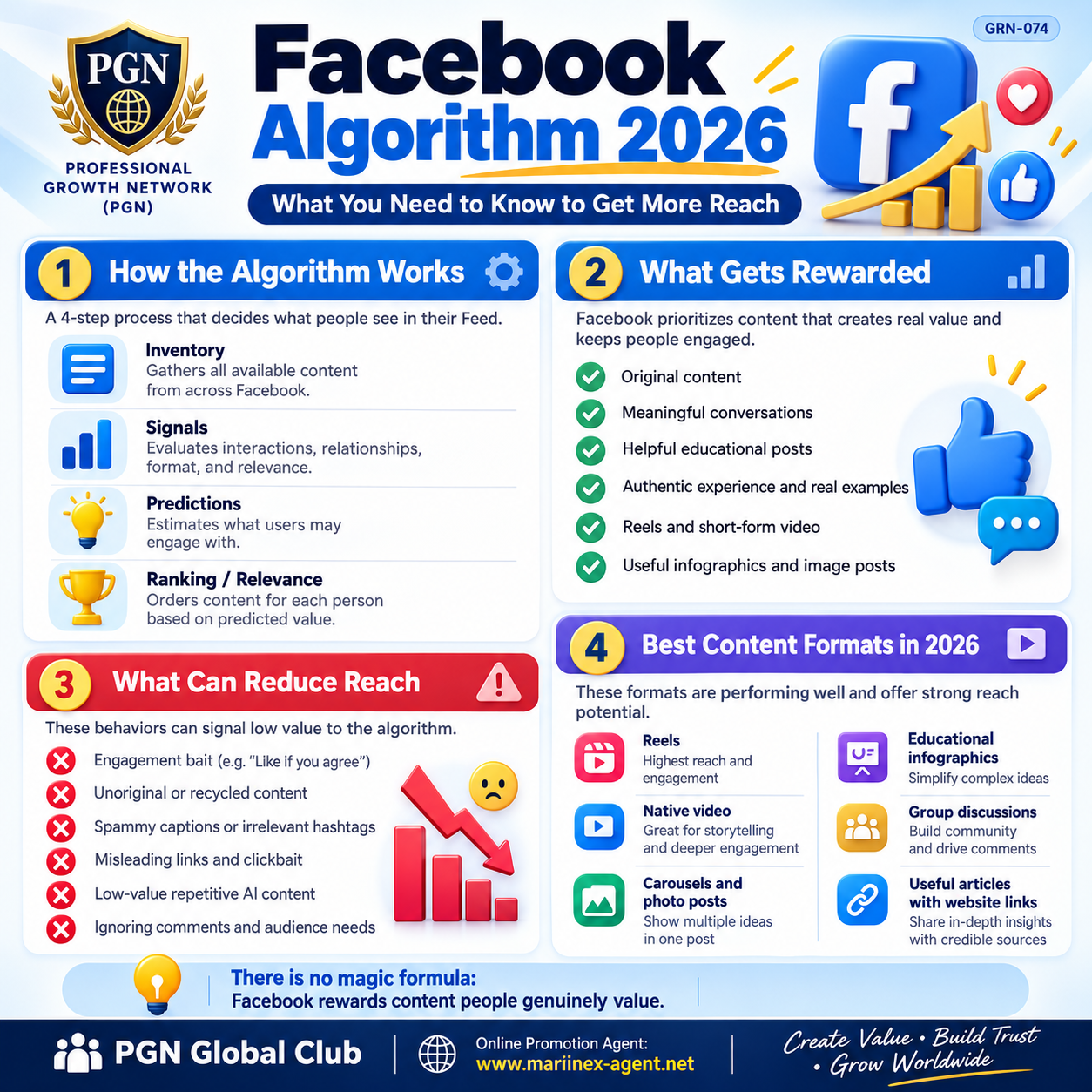
Facebook Algorithm 2027: How It Works, What Gets Rewarded, and How to Increase Your Reach
Parent Category: PROFESSIONAL GROWTH NETWORK (PGN)
Category: Computer Skills & Digital Literacy / Personal Growth & Self-Development
Article Code: GRN-074
Introduction: Understanding the Facebook Algorithm in 2026
Facebook remains an important digital platform for professional networking, business promotion, content distribution, and community development.
For entrepreneurs, freelancers, business owners, content creators, and administrators of Facebook Groups, understanding how Facebook distributes content can significantly improve the effectiveness of their online activities.
However, publishing information on Facebook does not guarantee that every follower, group member, or potential customer will see it.
Facebook uses sophisticated artificial intelligence systems to decide which posts, videos, photographs, and other content are most likely to interest individual users.
These systems evaluate many factors, including user preferences, previous interactions, content characteristics, and predicted relevance.
In 2026, Meta continues improving its recommendation systems, placing particular emphasis on original content, meaningful user experiences, and reducing spam.
The central principle is simple: Facebook attempts to show each person content that its systems predict will be valuable and interesting to them.
Understanding this principle is more useful than attempting to manipulate the algorithm through artificial engagement.
This article explains how Facebook ranking works, what types of content may receive greater visibility, which mistakes can reduce reach, and how businesses and professional communities can develop more effective content strategies.
1. How the Facebook Algorithm Works
Facebook does not use one simple algorithm.
Its content distribution systems combine multiple artificial intelligence models, ranking processes, recommendation technologies, and safety mechanisms.
Different systems help determine what appears in Facebook Feed, Reels, Stories, Groups, and other parts of the platform.
The Four-Step Ranking Process
Meta has described a useful four-part model for understanding Feed ranking.
Step 1 — Inventory: Collecting Available Content
The system begins by identifying content that could potentially be shown to a particular user.
This may include:
- Posts from friends.
- Updates from followed Pages.
- Content from joined Groups.
- Reels and videos.
- Recommended content from unfamiliar creators.
- Other eligible publications.
Not every post is automatically eligible for every recommendation surface.
The system applies relevant eligibility and content policies.
Step 2 — Signals: Evaluating Relevant Information
Facebook analyzes numerous signals that help predict whether a person might find a particular post interesting.
Examples include:
- Previous interactions with the author.
- Content types the user frequently views.
- Past comments, reactions, and shares.
- Video viewing behavior.
- Similar content previously consumed.
- Characteristics of the post.
- User feedback and preferences.
The relative importance of these signals varies across ranking systems and individual situations.
Step 3 — Predictions: Estimating User Interest
Artificial intelligence models estimate the likelihood of different user actions.
For example, the system may predict whether someone will:
- Read a post.
- Watch a video.
- Continue watching a Reel.
- React to content.
- Leave a comment.
- Share information.
- Show interest in similar publications.
Meta has explained that these models use multiple predictions rather than relying on a single engagement metric.
Step 4 — Ranking: Organizing Content
Finally, the system combines predictions and other ranking considerations to determine which content should appear and in what order.
This process is personalized.
Two people following the same Facebook Page may see different posts because their interests, previous interactions, and predicted preferences differ.
Key lesson: Facebook reach depends on relevance, user interest, recommendation eligibility, and multiple ranking signals—not simply the number of followers.
2. What Gets Rewarded: Creating Content People Value
The most sustainable strategy for improving Facebook reach is to create content that genuinely interests your intended audience.
In 2026, Meta has explicitly emphasized the importance of original content.
Original Content
Original publications may include:
- Personally written articles.
- Original photographs.
- Videos created by the publisher.
- Interviews.
- Professional analysis.
- Educational explanations.
- Unique business experiences.
- Original infographics.
- Practical tutorials.
In March 2026, Meta updated its guidance on original content, emphasizing that creators who publish their own material or make substantial creative contributions may receive better distribution opportunities.
Duplicated content and low-value modifications of other creators’ work may be deprioritized.
Meaningful Conversations
Content that stimulates genuine discussion can be valuable.
Examples include:
- Asking a relevant professional question.
- Discussing a practical business problem.
- Sharing an experience and inviting useful feedback.
- Presenting different approaches to a technical challenge.
- Encouraging members to contribute professional knowledge.
However, conversation quality matters more than artificially generating large numbers of comments.
Educational Content
Useful educational publications can attract audiences interested in professional development.
Examples include:
- Computer skills.
- Business fundamentals.
- Marketing strategies.
- Financial literacy.
- Digital security.
- Professional communication.
- Career development.
- International networking.
Educational content works best when it provides specific, understandable, actionable information.
Authentic Professional Experience
Real examples can make content particularly useful.
A business owner might explain how a project was developed.
A consultant could demonstrate how a customer problem was solved.
A professional may share lessons learned from a successful or unsuccessful initiative.
Such publications can strengthen credibility and create opportunities for meaningful engagement.
Key lesson: Publish content because it helps your audience—not merely because you want more reactions.
3. Reels and Short-Form Video: Opportunities for Visibility
Short-form video remains an important Facebook content format.
Reels can provide opportunities for creators to reach people who do not already follow their Pages or profiles.
However, no video format guarantees a particular number of views.
Why Reels Can Be Effective
Short videos can communicate ideas quickly.
They may be suitable for:
- Demonstrating products.
- Explaining simple concepts.
- Introducing professional services.
- Showing before-and-after results.
- Presenting short tutorials.
- Highlighting business achievements.
- Sharing practical advice.
The Importance of Audience Retention
Video recommendation systems consider viewing behavior, but Meta has also made clear that watch time and likes alone do not fully describe user satisfaction.
In January 2026, Meta described improvements to Facebook Reels recommendations that incorporate user feedback to better identify content people genuinely value.
This means creators should focus on useful, relevant videos rather than trying to maximize watch time through misleading techniques.
A Practical Reel Structure
Opening: Clearly introduce the subject.
Main Content: Explain one problem, idea, or solution.
Example: Provide a visual demonstration.
Conclusion: Summarize the main point.
Invitation: Encourage viewers to explore related information if interested.
Example for a Professional Community
A PGN educational Reel might cover:
Topic: Why Every Professional Should Have a Personal Web Presentation.
The video could explain:
- The importance of online professional identity.
- The purpose of a personal domain.
- The value of a clear professional profile.
- How potential clients can review services.
- How international networking may develop.
Key lesson: Create short videos that deliver useful information clearly and efficiently.
4. Photographs, Carousels, and Educational Infographics
Not every successful Facebook publication needs to be a video.
Photographs, image collections, explanatory graphics, and educational infographics can also provide valuable experiences.
Photographs
Original photographs can help document:
- Business events.
- Professional meetings.
- Completed projects.
- Educational activities.
- Community initiatives.
- Humanitarian programs.
- Product demonstrations.
Images should have relevant captions explaining what the audience is seeing.
Image Collections
Multiple images may be useful when explaining a process or presenting several related examples.
For example, a professional organization might publish a sequence showing the stages of a development project.
Educational Infographics
An infographic combines text, graphics, symbols, and visual organization to explain information efficiently.
Possible topics include:
- Business development.
- Digital literacy.
- Professional growth.
- Online safety.
- International cooperation.
- Productivity systems.
- Leadership skills.
Designing Better Infographics
An effective infographic should have:
- A clear headline.
- Readable typography.
- Logical information hierarchy.
- Consistent visual branding.
- Accurate information.
- A limited number of essential points.
- A recognizable source or publisher.
Avoid Overcrowding
A frequent mistake is attempting to include an entire article inside a single graphic.
Detailed information is often more readable in a linked article or accompanying caption.
The infographic should communicate the main ideas and encourage further learning.
Key lesson: Choose the content format that communicates your message most effectively rather than assuming one format always receives greater algorithmic priority.
5. Facebook Groups: Building Valuable Professional Communities
Facebook Groups can be particularly useful for professional development, business networking, and knowledge exchange.
They allow people with shared interests to communicate, ask questions, and develop relationships.
However, there is no universal rule that Group posts always receive more reach than Page posts.
Distribution depends on the relevant ranking systems, content, audience, and individual user behavior.
What Makes a Professional Group Valuable?
A successful professional community should have:
- A clearly defined purpose.
- Relevant discussion topics.
- Useful educational publications.
- Respectful communication.
- Active moderation.
- Clear participation rules.
- Opportunities for members to contribute.
Encourage Member Participation
Group administrators can invite members to share:
- Professional experiences.
- Educational resources.
- Practical questions.
- Business development ideas.
- Industry news.
- Lessons learned.
- Constructive professional opinions.
Avoid Turning the Group into an Advertising Board
Groups that contain mainly repetitive promotional messages may become less useful to members.
A more balanced strategy combines education, discussion, networking, and carefully selected business information.
The Role of Administrators
Effective administrators should:
- Maintain clear standards.
- Welcome new members.
- Encourage meaningful discussions.
- Remove obvious spam.
- Address inappropriate behavior.
- Recognize valuable contributions.
- Keep group information organized.
Key lesson: A professional Facebook Group should function as a useful community, not simply a distribution channel for advertisements.
6. What Can Reduce Facebook Reach?
Facebook has introduced measures intended to limit spam, manipulation, and unoriginal content.
Some practices can reduce the distribution of individual posts or affect broader account recommendation eligibility.
Excessive Engagement Bait
Examples include:
- “Like this if you agree!”
- “Comment YES to receive good luck!”
- “Share this with ten friends!”
- Artificially requesting reactions unrelated to the content.
Such tactics attempt to generate engagement without providing genuine value.
Unoriginal or Recycled Content
In March 2026, Meta clarified that content may be considered unoriginal when it simply republishes somebody else’s material or adds only minor changes without meaningful creative contribution.
Examples may include:
- Reuploading other creators’ videos without substantial added value.
- Combining clips without meaningful commentary.
- Adding superficial visual effects to copied material.
- Repeatedly publishing duplicated content.
Proper permission to use material and Facebook’s recommendation rules are separate considerations.
Spammy Captions
Meta has identified certain spam-related practices, including:
- Excessively long distracting captions.
- Large numbers of unrelated hashtags.
- Captions unrelated to the actual content.
- Repetitive promotional publishing designed to manipulate distribution.
Misleading Links and Clickbait
Headlines should accurately describe the material being offered.
A post promising important information should deliver that information when the user opens the link.
Ignoring Your Audience
Failure to respond to relevant questions may reduce the quality of community interaction.
Although responding quickly can improve engagement and customer service, Meta does not publish a universal rule requiring replies within a particular number of minutes.
Inconsistent Publishing
An irregular posting schedule can make it harder to build predictable audience expectations.
However, consistency should never take priority over content quality.
Key lesson: Avoid artificial engagement techniques, low-value duplication, and misleading promotional practices.
7. The First 60 Minutes: Useful Attention, Not a Guaranteed Algorithmic Rule
Some social media infographics claim that the first 60 minutes after publication determine whether a Facebook post will succeed.
This statement should be treated cautiously.
Meta has not established a universal public rule that every Facebook post is evaluated during a fixed 60-minute period.
Similarly, claims that exactly 50% of the Facebook Feed consists of recommended content should not be treated as a universal 2026 figure without current supporting evidence.
Why Early Engagement Can Still Matter
When a post is published, its initial audience may interact with it through views, comments, reactions, or shares.
Those interactions can contribute to the information available to ranking systems.
However, Facebook also considers many other signals and may continue distributing relevant content beyond the initial publication period.
Practical Actions After Publishing
First: Make sure your post is displayed correctly.
Second: Check that images, videos, and links work.
Third: Respond naturally to relevant questions.
Fourth: Correct factual mistakes if necessary.
Fifth: Observe audience feedback.
Sixth: Avoid artificially inflating reactions or comments.
Timing Your Publications
Post timing can influence how many members of your audience are available to see new content.
However, the best publication schedule depends on your audience and should be evaluated using actual performance data.
Key lesson: Early interaction can be useful, but there is no verified universal 60-minute formula for Facebook success.
8. External Links: Should You Include Website Addresses?
For businesses and professional organizations, external websites play an important role.
A Facebook publication may introduce an idea, while a website provides detailed information, documentation, professional credentials, or commercial contact details.
Understanding External Links
Facebook’s ranking systems consider numerous signals, and links may perform differently depending on the content and audience.
It is inaccurate to assume that every external link automatically causes a fixed reduction in reach.
When External Links Are Useful
Links can direct visitors to:
- Professional websites.
- Educational articles.
- Product information.
- Business presentations.
- Registration pages.
- Event details.
- Official documentation.
- Contact information.
A Balanced Publication Strategy
A practical Facebook post could contain:
Headline: A clear explanation of the topic.
Summary: Several useful points that provide immediate value.
Infographic: A visual presentation of the main ideas.
Website Link: An optional link to a more detailed resource.
Example
Topic: Designing Smarter Folder Structures.
A Facebook publication can summarize the seven main principles, display an educational infographic, and direct interested readers to the complete GRN-072 article.
The Facebook post should remain useful even if the reader does not open the external link.
Key lesson: Use external links when they genuinely improve the reader’s experience.
9. Artificial Intelligence and Facebook Content Creation
Artificial intelligence can help creators prepare content more efficiently.
Possible applications include:
- Brainstorming subjects.
- Organizing article outlines.
- Improving grammar.
- Translating information.
- Preparing draft captions.
- Designing visual concepts.
- Summarizing long documents.
- Developing educational materials.
AI Is a Tool, Not a Substitute for Expertise
AI-generated material can contain factual errors, misleading statements, or repetitive language.
Therefore, creators should review and verify important information before publication.
The Importance of Original Contribution
Meta’s content guidance places emphasis on meaningful original contributions rather than superficial reuse.
A high-quality AI-assisted article can benefit from:
- Independent fact-checking.
- Original professional analysis.
- Real examples.
- Human editorial judgment.
- Useful practical recommendations.
Building Trust
Professional content should accurately identify its sources and avoid presenting invented experiences or unsupported claims as facts.
Key lesson: Use AI to strengthen your ability to communicate knowledge, not to mass-produce low-value content.
10. Measuring Facebook Performance
An effective publishing strategy requires regular evaluation.
Simply counting likes does not provide a complete understanding of a publication’s success.
Important Performance Indicators
Reach: The number of people who saw the content.
Views: The number of times eligible content was viewed or played, according to the applicable Meta metric.
Engagement: Relevant interactions such as reactions, comments, and shares.
Watch Time: Time spent watching video content.
Shares: The frequency with which people distribute content to others.
Link Clicks: Interactions with external or internal links, where measured.
Follower Growth: Changes in the size of the audience.
Website Visits: Visitors arriving at the organization’s website.
Understand Your Objective
Different publications serve different purposes.
An educational infographic may aim to increase awareness.
A business presentation may seek inquiries from potential customers.
A professional announcement may encourage networking.
A website article may focus on attracting readers.
Use Appropriate Analytics
Depending on the account and available features, Meta Business Suite, Professional Dashboard, and related insights can help assess content performance.
Website analytics can provide additional information about visitors arriving through Facebook.
Evaluate Trends
Do not judge your entire strategy from one successful or unsuccessful post.
Compare multiple publications over time.
Consider which subjects, formats, publication schedules, and audience interactions generate meaningful results.
Key lesson: Measure results according to your professional objectives rather than concentrating exclusively on likes.
11. A Practical Facebook Content Strategy for 2026
A structured approach can help organizations publish consistently while maintaining quality.
Step 1 — Define Your Audience
Identify who your content is intended to help.
Possible audiences include entrepreneurs, professionals, students, business owners, and international partners.
Step 2 — Select Your Core Topics
Choose subject areas directly related to the interests of your audience.
Step 3 — Prepare Original Educational Material
Develop useful publications based on reliable information and professional knowledge.
Step 4 — Choose Appropriate Formats
Combine articles, photographs, infographics, short videos, and discussion posts where suitable.
Step 5 — Maintain Consistent Branding
Use recognizable visual identity, clear headlines, and consistent professional presentation.
Step 6 — Encourage Genuine Interaction
Invite relevant questions and respond constructively.
Step 7 — Evaluate Performance
Review available analytics and identify successful subjects.
Step 8 — Improve Continuously
Adjust your strategy according to audience needs, platform changes, and actual results.
An Illustrative Weekly Plan
| Day | Suggested Content |
|---|---|
| Monday | Educational article |
| Tuesday | Practical infographic |
| Wednesday | Professional discussion |
| Thursday | Short educational video |
| Friday | Business or networking insight |
| Saturday | Community contribution |
| Sunday | Optional recap or planning |
This schedule is an example, not an algorithmic requirement. Organizations should adapt publishing frequency to their resources and audience.
12. PROFESSIONAL GROWTH NETWORK: Using Facebook for International Networking
Facebook can support the mission of the PROFESSIONAL GROWTH NETWORK (PGN) by connecting individuals interested in knowledge, professional development, business cooperation, and international opportunities.
The PGN Global Club Concept
PGN brings together several important elements:
Knowledge: Sharing useful educational information.
Personal Growth: Supporting continuous professional development.
Digital Literacy: Helping people use modern technologies effectively.
Networking: Developing international professional relationships.
Business Development: Identifying opportunities for mutually beneficial cooperation.
Online Promotion: Helping individuals establish a professional Internet presence.
The Importance of Educational Hub Articles
A Hub Article provides a comprehensive overview of a particular subject.
Supporting Articles can then explain individual topics in greater detail.
This structure allows a professional community to develop an organized collection of educational resources.
For example:
GRN-071: How to Make Money with Canva.
GRN-072: Designing Smarter Folder Structures.
GRN-073: Facebook Algorithm 2026.
Each article can be supported by a dedicated infographic and appropriate Facebook publications.
Facebook as a Discovery Platform
A Facebook post may introduce a topic to a new audience.
An interested reader can then explore the complete educational article on the website.
This creates a useful relationship between Facebook and the organization’s own digital resources.
Professional Networking
Members can use discussions and educational materials as starting points for establishing professional contacts.
The emphasis should remain on knowledge sharing, credibility, and genuine cooperation.
Key lesson: Facebook can be an effective communication channel when integrated into a broader professional development strategy.
13. Combining Facebook with Your Personal Online Promotion Agent
A professional Facebook profile or Page can help people communicate with potential customers.
However, a personal website or web presentation provides an additional level of control over professional information.
Facebook Presence
Useful for:
- Publishing updates.
- Building communities.
- Sharing educational resources.
- Encouraging discussions.
- Discovering new contacts.
Personal Web Presentation
Useful for:
- Presenting professional qualifications.
- Describing services.
- Displaying a portfolio.
- Providing business information.
- Sharing contact details.
- Organizing professional references.
Personal Domain
A personal domain can provide a recognizable online address that remains associated with the individual or business, subject to registration and renewal.
The Integrated Promotion Model
Professional Knowledge → Original Content → Facebook Visibility → Personal Web Presentation → International Networking → Business Opportunities.
The Marinex-Agent Principle
First, Promote Yourself. Then Promote Your Products, Services, and Business Opportunities.
This approach encourages individuals to establish a clear and credible professional identity before pursuing wider commercial promotion.
14. Seven Common Facebook Marketing Mistakes
Even experienced professionals may make avoidable mistakes when managing Facebook content.
Mistake 1 — Publishing Without a Clear Purpose
Every publication should have a meaningful objective.
Mistake 2 — Concentrating Only on Likes
Reactions are not the same as business results.
Mistake 3 — Copying Other People’s Content
Original analysis and useful contributions are generally more valuable than repetitive reposting.
Mistake 4 — Using Excessive Promotional Language
Continuous advertising can make a professional community less attractive.
Mistake 5 — Ignoring Comments and Questions
Relevant audience feedback should receive appropriate attention.
Mistake 6 — Publishing Unverified Information
Incorrect facts can damage professional credibility.
Mistake 7 — Expecting Immediate Results
Building a professional audience normally requires sustained effort, useful content, and consistent communication.
15. A 30-Day Facebook Improvement Plan
A practical development program can help businesses and community administrators improve their online activities.
Week 1 — Review
Examine existing publications.
Identify which topics generate useful engagement.
Review branding, descriptions, and account information.
Week 2 — Develop
Prepare original educational content.
Create several informative graphics.
Plan suitable short videos and discussion posts.
Week 3 — Publish and Communicate
Introduce the new materials.
Respond to genuine comments.
Encourage professional discussions.
Avoid artificial engagement techniques.
Week 4 — Analyze and Improve
Review available performance data.
Compare content formats.
Identify subjects that interest your audience.
Prepare the next month’s publication strategy.
The goal is continuous improvement, not attempting to discover a secret algorithmic shortcut.
Conclusion: Create Value, Build Trust, and Grow Your Audience
Facebook’s recommendation systems continue evolving as Meta develops new artificial intelligence models and content policies.
There is no single guaranteed formula for achieving high reach.
However, several principles remain particularly useful.
Understand the Ranking Process: Facebook uses inventory, signals, predictions, and ranking systems to personalize content distribution.
Create Original Content: Share meaningful information, professional experience, and useful educational materials.
Encourage Genuine Engagement: Build constructive discussions rather than manipulating reactions.
Use Appropriate Formats: Combine articles, photographs, infographics, and videos according to audience needs.
Avoid Spam and Low-Value Reposting: Maintain quality, accuracy, and professional standards.
Measure Real Results: Evaluate reach, interaction, website visits, and relevant business outcomes.
Build Long-Term Professional Relationships: Treat Facebook as part of a broader communication and networking strategy.
For the PROFESSIONAL GROWTH NETWORK, these principles are particularly important.
Our objective is not simply to attract views or accumulate followers.
We aim to help people develop knowledge, establish their professional identities, exchange valuable information, and discover international cooperation opportunities.
The most sustainable Facebook strategy is not to chase the algorithm, but to create content that people genuinely value.
Create Value. Build Trust. Connect People. Grow Worldwide.
Official Sources and Further Reading
Meta — How AI Influences What You See on Facebook and Instagram
https://about.fb.com/news/2023/06/how-ai-ranks-content-on-facebook-and-instagram/
Meta — News Feed Ranking in Three Minutes Flat
https://about.fb.com/news/2018/05/inside-feed-news-feed-ranking/
Meta — Cracking Down on Spammy Content on Facebook (2025)
https://about.fb.com/news/2025/04/cracking-down-spammy-content-facebook/
Meta — Rewarding Original Creators on Facebook (March 2026)
https://about.fb.com/news/2026/03/rewarding-original-creators-on-facebook/
Meta Engineering — Adapting the Facebook Reels Recommendation Model (January 2026)
https://engineering.fb.com/2026/01/14/ml-applications/adapting-the-facebook-reels-recsys-ai-model-based-on-user-feedback/
PROFESSIONAL GROWTH NETWORK (PGN)
PGN Global Club
Online Promotion Agent: https://www.marinex-agent.net/
Article Code: GRN-074