
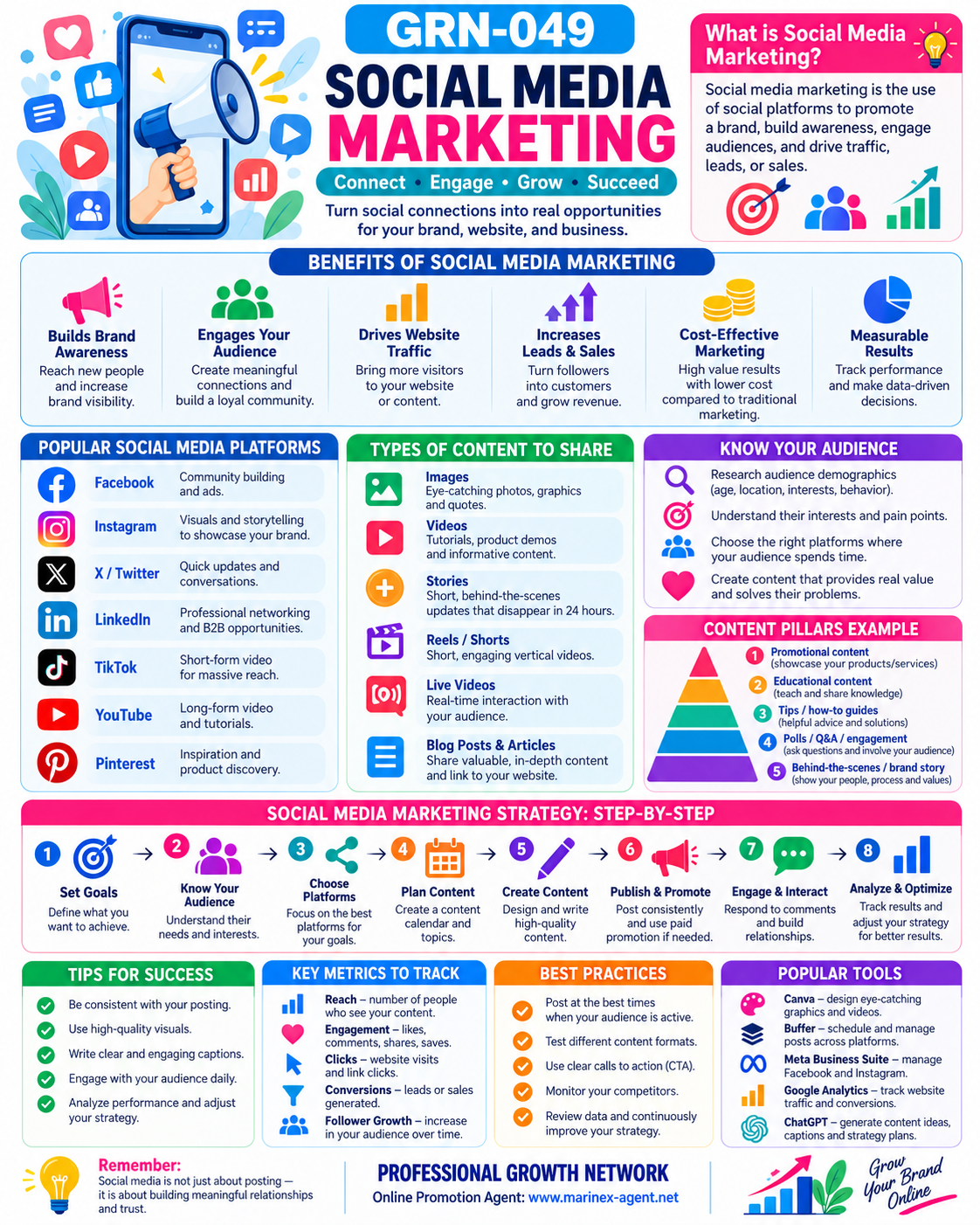
Social Media Marketing: A Practical Guide to Growing
Your Brand and Business Online
Parent Category: PROFESSIONAL GROWTH NETWORK
Category: Computer Skills & Digital Literacy
Article Code: GRN-049
Introduction — Connect • Engage • Grow • Succeed
Social media has become one of the most powerful tools for promoting individuals, businesses, products, and professional services worldwide.
Millions of entrepreneurs, freelancers, consultants, manufacturers, and service providers use social media platforms to introduce themselves, establish professional relationships, attract customers, and develop international business opportunities.
Social Media Marketing (SMM) allows individuals and businesses to reach potential customers without necessarily investing large amounts of money in traditional advertising.
However, successful social media marketing is not simply about publishing posts or collecting followers.
It requires a clear strategy, valuable content, consistent communication, and the ability to build trust with the target audience.
The main principle is simple: Promote Yourself First — Then Promote Your Products and Services.
This article presents the essential elements of social media marketing and explains how to transform online communication into practical business opportunities.
1. What Is Social Media Marketing?
Social Media Marketing is the use of social networking platforms to promote a personal brand, company, products, services, or professional activities.
Its primary objectives include:
- Increasing brand awareness and professional visibility.
- Developing relationships with potential customers.
- Promoting products and services.
- Attracting visitors to websites and blogs.
- Generating business inquiries and potential sales.
- Creating professional communities.
- Building international business connections.
Social media marketing can include both organic promotion (unpaid publications and audience interaction) and paid advertising campaigns.
For small businesses, organic promotion is often a practical starting point.
A professional profile, useful publications, and regular communication can establish the foundation for future commercial activities.
2. Six Important Benefits of Social Media Marketing
Social media marketing offers numerous opportunities for individuals and businesses.
1. Builds Brand Awareness
Regular publications help people recognize a professional identity, business name, or commercial brand.
A recognizable online presence makes it easier for potential customers to find information about a company or individual.
2. Engages Your Audience
Social media enables direct communication with followers, customers, and business partners.
Comments, discussions, private messages, and educational publications can help strengthen relationships.
3. Drives Website Traffic
Social media publications can direct visitors to a company’s official website, personal web presentation, or professional blog.
This is particularly important because a website provides a more permanent and organized presentation of business information.
4. Increases Leads and Sales
Relevant content can attract potential customers interested in purchasing products or obtaining professional services.
However, commercial success depends on the quality of the offer, customer confidence, and effective follow-up communication.
5. Supports Cost-Effective Marketing
Small businesses can begin promoting themselves through organic content without large advertising budgets.
Paid advertising can later be introduced when a clear commercial strategy is established.
6. Provides Measurable Results
Social platforms provide statistics that help evaluate audience reach, engagement, website visits, and advertising performance.
These measurements allow businesses to improve their marketing strategies.
3. Popular Social Media Platforms and Their Business Applications
Different social media platforms serve different audiences and commercial purposes.
| Platform | Main Business Applications |
|---|---|
| Business communities, groups, promotion, advertising | |
| Visual branding, products, storytelling | |
| X (Twitter) | News, professional updates, industry discussions |
| Professional networking, B2B relationships, recruitment | |
| TikTok | Short videos, product demonstrations, audience discovery |
| YouTube | Educational videos, tutorials, product presentations |
| Visual discovery, product inspiration, website referrals |
How to choose the right platform
Businesses should select platforms according to their target customers rather than attempting to maintain an active presence everywhere.
For example:
- LinkedIn: Particularly useful for international professional networking and B2B services.
- Facebook: Suitable for communities, business groups, local promotion, and direct communication.
- Instagram: Effective for visually attractive products and personal branding.
- YouTube: Valuable for educational materials and detailed product demonstrations.
Professional Recommendation: Begin with two or three platforms that best match your business objectives.
4. Types of Content to Share
A successful social media strategy requires different types of content.
Publishing only advertisements can reduce audience interest.
An effective business profile should combine promotional information with education, practical advice, and professional communication.
1. Images
Professional photographs, infographics, diagrams, and visual presentations can explain information quickly and attract attention.
2. Videos
Videos can demonstrate products, introduce services, explain procedures, and present business opportunities.
3. Stories
Short publications can provide updates, announcements, and behind-the-scenes information.
Some story formats disappear after 24 hours, depending on the platform.
4. Reels and Shorts
Short vertical videos are useful for presenting practical tips, product demonstrations, and brief educational messages.
5. Live Videos
Live broadcasts enable direct interaction with audiences through discussions, presentations, and questions.
6. Blog Posts and Articles
Detailed articles can demonstrate professional knowledge and provide information that is difficult to communicate in short social media posts.
Social media can then be used to direct interested readers to the complete article on a website.
The most effective strategy combines short social media publications with valuable information on a professional website or blog.
5. Know Your Audience Before Promoting Your Business
Understanding potential customers is one of the most important principles of effective marketing.
Before preparing publications, entrepreneurs should identify whom they want to reach.
Four Essential Questions
1. Who are your potential customers?
Identify their industries, professions, locations, business interests, and relevant demographic characteristics.
2. What problems do they need to solve?
Understand the challenges, requirements, and commercial needs of the target audience.
3. Which social platforms do they use?
Choose platforms where potential customers and professional partners are most active.
4. What valuable information can you provide?
Create publications that answer questions, explain solutions, and demonstrate practical expertise.
Business Principle: Customers are generally more interested in how you can help them than in how frequently you advertise your services.
6. Five Content Pillars for Professional Social Media Marketing
Content pillars are the main categories of information published by a business or professional.
A balanced content strategy can include five essential directions.
| Content Pillar | Purpose |
|---|---|
| 1. Promotional Content | Present products, services, and commercial offers |
| 2. Educational Content | Share professional knowledge and useful information |
| 3. Tips and How-To Guides | Provide practical advice and solutions |
| 4. Polls and Q&A | Encourage communication and audience participation |
| 5. Brand Story | Introduce experience, achievements, values, and people |
Example for an International Business Consultant
- Promotional: Introduce consulting or commercial representation services.
- Educational: Explain international trade procedures.
- Tips: Share practical recommendations for business communication.
- Q&A: Discuss common questions from potential customers.
- Brand Story: Present professional experience and completed projects.
This approach helps build a professional reputation instead of creating an endless stream of advertisements.
7. Social Media Marketing Strategy — Eight Practical Steps
An organized marketing strategy allows individuals and businesses to use their time and resources more effectively.
Step 1 — Set Clear Goals
Determine what you want to achieve.
Possible objectives include professional visibility, new business contacts, website visitors, customer inquiries, or sales.
Step 2 — Know Your Audience
Identify potential customers and understand their interests, requirements, and commercial needs.
Step 3 — Choose Suitable Platforms
Select social networks that match your professional activities and target audience.
Step 4 — Plan Your Content
Prepare a publication calendar.
For example:
- Monday: Educational article.
- Wednesday: Practical business advice.
- Friday: Product or service presentation.
- Weekend: Professional networking or community discussion.
Step 5 — Create Professional Content
Prepare useful articles, illustrations, infographics, short videos, and promotional messages.
ChatGPT and other digital tools can assist with content preparation, but all information should be verified before publication.
Step 6 — Publish and Promote
Share content consistently.
Use appropriate groups, professional communities, hashtags, and advertising when justified.
Avoid repetitive unsolicited messages and spam.
Step 7 — Engage and Interact
Respond to relevant comments, questions, and business inquiries.
Professional communication is essential for developing trustworthy relationships.
Step 8 — Analyze and Optimize
Review publication statistics, website visits, customer inquiries, and actual commercial results.
Improve your strategy based on measurable performance.
8. Key Social Media Marketing Metrics to Track
Successful marketing requires more than counting followers.
Businesses should evaluate indicators connected to their actual objectives.
| Metric | Meaning |
|---|---|
| Reach | Number of people exposed to content |
| Engagement | Likes, comments, shares, saves, and interactions |
| Website Clicks | Visitors arriving through social media links |
| Leads | Potential customers expressing commercial interest |
| Conversions | Desired actions, such as inquiries, registrations, or purchases |
| Follower Growth | Changes in the size of the social media audience |
Important: A large number of followers does not automatically mean commercial success.
A smaller audience consisting of genuinely interested potential customers can be more valuable than thousands of unrelated followers.
9. Best Practices for Social Media Marketing
Several practical principles can improve the quality and effectiveness of social media activities.
Consistency
Publish regularly according to a realistic schedule.
Professional Presentation
Use clear images, readable infographics, accurate information, and well-written text.
Audience Value
Provide useful knowledge rather than focusing exclusively on commercial advertising.
Calls to Action
Invite interested readers to visit your website, request information, or contact you through appropriate channels.
Professional Communication
Respond politely and promptly to genuine business inquiries.
Performance Analysis
Study results and modify content strategies when necessary.
Reputation Management
Avoid misleading commercial claims, unverified information, fake reviews, and unrealistic promises.
A strong professional reputation develops through consistent behavior and reliable information.
10. Popular Digital Tools for Social Media Marketing
Digital tools can simplify the preparation, publication, and evaluation of marketing content.
| Tool | Main Application |
|---|---|
| Canva | Designing graphics, infographics, and presentations |
| Buffer | Planning and scheduling social media publications |
| Meta Business Suite | Managing Facebook and Instagram activities |
| Google Analytics | Analyzing website traffic and user activity |
| ChatGPT | Preparing content ideas, drafts, research plans, and marketing strategies |
ChatGPT as a Personal Digital Assistant
ChatGPT can help entrepreneurs:
- Generate ideas for social media publications.
- Prepare professional promotional messages.
- Write educational articles.
- Develop content calendars.
- Improve business presentations.
- Draft communication with potential partners.
- Analyze supplied marketing information.
- Prepare multilingual content.
These capabilities can be especially valuable for individuals starting a small business with limited financial resources.
Nevertheless, successful marketing requires human judgment, reliable information, and personal responsibility.
11. Social Media Marketing and Your Personal Online Promotion Agent
One of the most important principles of modern digital business development is the distinction between social media presence and professional web presence.
Social media platforms provide opportunities to reach audiences and establish communication.
However, a personal website or professional webpage provides a more permanent location where individuals can present information about themselves, their experience, products, services, and business interests.
A Practical Business Development Model
1. Establish Your Professional Identity
Prepare information about your professional background, business experience, and commercial interests.
2. Create Your Personal Web Presentation
Develop a personal webpage that serves as your professional digital business card.
3. Connect Your Social Media Profiles
Use Facebook, LinkedIn, and other relevant platforms to introduce your professional activities.
4. Publish Valuable Information
Share articles, infographics, professional recommendations, and commercial updates.
5. Direct Interested People to Your Webpage
Provide visitors with organized information and clear contact options.
6. Develop Business Relationships
Communicate with potential customers, suppliers, manufacturers, investors, and professional partners.
7. Convert Professional Connections into Commercial Opportunities
Offer useful services, negotiate transparent agreements, and develop mutually beneficial business relationships.
The Essential Principle: Promote Yourself First — Then Promote Your Business.
A strong personal professional identity can support the promotion of many different products and services throughout a business career.
12. PROFESSIONAL GROWTH NETWORK — From Digital Knowledge to Business Opportunities
The PROFESSIONAL GROWTH NETWORK (PGN) supports the development of practical knowledge, professional skills, business relationships, and commercial opportunities.
Social media marketing is one of the important digital skills that individuals can learn and use in their professional activities.
For example, a person with basic computer skills can gradually develop the ability to:
- Create and manage professional social media profiles.
- Prepare promotional articles and infographics.
- Introduce businesses to new audiences.
- Provide digital marketing assistance.
- Promote professional services internationally.
- Build relationships with potential business partners.
- Develop a small online promotion business.
These activities may become sources of additional income when they deliver genuine value to customers and are supported by appropriate commercial agreements.
The combination of ChatGPT, Social Media Marketing, and Personal Online Promotion creates practical opportunities for independent professional and business development.
Conclusion — Build Your Brand, Develop Trust, and Grow Your Business
Social media marketing is not simply about publishing advertisements or collecting followers.
It is about building professional visibility, sharing valuable information, establishing trusted relationships, and creating opportunities for business cooperation.
Modern digital technologies enable individuals and small businesses to promote their activities to international audiences with comparatively limited initial resources.
However, sustainable business development requires knowledge, consistency, professionalism, and the ability to provide valuable services.
Your professional reputation is one of your most important business assets.
Start with Knowledge. Build Your Network. Promote Yourself. Grow Your Business.
PROFESSIONAL GROWTH NETWORK
Knowledge • Digital Skills • Business Networking • Professional Development
Online Promotion Agent: https://www.marinex-agent.net
Article Code: GRN-049