
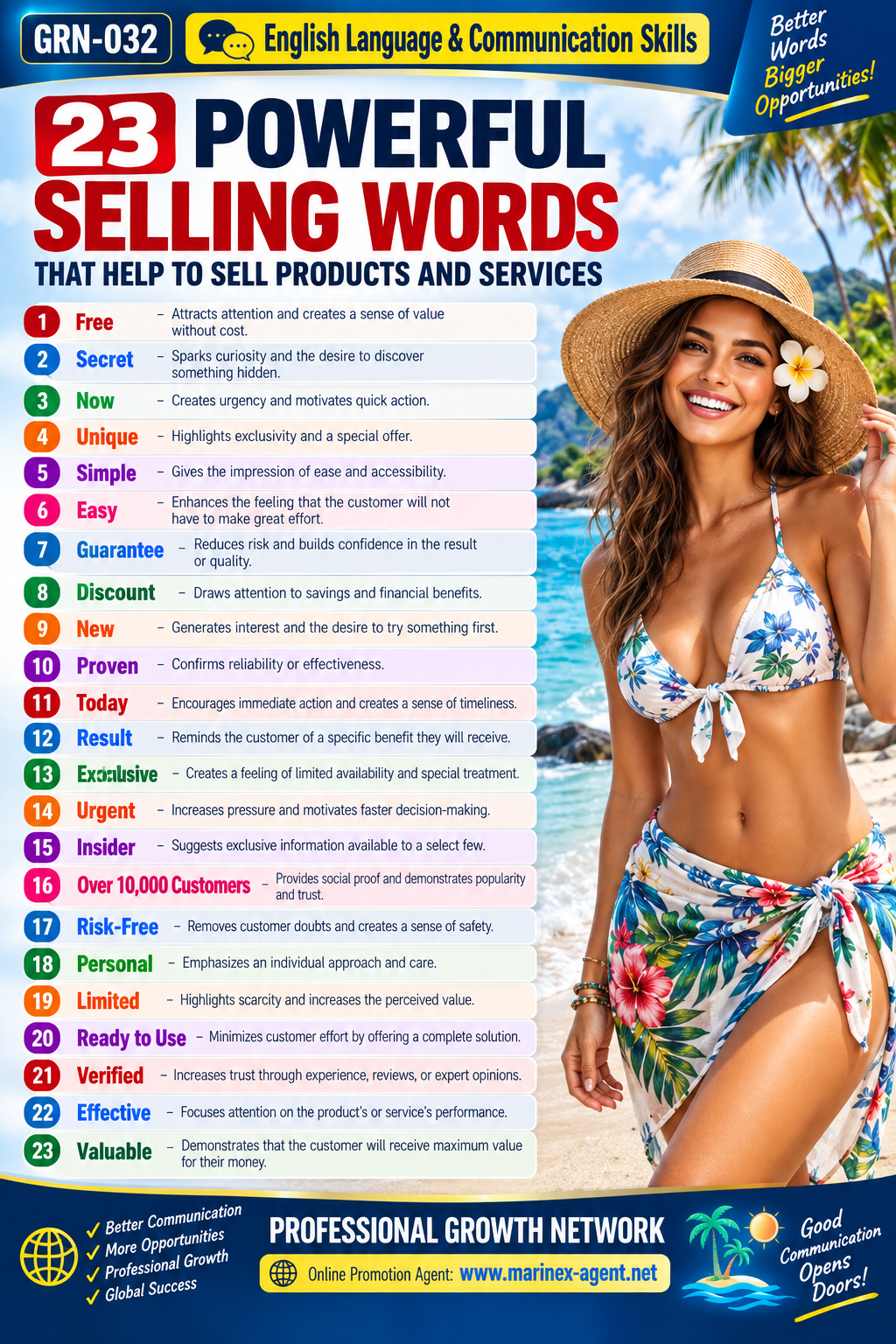
23 POWERFUL SELLING WORDS THAT HELP SELL PRODUCTS AND SERVICES
Category: English Language & Communication Skills
Parent Category: PROFESSIONAL GROWTH NETWORK
Article Code: GRN-032
BETTER WORDS • BETTER COMMUNICATION • BIGGER OPPORTUNITIES!
Introduction
Words are powerful tools in business communication. The way we describe a product, introduce a service, or present a commercial opportunity can influence how potential customers understand our offer.
In sales and marketing, certain English words are frequently used to attract attention, explain benefits, build confidence, and encourage customers to consider purchasing decisions.
However, successful communication is not simply about using persuasive expressions. It also requires honesty, clarity, professionalism, and a genuine understanding of customer needs.
The GRN-032 infographic introduces 23 useful English selling words and expressions that can help individuals improve their marketing vocabulary and communicate more effectively in international business.
1. Free — Attract Attention
The word Free immediately attracts attention because it suggests that customers can receive something without an additional charge.
It is commonly used for samples, consultations, demonstrations, and introductory services.
Example
“Get a free consultation to discover how we can help promote your business internationally.”
Communication Tip: Always explain what is free and whether any conditions apply.
2. Secret — Create Curiosity
The word Secret can encourage people to discover information that appears unfamiliar or especially valuable.
It is often used in educational content, marketing headlines, and promotional campaigns.
Example
“Discover the secret behind successful online business presentations.”
Communication Tip: Avoid suggesting that ordinary or publicly available information is confidential or exclusive.
3. Now — Encourage Action
The word Now encourages customers to consider taking immediate action.
It is especially useful when an offer is currently available or when customers can begin using a service without unnecessary delay.
Example
“Start building your professional online presence now.”
Communication Tip: Use urgency appropriately without creating artificial pressure.
4. Unique — Highlight Distinctive Features
The word Unique emphasizes qualities that distinguish a product or service from competing alternatives.
Customers often want to understand why one offer is different from another.
Example
“Our unique approach combines personal online promotion with international business networking.”
Communication Tip: Explain what makes the offer distinctive rather than relying on the word alone.
5. Simple — Make the Offer Easy to Understand
The word Simple suggests that a process, service, or product is straightforward.
Customers appreciate clear explanations and procedures that are easy to follow.
Example
“We offer a simple way to introduce your professional services to an international audience.”
Communication Tip: Describe the actual steps involved so customers understand the process.
6. Easy — Reduce Perceived Effort
The word Easy suggests convenience and accessibility.
It can be effective when describing registration, communication, ordering, or other customer activities.
Example
“Our online application process is easy to understand and complete.”
Communication Tip: Avoid promising that a complicated procedure is effortless when it requires significant customer participation.
7. Guarantee — Build Confidence
The word Guarantee communicates a commitment to a specific result, standard, or obligation.
A clearly defined guarantee can help customers evaluate the risks associated with a purchase.
Example
“We guarantee that your personal web presentation will include the features specified in our service agreement.”
Communication Tip: Guarantees must be realistic, clearly documented, and supported by the seller’s actual ability to fulfill them.
8. Discount — Highlight Savings
The word Discount draws attention to a reduction in the regular price of a product or service.
Discounts are commonly used during promotional campaigns and special sales periods.
Example
“Receive a 15% discount on selected annual service packages.”
Communication Tip: State the applicable price, conditions, and validity period accurately.
9. New — Introduce Innovation
The word New generates interest in recently introduced products, services, or features.
Customers may be interested in improvements, innovations, and additional capabilities.
Example
“Explore our new digital business presentation services.”
Communication Tip: Use this word for genuinely new or recently introduced offerings.
10. Proven — Demonstrate Reliability
The word Proven suggests that a method, product, or service has demonstrated results.
It can help establish confidence when supported by verifiable evidence.
Example
“Our training method has been proven effective in a documented pilot program.”
Communication Tip: Claims of proven effectiveness should be supported by reliable testing, evidence, or documented experience.
11. Today — Create a Sense of Timeliness
The word Today emphasizes the present moment and can encourage customers to begin considering an opportunity.
It is often used in calls to action.
Example
“Contact us today to discuss your professional online presentation.”
Communication Tip: Encourage timely communication without suggesting false deadlines.
12. Result — Focus on Customer Benefits
The word Result directs attention toward the outcome that a customer wants to achieve.
In professional sales communication, customers are often more interested in practical benefits than technical descriptions alone.
Example
“Our objective is to deliver a professional web presentation that clearly introduces your services to potential customers.”
Communication Tip: Distinguish between the service delivered and business outcomes that cannot be guaranteed.
13. Exclusive — Emphasize Special Access
The word Exclusive suggests that an offer, product, or service is available only under particular conditions.
It can be useful for premium services, special memberships, or limited-access programs.
Example
“Exclusive networking opportunities are available to eligible club members.”
Communication Tip: Clearly explain the eligibility conditions and avoid misleading exclusivity claims.
14. Urgent — Communicate Time Sensitivity
The word Urgent indicates that an issue requires prompt attention.
It is commonly used in business correspondence, technical support, and time-sensitive commercial operations.
Example
“Urgent: Please confirm the required shipping documents before the agreed deadline.”
Communication Tip: Reserve urgent language for genuinely time-sensitive matters.
15. Insider — Suggest Specialized Knowledge
The word Insider can refer to information or experience gained through close professional involvement in a particular industry.
It may attract readers interested in specialized knowledge.
Example
“Learn practical insider insights from experienced maritime professionals.”
Communication Tip: Do not imply access to confidential or unlawfully obtained information.
16. Over 10,000 Customers — Provide Social Proof
Expressions such as Over 10,000 Customers can demonstrate the popularity or scale of a business.
Customer numbers may help prospective buyers evaluate an organization’s experience.
Example
“Trusted by over 10,000 customers worldwide.”
Communication Tip: Use numerical claims only when accurate, current, and supported by company records. Never invent customer statistics.
17. Risk-Free — Reduce Customer Concerns
The expression Risk-Free is intended to reassure customers that a particular transaction or trial involves limited or no specified risk.
It may be used for free trials, refundable purchases, or clearly defined satisfaction guarantees.
Example
“Try our service with a 14-day money-back guarantee, subject to the published terms.”
Communication Tip: Avoid describing an offer as completely risk-free unless that statement is genuinely justified.
18. Personal — Emphasize Individual Attention
The word Personal highlights an individualized approach to customer service.
It can be particularly effective in consulting, education, professional representation, and business development.
Example
“Your personal online promotion agent helps present your professional profile and services.”
Communication Tip: Explain which elements of the service are actually personalized.
19. Limited — Highlight Availability
The word Limited communicates that an offer has restrictions concerning quantity, time, or eligibility.
It may encourage customers to make decisions before an opportunity expires.
Example
“Limited availability: Registration is open for 20 participants.”
Communication Tip: Scarcity claims must reflect genuine limitations.
20. Ready to Use — Emphasize Convenience
The expression Ready to Use suggests that a product or service can be used immediately or with minimal preparation.
It is useful when customers are looking for practical, complete solutions.
Example
“Receive a ready-to-use professional web presentation with your approved contact information.”
Communication Tip: Clearly identify any setup, activation, or customer input still required.
21. Verified — Strengthen Trust
The word Verified indicates that specific information, qualifications, or claims have been checked.
Verification can increase confidence when the process is transparent and credible.
Example
“All published professional qualifications are verified against the documents provided by the applicant.”
Communication Tip: Specify what has been verified, by whom, and according to which procedure.
22. Effective — Emphasize Performance
The word Effective describes something that successfully achieves its intended purpose.
It is often used in marketing, education, management, and professional services.
Example
“Effective communication helps businesses explain their services clearly and professionally.”
Communication Tip: When describing a product or service as effective, provide relevant supporting information whenever possible.
23. Valuable — Communicate Worth
The word Valuable emphasizes usefulness, practical benefits, or importance.
It helps customers understand why a product, service, or piece of information deserves their attention.
Example
“A professional online presentation can become a valuable communication tool for your business.”
Communication Tip: Explain the specific value offered to the customer.
24. How to Use Selling Words in Professional English
Learning individual words is useful, but their real value becomes apparent when they are combined into clear, natural sentences.
Consider the following examples.
Introducing a Service
“Discover a simple and effective way to present your professional services online.”
Offering a Consultation
“Contact us today for a free introductory consultation.”
Presenting a New Product
“Explore our new product range and discover its unique features.”
Describing Customer Benefits
“Our personalized service provides a practical solution designed around your business needs.”
Announcing a Special Offer
“Enjoy a limited-time discount on selected services. Full terms and conditions are available upon request.”
Building Professional Trust
“We provide verified information and clearly defined service commitments.”
These examples demonstrate how persuasive vocabulary can be incorporated into professional English without relying on exaggerated promises.
25. Selling Words in International Business Communication
Effective international business communication requires more than attractive vocabulary.
Business partners, buyers, suppliers, and investors usually expect clear and verifiable information.
A professional commercial proposal should explain:
- Who you are — company identity and professional background.
- What you offer — product or service description.
- Why it matters — practical benefits for the customer.
- What it costs — pricing and commercial conditions.
- How it works — procedures and responsibilities.
- What evidence is available — specifications, certifications, references, or other relevant documentation.
- What happens next — a clear invitation to communicate or proceed.
Persuasive words can support a proposal, but they cannot replace accurate commercial information.
26. Common Mistakes to Avoid
When using persuasive English in advertising and sales, avoid the following mistakes:
- Excessive urgency: Repeatedly telling customers to act immediately without a genuine reason.
- Unverified claims: Using expressions such as “proven,” “guaranteed,” or “verified” without supporting evidence.
- Artificial scarcity: Advertising limited availability when no real limitation exists.
- Misleading price statements: Using “free” or “discount” without explaining relevant conditions.
- Overpromising results: Suggesting that customers will automatically achieve sales, profits, or business success.
- Unnatural language: Filling every sentence with promotional expressions instead of communicating clearly.
The most effective sales communication combines persuasive language with credibility, transparency, and respect for the customer.
27. Practical English Learning Exercise
To improve your business English, practice using the 23 selling words in your own sentences.
Exercise 1 — Vocabulary
Choose five words from the infographic and write one business sentence for each.
Exercise 2 — Product Presentation
Select a product or service and prepare a short description using three suitable selling words.
Exercise 3 — Business Email
Write a brief introductory email to a potential customer.
Include:
- A professional greeting.
- A clear introduction.
- A description of your product or service.
- One or two genuine customer benefits.
- A polite call to action.
Exercise 4 — Review and Improve
Check whether your message is:
- Grammatically correct.
- Easy to understand.
- Professional in tone.
- Factually accurate.
- Free from misleading promises.
Regular practice can help develop confidence in English-language marketing and international business communication.
28. The Role of Professional Online Promotion
For entrepreneurs, consultants, freelancers, and small business owners, professional communication is closely connected with online visibility.
A personal web presentation allows potential customers to learn about an individual, review available services, and find contact information.
The PROFESSIONAL GROWTH NETWORK encourages individuals to develop practical knowledge, improve communication skills, and build professional relationships.
Through the concept of a Personal Online Promotion Agent, MARINEX AGENT supports the idea that individuals should first establish their own professional identity before promoting third-party products or services.
First promote yourself. Then promote the products and services you represent.
A professional online presentation can serve as a digital business card and a starting point for international communication.
Online Promotion Agent: www.marinex-agent.net
Conclusion
The 23 powerful selling words presented in GRN-032 are useful vocabulary tools for improving English-language marketing and professional communication.
Words such as Free, Unique, Simple, Guarantee, Discount, Proven, Exclusive, Personal, Verified, Effective, and Valuable can help communicate benefits and attract customer attention.
However, persuasive language should always be supported by truthful information, professional conduct, and genuine customer value.
The objective of successful communication is not simply to convince someone to purchase a product.
It is to help customers understand an offer, evaluate its benefits, and make informed decisions.
For individuals developing international business activities, English communication skills can become an important professional advantage.
Better Words • Better Communication • Bigger Opportunities!
PROFESSIONAL GROWTH NETWORK
Online Promotion Agent: www.marinex-agent.net