
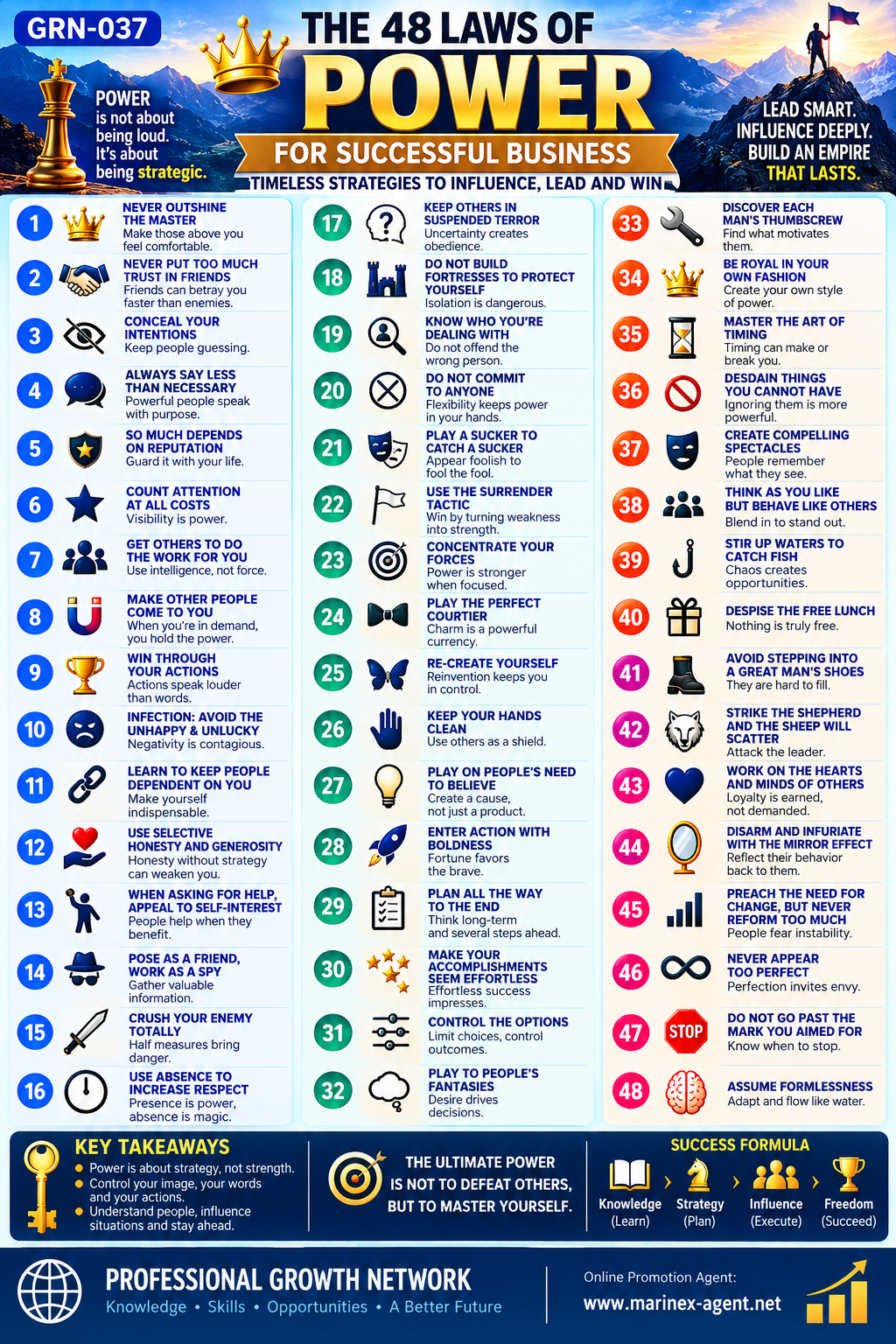
GRN-037
THE 48 LAWS OF POWER
FOR SUCCESSFUL BUSINESS
Category: Personal Growth & Self-Development
PROFESSIONAL GROWTH NETWORK
Introduction
Power is one of the most important and frequently misunderstood concepts in business, leadership, and professional relationships.
Many people associate power with wealth, authority, political influence, or the ability to control others.
However, sustainable professional influence is not simply about occupying a powerful position.
It is also about understanding human behaviour, developing strategic thinking, communicating effectively, protecting your reputation, and making intelligent decisions.
Real power is not about being loud. It is about being strategic.
The 48 principles presented in this article are inspired by the strategic framework of The 48 Laws of Power by Robert Greene.
The book examines historical examples of ambition, influence, competition, leadership, and human relationships.
Some of its principles describe manipulative, deceptive, or aggressive behaviour. They should therefore be studied critically rather than accepted as universal rules for ethical business conduct.
For the PROFESSIONAL GROWTH NETWORK, the purpose of studying these principles is to improve strategic awareness, recognize potentially harmful behaviour, develop professional judgment, and build sustainable influence.
The ultimate objective is not to dominate other people, but to understand yourself, protect your interests, and develop the knowledge and discipline required for long-term success.
1. Never Outshine the Master
Core Principle: Make those above you feel comfortable.
In professional environments, demonstrating competence is important, but unnecessarily threatening the authority or reputation of a superior can create resistance.
Successful professionals understand the importance of presenting their achievements with confidence and diplomacy.
Practical Business Application
- Respect the responsibilities of senior colleagues.
- Present your ideas constructively.
- Recognize contributions made by others.
- Avoid unnecessary public competition with supervisors.
- Demonstrate leadership without humiliating colleagues.
Key Lesson: Professional success requires both competence and emotional intelligence.
2. Never Put Too Much Trust in Friends
Core Principle: Personal friendship does not automatically guarantee professional reliability.
Business relationships require clear responsibilities, accountability, and appropriate safeguards.
Even close friends may have different financial priorities or expectations.
Practical Business Application
- Establish written agreements.
- Define responsibilities clearly.
- Evaluate partners according to competence.
- Separate personal relationships from contractual obligations.
- Maintain transparent financial records.
Key Lesson: Trust should be supported by professional discipline.
3. Conceal Your Intentions
Core Principle: Avoid revealing every strategic decision before the appropriate time.
In competitive business environments, confidentiality can protect negotiations, commercial plans, and sensitive information.
However, confidentiality should not be confused with deliberate deception.
Practical Business Application
- Protect confidential commercial information.
- Avoid announcing unfinished plans prematurely.
- Use appropriate nondisclosure agreements.
- Communicate honestly with authorized stakeholders.
- Respect contractual and legal disclosure obligations.
Key Lesson: Strategic discretion is valuable when combined with integrity.
4. Always Say Less Than Necessary
Core Principle: Powerful communication is often concise and purposeful.
Excessive explanations can create confusion and weaken the impact of an important message.
Practical Business Application
- Prepare clear business proposals.
- Avoid unnecessary details in initial correspondence.
- Listen carefully before responding.
- Use precise language during negotiations.
- Provide supporting information when it is relevant.
Key Lesson: Clear communication is more effective than excessive communication.
5. So Much Depends on Reputation
Core Principle: Your professional reputation is one of your most valuable assets.
In international business, reputation influences trust, partnerships, negotiations, and access to new opportunities.
Practical Business Application
- Honour contractual commitments.
- Communicate professionally.
- Avoid misleading commercial claims.
- Maintain consistent business standards.
- Resolve disputes responsibly.
Key Lesson: Reputation takes years to build and can be damaged by a single irresponsible decision.
6. Court Attention at All Costs
Core Principle: Professional visibility creates opportunities.
Even excellent products and services may remain unnoticed without effective communication and promotion.
However, attention should be earned through genuine value rather than misleading publicity.
Practical Business Application
- Develop a professional online presence.
- Publish useful business information.
- Maintain consistent branding.
- Participate in professional communities.
- Present your expertise clearly.
Key Lesson: Visibility matters, but credibility determines its long-term value.
7. Get Others to Do the Work for You
Core Principle: Effective leaders understand delegation.
No successful business can depend indefinitely on one person performing every task.
Practical Business Application
- Delegate responsibilities according to expertise.
- Build reliable professional teams.
- Establish clear performance expectations.
- Recognize and reward contributors.
- Maintain accountability for final results.
Key Lesson: Leadership means organizing collective capabilities, not exploiting other people’s work.
8. Make Other People Come to You
Core Principle: Build a professional position that attracts opportunities.
A credible business identity, useful expertise, and a strong reputation can encourage potential customers and partners to initiate contact.
Practical Business Application
- Create a professional website.
- Publish useful information.
- Develop a recognizable business profile.
- Demonstrate expertise through practical results.
- Make contact information easily accessible.
Key Lesson: A strong professional presence can reduce dependence on constant unsolicited promotion.
9. Win Through Your Actions
Core Principle: Results are more persuasive than arguments.
Business credibility develops when promises are supported by measurable performance.
Practical Business Application
- Deliver services on time.
- Demonstrate product quality.
- Complete agreed projects.
- Provide verifiable references.
- Resolve problems through practical action.
Key Lesson: Performance builds confidence more effectively than empty promises.
10. Infection: Avoid the Unhappy and Unlucky
Core Principle: Your professional environment influences your decisions and motivation.
Persistent negativity and destructive behaviour can undermine teamwork.
However, people experiencing illness, hardship, or temporary setbacks should not be treated as inherently undesirable.
Practical Business Application
- Establish constructive workplace standards.
- Avoid persistent dishonesty and destructive conduct.
- Encourage problem-solving.
- Support colleagues facing legitimate difficulties.
- Build relationships with responsible and motivated professionals.
Key Lesson: Protect your professional environment without abandoning empathy.
11. Learn to Keep People Dependent on You
Core Principle: Become valuable through specialized knowledge and reliable service.
The original principle emphasizes dependence. In ethical business, a stronger approach is to become a preferred partner because of the value you provide.
Practical Business Application
- Develop specialized expertise.
- Deliver consistent quality.
- Understand customers’ long-term needs.
- Provide reliable support.
- Build mutually beneficial relationships.
Key Lesson: Sustainable influence comes from value, not artificial dependence.
12. Use Selective Honesty and Generosity
Core Principle: Trust and goodwill can influence relationships.
Selective honesty used to manipulate others can damage credibility.
A more sustainable approach is to demonstrate consistent honesty and appropriate generosity.
Practical Business Application
- Provide accurate commercial information.
- Offer useful professional advice.
- Be transparent about limitations.
- Help partners when reasonable.
- Avoid using generosity as a tool for deception.
Key Lesson: Genuine trust is more valuable than temporary psychological advantage.
13. When Asking for Help, Appeal to Self-Interest
Core Principle: Explain the mutual benefits of cooperation.
Successful business proposals should demonstrate why an opportunity is valuable to every participating party.
Practical Business Application
- Identify the partner’s objectives.
- Explain expected commercial benefits.
- Present a clear cooperation model.
- Define responsibilities.
- Discuss how revenue and risks will be shared.
Key Lesson: Mutually beneficial cooperation is more sustainable than one-sided requests.
14. Pose as a Friend, Work as a Spy
Core Principle: Information provides strategic advantages.
The original principle describes deceptive information gathering.
Ethical business intelligence should instead rely on lawful research, transparent relationships, and publicly available information.
Practical Business Application
- Research market conditions.
- Study competitors’ public offerings.
- Verify potential business partners.
- Monitor industry developments.
- Protect confidential information.
Key Lesson: Be well informed without violating trust or privacy.
15. Crush Your Enemy Totally
Core Principle: Unresolved conflicts can create continuing risks.
In business, treating competitors or opponents as enemies to be destroyed is usually counterproductive.
The constructive lesson is to address serious problems decisively and lawfully.
Practical Business Application
- Resolve contractual disputes clearly.
- Protect intellectual property.
- Address repeated misconduct.
- Establish appropriate legal safeguards.
- Avoid unnecessary escalation.
Key Lesson: Solve problems thoroughly without turning business competition into personal hostility.
16. Use Absence to Increase Respect
Core Principle: Availability and attention should be managed strategically.
Constant presence does not necessarily increase professional value.
Practical Business Application
- Establish reasonable communication boundaries.
- Avoid unnecessary meetings.
- Focus on high-value responsibilities.
- Respect other people’s time.
- Maintain reliable response procedures.
Key Lesson: Professional value is demonstrated by results, not constant visibility.
17. Keep Others in Suspended Terror
Core Principle: Unpredictability can influence behaviour.
However, deliberately creating fear or anxiety is harmful to workplace trust.
Business leaders should distinguish strategic flexibility from intimidation.
Practical Business Application
- Maintain flexibility in negotiations.
- Prepare alternative strategies.
- Avoid revealing confidential plans prematurely.
- Communicate expectations clearly.
- Never use fear as a substitute for leadership.
Key Lesson: Be adaptable and difficult to exploit, but predictable in your ethical standards.
18. Do Not Build Fortresses to Protect Yourself
Core Principle: Isolation can weaken strategic awareness.
Professionals who disconnect from customers, colleagues, and market developments may overlook important information.
Practical Business Application
- Maintain industry contacts.
- Participate in professional networks.
- Seek independent advice.
- Listen to customer feedback.
- Monitor changing market conditions.
Key Lesson: Strong professional relationships improve resilience.
19. Know Who You Are Dealing With
Core Principle: Understand your business partners before making commitments.
Different individuals and organizations have different expectations, capabilities, and risk profiles.
Practical Business Application
- Verify company registration.
- Confirm authorized representatives.
- Review commercial references.
- Understand cultural differences.
- Conduct appropriate due diligence.
Key Lesson: Careful partner evaluation prevents avoidable business problems.
20. Do Not Commit to Anyone
Core Principle: Maintain strategic independence.
Excessive dependence on a single customer, supplier, or intermediary can create vulnerability.
However, successful cooperation also requires honouring legitimate commitments.
Practical Business Application
- Diversify business relationships.
- Avoid unnecessary exclusivity.
- Negotiate fair contractual conditions.
- Preserve independent decision-making.
- Fulfil agreed obligations.
Key Lesson: Independence and reliability should work together.
21. Play a Sucker to Catch a Sucker
Core Principle: Never underestimate the importance of observing other people’s assumptions.
The original law describes using apparent ignorance as a deceptive tactic.
A constructive alternative is to remain humble, ask questions, and avoid unnecessary demonstrations of superiority.
Practical Business Application
- Listen before presenting conclusions.
- Ask thoughtful questions.
- Avoid revealing confidential information.
- Do not underestimate counterparties.
- Evaluate claims using evidence.
Key Lesson: Humility and observation can reveal information that arrogance overlooks.
22. Use the Surrender Tactic
Core Principle: Strategic withdrawal can sometimes prevent greater losses.
Not every conflict should be continued indefinitely.
Practical Business Application
- Recognize when negotiations are unproductive.
- Reassess unrealistic objectives.
- Accept temporary compromises when justified.
- Preserve resources for better opportunities.
- Avoid emotional decision-making.
Key Lesson: Knowing when to withdraw is a form of strategic strength.
23. Concentrate Your Forces
Core Principle: Focus resources on the most important objectives.
Trying to pursue too many projects simultaneously can weaken performance.
Practical Business Application
- Identify priority markets.
- Focus on profitable products and services.
- Allocate resources carefully.
- Establish measurable goals.
- Avoid unnecessary operational complexity.
Key Lesson: Concentrated effort often produces stronger results than scattered activity.
24. Play the Perfect Courtier
Core Principle: Diplomacy and professional etiquette matter.
Successful professionals understand organizational culture and communicate respectfully.
Practical Business Application
- Demonstrate courtesy.
- Understand professional hierarchy.
- Respect cultural differences.
- Manage disagreements diplomatically.
- Avoid unnecessary personal conflicts.
Key Lesson: Professional diplomacy strengthens relationships and opens doors.
25. Re-Create Yourself
Core Principle: Personal reinvention supports long-term development.
Business environments change, and professionals must continuously adapt.
Practical Business Application
- Learn new technologies.
- Improve digital literacy.
- Develop additional qualifications.
- Update your professional presentation.
- Explore new business opportunities.
Key Lesson: Continuous improvement protects against professional stagnation.
26. Keep Your Hands Clean
Core Principle: Protect your professional integrity.
The original law concerns avoiding blame and preserving appearances.
Ethical leadership requires genuine accountability rather than shifting responsibility to others.
Practical Business Application
- Follow applicable laws.
- Maintain transparent records.
- Avoid conflicts of interest.
- Establish compliance procedures.
- Accept responsibility for decisions.
Key Lesson: A clean reputation should reflect clean business practices.
27. Play on People’s Need to Believe
Core Principle: Shared purpose can motivate people.
However, exploiting people’s beliefs or vulnerabilities for personal gain is unethical.
Practical Business Application
- Communicate a clear business mission.
- Establish realistic goals.
- Encourage team participation.
- Support professional development.
- Avoid exaggerated promises.
Key Lesson: Inspire confidence through purpose and evidence, not manipulation.
28. Enter Action With Boldness
Core Principle: Confidence and decisive action are important in business.
Excessive hesitation can result in missed opportunities.
However, boldness should be supported by preparation.
Practical Business Application
- Research opportunities carefully.
- Calculate financial risks.
- Make timely decisions.
- Accept reasonable uncertainty.
- Learn from mistakes.
Key Lesson: Courage is most effective when combined with knowledge.
29. Plan All the Way to the End
Core Principle: Long-term planning reduces avoidable risks.
Before launching a business project, consider its financial, operational, and legal implications.
Practical Business Application
- Define final objectives.
- Establish implementation stages.
- Calculate expected costs.
- Identify potential obstacles.
- Prepare contingency plans.
Key Lesson: Strategic planning improves the probability of successful execution.
30. Make Your Accomplishments Seem Effortless
Core Principle: Professional competence often appears calm and organized.
Behind successful performance are preparation, experience, and disciplined work.
Practical Business Application
- Prepare thoroughly.
- Develop efficient procedures.
- Communicate confidently.
- Manage operational details.
- Recognize the contributions of your team.
Key Lesson: Professional excellence is usually the result of sustained effort.
31. Control the Options
Core Principle: The way choices are presented can influence decisions.
In ethical business, structured options should help customers and partners make informed decisions rather than manipulate them.
Practical Business Application
- Offer clear service packages.
- Explain differences between alternatives.
- Present transparent prices.
- Identify relevant risks.
- Allow customers to make independent choices.
Key Lesson: Well-structured choices improve communication and decision-making.
32. Play to People’s Fantasies
Core Principle: People respond to attractive possibilities and meaningful aspirations.
However, unrealistic promises can create disappointment and reputational damage.
Practical Business Application
- Explain the potential benefits of your services.
- Use realistic examples.
- Demonstrate achievable results.
- Avoid guaranteed-profit claims.
- Communicate honestly about uncertainty.
Key Lesson: Inspire customers with credible opportunities.
33. Discover Each Man’s Thumbscrew
Core Principle: Understanding motivation improves communication.
The original law focuses on identifying personal vulnerabilities.
A responsible business approach is to understand genuine needs, concerns, and decision-making priorities without exploiting weaknesses.
Practical Business Application
- Ask customers about their objectives.
- Identify operational problems.
- Understand purchasing priorities.
- Listen to objections.
- Offer relevant solutions.
Key Lesson: Understanding needs creates better business relationships.
34. Be Royal in Your Own Fashion
Core Principle: Professional confidence influences how others perceive you.
People who respect themselves and maintain professional standards are often taken more seriously.
Practical Business Application
- Communicate confidently.
- Maintain professional appearance.
- Present your qualifications clearly.
- Establish appropriate boundaries.
- Demonstrate consistent competence.
Key Lesson: Self-respect should be reflected in professional behaviour.
35. Master the Art of Timing
Core Principle: Timing can determine the success of a business decision.
A good proposal presented at the wrong moment may fail.
Practical Business Application
- Monitor market conditions.
- Understand seasonal demand.
- Evaluate customer readiness.
- Avoid unnecessary pressure.
- Act promptly when opportunities are well supported.
Key Lesson: Strategic timing is as important as strategic planning.
36. Disdain Things You Cannot Have
Core Principle: Do not waste resources pursuing every unavailable opportunity.
Some projects are unsuitable, unrealistic, or outside your present capabilities.
Practical Business Application
- Establish realistic priorities.
- Recognize unproductive negotiations.
- Avoid emotional attachment to failed proposals.
- Redirect resources toward achievable goals.
- Learn from unsuccessful attempts.
Key Lesson: Knowing what to ignore protects time and resources.
37. Create Compelling Spectacles
Core Principle: Strong visual communication attracts attention.
Professional presentations can make complex information easier to understand and remember.
Practical Business Application
- Create high-quality infographics.
- Use clear business presentations.
- Develop professional websites.
- Present products with accurate photographs.
- Maintain consistent visual branding.
Key Lesson: Effective visual presentation strengthens professional communication.
38. Think as You Like but Behave Like Others
Core Principle: Understand the importance of social and cultural adaptation.
International business requires respect for different customs, expectations, and communication styles.
Practical Business Application
- Study local business etiquette.
- Respect cultural traditions.
- Adapt communication methods.
- Avoid unnecessary confrontation.
- Maintain your ethical principles.
Key Lesson: Cultural intelligence improves international cooperation.
39. Stir Up Waters to Catch Fish
Core Principle: Emotional reactions can create strategic disadvantages.
The original law describes provoking confusion to gain an advantage.
A more responsible approach is to recognize such tactics and maintain emotional discipline.
Practical Business Application
- Remain calm during negotiations.
- Avoid reacting to deliberate provocation.
- Verify information before making decisions.
- Maintain professional communication.
- Focus on facts and contractual terms.
Key Lesson: Emotional self-control protects your negotiating position.
40. Despise the Free Lunch
Core Principle: Attractive offers may involve hidden obligations.
Business professionals should evaluate the true cost of products, services, and partnerships.
Practical Business Application
- Examine contract conditions.
- Identify hidden fees.
- Verify promotional offers.
- Evaluate long-term commitments.
- Avoid accepting benefits that create inappropriate obligations.
Key Lesson: Understand the full cost before accepting an offer.
41. Avoid Stepping Into a Great Man’s Shoes
Core Principle: Develop your own professional identity.
Attempting to imitate a successful predecessor may prevent independent development.
Practical Business Application
- Study successful examples.
- Identify your personal strengths.
- Develop original ideas.
- Establish your own professional reputation.
- Create a distinctive business presentation.
Key Lesson: Learn from others without becoming dependent on their identity.
42. Strike the Shepherd and the Sheep Will Scatter
Core Principle: Leadership strongly influences organizational behaviour.
The original law describes targeting a leader to weaken a group.
In ethical business, the practical lesson is to understand leadership structures and address organizational problems through legitimate procedures.
Practical Business Application
- Identify responsible decision-makers.
- Understand organizational authority.
- Resolve problems at the appropriate management level.
- Strengthen governance and accountability.
- Avoid personal attacks or intimidation.
Key Lesson: Effective organizational change requires understanding leadership and responsibility.
43. Work on the Hearts and Minds of Others
Core Principle: Lasting influence depends on trust and understanding.
People respond more positively when they feel respected and their interests are recognized.
Practical Business Application
- Listen to customers.
- Understand employee concerns.
- Communicate with empathy.
- Explain shared objectives.
- Maintain reliable professional relationships.
Key Lesson: Trust and respect create stronger influence than pressure.
44. Disarm and Infuriate With the Mirror Effect
Core Principle: Mirroring can influence communication.
The original law describes imitation as a method of confusing or provoking others.
A constructive alternative is to use appropriate mirroring to improve listening and mutual understanding.
Practical Business Application
- Reflect customer concerns accurately.
- Confirm your understanding.
- Adapt your communication style.
- Avoid mocking or provoking others.
- Use empathy during disagreements.
Key Lesson: Thoughtful communication helps reduce misunderstandings.
45. Preach the Need for Change, but Never Reform Too Much at Once
Core Principle: Successful organizational change requires careful implementation.
Even beneficial reforms may encounter resistance when introduced too quickly.
Practical Business Application
- Explain the purpose of change.
- Introduce improvements in manageable stages.
- Provide training.
- Collect feedback.
- Monitor implementation results.
Key Lesson: Gradual, well-managed change often produces more sustainable results.
46. Never Appear Too Perfect
Core Principle: Excessive displays of superiority can create unnecessary resentment.
Professional confidence should be balanced with humility.
Practical Business Application
- Acknowledge mistakes.
- Recognize colleagues’ contributions.
- Remain open to feedback.
- Avoid exaggerated self-promotion.
- Demonstrate continuous learning.
Key Lesson: Authenticity and humility strengthen professional credibility.
47. Do Not Go Past the Mark You Aimed For
Core Principle: Know when your objective has been achieved.
Continuing to pursue additional gains after reaching a reasonable goal can introduce unnecessary risks.
Practical Business Application
- Establish measurable objectives.
- Define acceptable negotiation outcomes.
- Avoid excessive risk-taking.
- Recognize successful completion.
- Review results before expanding commitments.
Key Lesson: Strategic discipline includes knowing when to stop.
48. Assume Formlessness
Core Principle: Adaptability is essential in a changing business environment.
Rigid strategies may become ineffective when markets, technologies, or customer expectations change.
Practical Business Application
- Monitor emerging technologies.
- Diversify business capabilities.
- Maintain flexible operating procedures.
- Review market developments.
- Adapt without abandoning core values.
Key Lesson: Sustainable success requires flexibility and continuous learning.
49. Key Takeaways — What the 48 Laws Teach Us
The 48 Laws of Power present a wide range of observations about influence, competition, leadership, and human behaviour.
Some principles emphasize valuable professional skills such as planning, reputation management, emotional discipline, and adaptability.
Others describe tactics involving secrecy, intimidation, manipulation, or exploitation.
For modern business professionals, the most useful approach is to understand these tactics without automatically adopting them.
Five Essential Lessons
1. Protect Your Reputation
Trust and credibility are essential foundations of long-term business relationships.
2. Develop Strategic Thinking
Understand your objectives, evaluate risks, and prepare for changing circumstances.
3. Improve Communication
Listen carefully, speak clearly, and adapt your communication to different professional environments.
4. Build Professional Influence
Create value through knowledge, competence, reliability, and effective cooperation.
5. Maintain Ethical Standards
Short-term advantages obtained through deception or intimidation may create serious long-term consequences.
The strongest professional influence is based on competence, trust, and responsible leadership.
50. The Success Formula — Knowledge, Strategy, Influence, Freedom
Our GRN-037 infographic summarizes a practical sequence for professional development:
Knowledge → Strategy → Influence → Freedom
Knowledge — Learn
Develop useful professional skills and understand the environment in which you operate.
Strategy — Plan
Set clear objectives, evaluate opportunities, and manage risks.
Influence — Execute
Use your expertise, communication skills, and professional relationships to create value.
Freedom — Succeed
Build greater independence through responsible decisions, sustainable income, and long-term professional development.
This sequence is a practical framework rather than a guarantee of financial or business success.
51. The Role of PROFESSIONAL GROWTH NETWORK
The PROFESSIONAL GROWTH NETWORK (PGN) encourages individuals to develop knowledge, professional skills, strategic thinking, and international business relationships.
Our objective is to help entrepreneurs and professionals strengthen their personal identity, improve their visibility, and explore sustainable opportunities for cooperation.
Through educational publications and the services of Marinex-Agent — Your Personal Online Promotion Agent, we promote the principle:
First Promote Yourself — Then Promote the Products and Services You Represent.
A professional online presence can help potential customers and partners understand who you are, what you offer, and why they should consider working with you.
Combined with integrity, practical experience, and effective communication, this can become an important part of long-term professional development.
Conclusion
The 48 Laws of Power provide a framework for studying influence, ambition, competition, leadership, and strategic behaviour.
They remind us that professional success requires more than technical knowledge or financial resources.
It also depends on understanding people, protecting reputation, making intelligent decisions, recognizing risks, and adapting to changing circumstances.
However, power should never be confused with the unrestricted ability to manipulate or control others.
The ultimate power is not to defeat others, but to master yourself.
Self-discipline, knowledge, emotional intelligence, ethical judgment, and professional competence are among the most valuable foundations of sustainable influence.
For entrepreneurs, business professionals, and members of the PROFESSIONAL GROWTH NETWORK, the central message is clear:
Study the Laws. Understand Human Behaviour. Think Strategically. Act Responsibly. Build Lasting Success.
Reference and Further Reading
Robert Greene — The 48 Laws of Power (1998).
This article is an independent educational interpretation of the 48 principles, adapted to professional development, ethical leadership, and modern business practice. It is not an official summary or endorsement by the author or publisher.
PROFESSIONAL GROWTH NETWORK
Knowledge • Skills • Opportunities • A Better Future
Online Promotion Agent: https://www.marinex-agent.net